When neutron stars warp their surroundings
Over the past decade it has become increasingly clear that thermonuclear explosions on the surface of neutron stars can have a significant impact on their surrounding accretion disks and on the outflows that they produce. This provides us with something that is very rare and truly unique in astrophysics: a highly repeatable and (somewhat) controllable experiment. By carefully choosing our subjects and measurement equipment, we can use thermonuclear bursts to study fundamental structures and processes that remain challenging to unravel after decades of study. Had it previously already been shown how thermonuclear bursts can enlighten the dynamic physical properties of accretion disks, hot electron coronae, radio jets and disk winds, we can now add another intriguing phenomena that can be studied in this way: accretion disk warps.
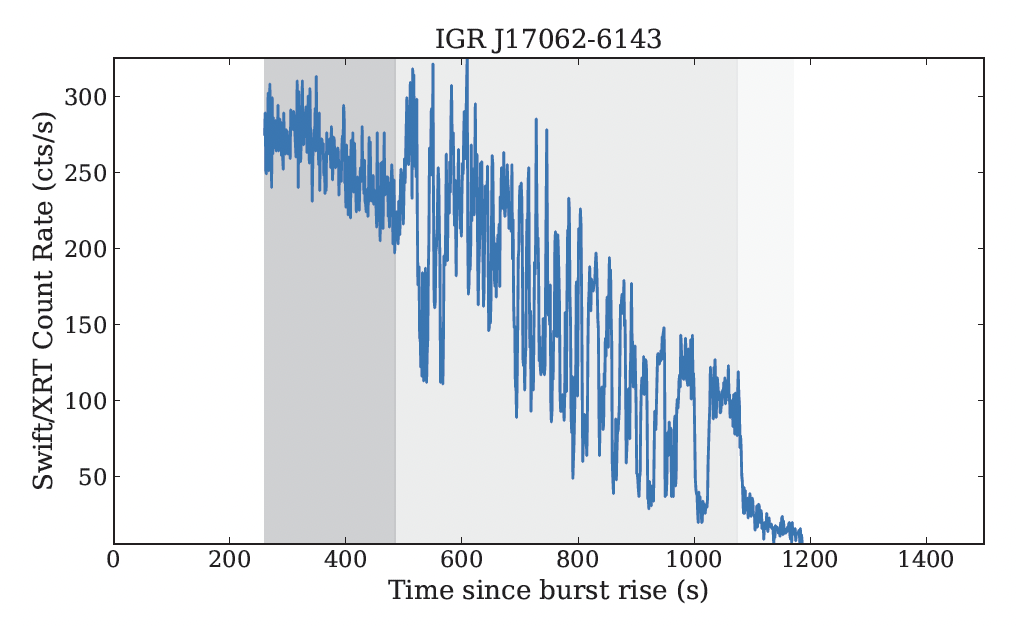
Thermonuclear X-ray bursts happen when material piles up on the surface of an accreting neutron star and suddenly ignites, burning away an entire surface layer in an instant, much like the head of a matchstick at stroke. These explosions generate a flash of X-ray emission that last seconds to to hours and are easily detectable with many X-ray telescopes because they are so whooping bright. We can thus easily pinpoint when these explosions are happening and can also readily measure the amount of radiation and energy that is released during these events. The explosions also act like a sudden floodlight, illuminating the surrounding gas and allowing us to watch how the accretion disk reacts to extreme heat and radiation. Usually, the X-ray bursts follow a predictable pattern of a sharp rise in brightness followed by a smooth, graceful fade. Every now and then, however, some of the longer and more energetic bursts instead show rapid, chaotic flickering as the bright emission from the explosion gradually fades.
For years, the cause of the flickering fluctuations in long bursts, where the X-ray emission jumps up and down by as much as 70%, has remained unknown. But now we have found evidence that these flickers are likely the result of the accretion disk literally getting bent out of shape due to the impact of the explosion. By performing a systematic and analysis of a sample of long bursts caught by the Swift satellite, we found that the direct light that we normally see from the neutron star’s surface vanishes from view when erratic flickering occurs. We concluded that when a burst is long and energetic enough, the sheer pressure of the radiation pushes against the disk, triggering an instability that warps it into a three-dimensional, wavy structure.
The most exciting part of this discovery is what it tells us about the physics of the disk itself. This warping instability is incredibly sensitive to the viscosity of the disk, essentially the cosmic glue or friction that determines how rapidly the gas flows toward the neutron star. Only disks with high viscosity are likely to get bent out of shape in this way. By studying long energetic thermonuclear bursts that flicker, we thus aren’t just watching a light show but we are actually measuring the sticky properties of ultra-hot gas in some of the Galaxy’s most extreme environments.
Understanding the viscosity of accretion disk is important for big picture questions about the universe. However, it is very difficult to know the value of this parameter from theoretical principles or to determine it from astrophysical observations. We now know that catching and studying long bursts with erratic fluctuations with (next-generation) sensitive X-ray satellites allows us to watch accretion disks ripple and bend in real-time, providing a new view of the hidden mechanics that drive the growth of neutron stars and black holes.
Ballantyne & Degenaar 2026, appearing in ApJ, arXiv:2608.07758: Do Accretion Disks Get Bent Out of Shape? Investigating the Origin of Rapid Fluctuations in the Tails of Long Thermonuclear X-ray Bursts
Paper link: SciX


You must be logged in to post a comment.