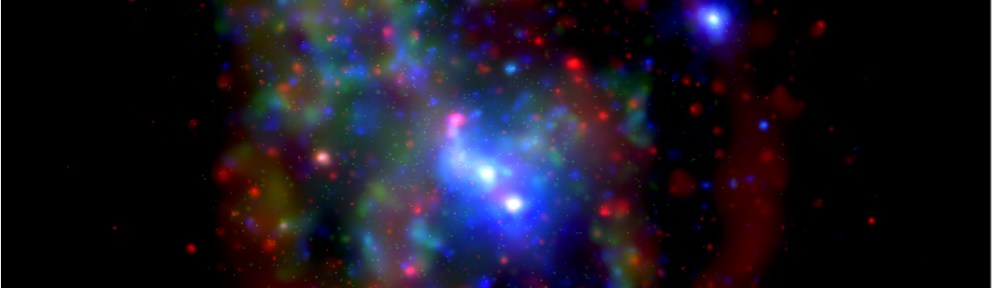
The center of our Milky Way is like the cosmic Times Square; a crowded, chaotic neighborhood where stars are closely packed and a supermassive black hole, Sgr A*, is the center of attention. For over 20 years, the Swift satellite has been our eyes on the ground, taking daily X-ray snapshots to catch the sudden activation of otherwise quiet inhabitants in this busy region. In February 2024, suddenly a shy new face appeared in the crowd: a faint X-ray source popped up and now carries the name Swift J174610−290018.
Soon after it stuck its head above the crowd, it became clear that Swift J174610−290018 was a member of the X-ray binary class of objects. These are binary star systems wherein a neutron star or a black hole devours its companion star through a process that we call accretion. However, while most X-ray binaries draw attention by shining very brightly in X-rays, this new kid on the block appeared much more shy, radiating only faint X-ray emission. This sub-set of X-ray binaries are called Very Faint X-ray Transients (VFXTs) and they appear to take only light bites instead of full meals, which makes them much harder to spot and to study in detail. Swift J174610−290018 showed up for about 50 days in 2024, only to vanish and reappear for a brief, five-day rendez-vous in April 2025,
Figuring out the exact nature of Swift J174610−290018, for instance if it contains a black hole or a neutron star, required some serious detective work in the X-ray data archives of NASA and ESA. Digging through data from the XMM-Newton satellite, we found a single, bright X-ray flare coming from the position of Swift J174610−290018 that had occurred in 2004 and hence had been hiding in the archives for two decades. This X-ray flare had all the hallmarks of a thermonuclear X-ray burst: a sudden thermonuclear explosion on the surface of an accreting neutron star. Such an event is the ultimate ID card showing that Swift J174610−290018 most host a neutron star, because black holes don’t have a solid surface to catch falling gas and hence cannot trigger these kinds of explosions.
Very-faint X-ray binaries are among the Galactic center’s most elusive inhabitants but may well represent the largest population of X-ray binaries in the Milky Way. For this reason finding, identifying and characterizing them, as we did for Swift J174610−290018, remains an important endeavor to understand the make-up of our Galaxy and to understand how pairs of binary stars live and end their lives. The discovery of this new X-ray source is another win for long-term monitoring programs which have proven very effective in catching these faint transients and allowing to trace their history across decades of data. Swift J174610−290018 also proves that even in a region we’ve watched daily for 20 years, there are still new neighbors waiting to be introduced.
Stel, Ponti, Degenaar, Sidoli, Mereghetti, Mori, Bao, Illiano, Mondal, Reynolds, Jin, Lian, Mandel, Scaringi, Zhang, Sanger-Johnson, Wijnands, Miller, Kennea, Zhu 2026, Astronomy & Astrophysics 705, 135: The very faint X-ray transient Swift J174610-290018 at the Galactic center
Paper link: SciX


You must be logged in to post a comment.