
Compact binaries may merge quicker than we thought due to disk winds.
In the world of X-ray binaries, disk size matters. These binary star systems are cosmic pairings where the dead(ly) remains of a massive star, a neutron star or a black hole, feeds on its neighboring star by pulling in gas that swirls into a vast, glowing whirlpool known as an accretion disk. Generally, the larger the orbital path between a cosmic cannibal and its unfortunate companion, the larger this accretion disk will be, the brighter it will shine and the more gas it will blow away in a disk wind. At least we thought so.
For long, it has been established that only X-ray binaries with fairly large accretion disks had the right conditions to blow disk winds into space. Compact binaries were thought to be too tiny to manage it. When we discovered footprints of an outflowing wind in the compact neutron star X-ray binary UW CrB this therefore came as an unexpected surprise. However, as excitingly puzzling as this discovery was, we had too little information to determine if this was an sporadic breeze or a persistent storm, nor if the outflow we picked up was actually a wind blown off the accretion disk rather than some gas stream that happened to pass through our line of sight.
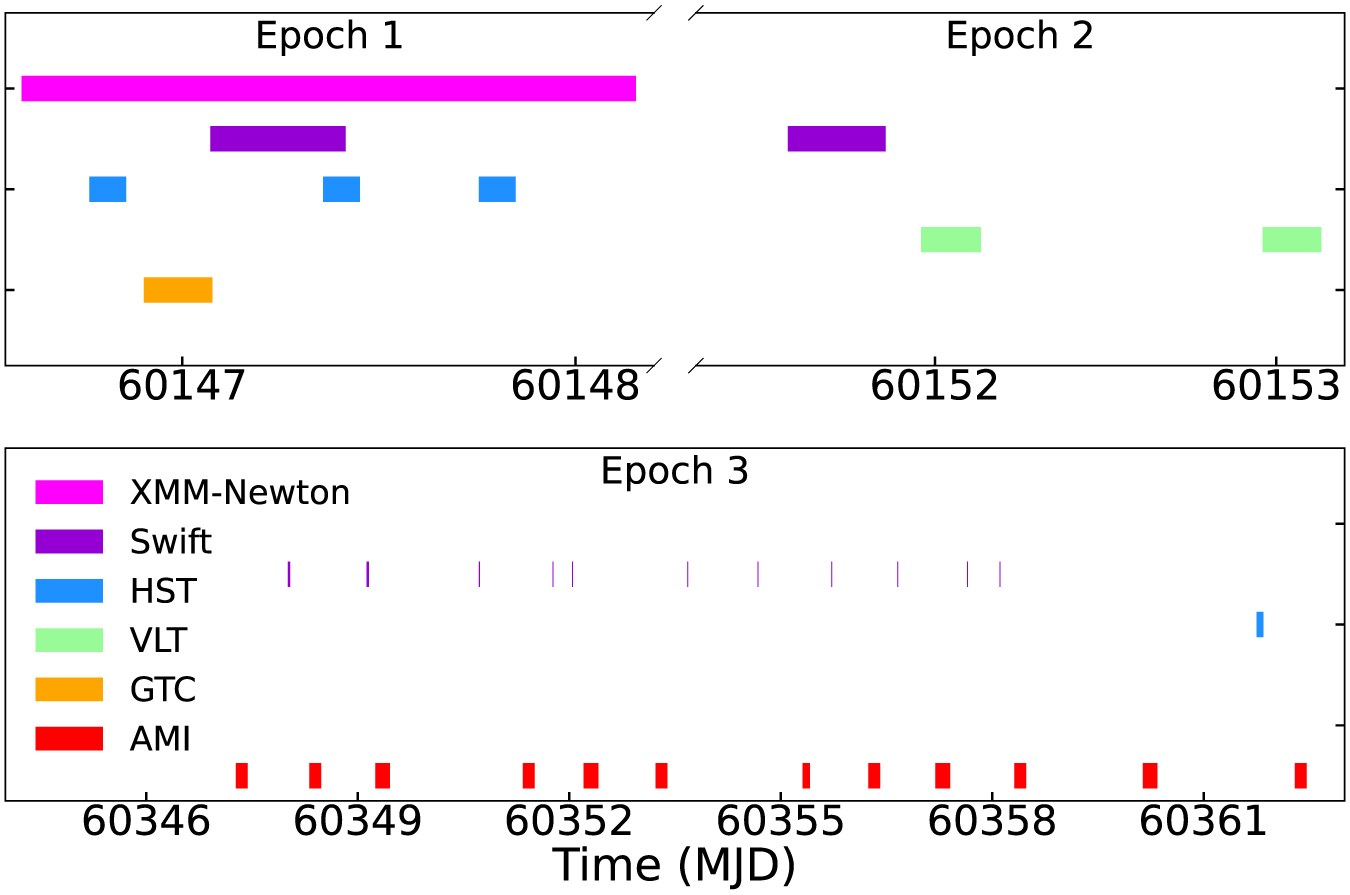
To get to the bottom of UW CrB’s windy secret, we launched a monster campaign wherein we pointed several major space-based and ground-based observing facilities at this neutron star located a few tens of thousands of light years away from us. By catching as much of its emitted light as we possibly could, cutting through the electromagnetic spectrum from radio waves to optical and infrared light to UV and X-ray radiation, we hoped to find more features of a wind and to map thet overall behavior of the X-ray binary. Within a window of 6 days in July 2023, the Hubble Space Telescope (UV), XMM-Newton and Swift satellites (both X-ray) observed from space, while the Very Large Telescope (VLT, optical/infrared) was watching from Chile and Gran Telescopio Canaria (Grantecan, optical) from La Palma. In a later campaign, performed in February 2024, we also monitored UW CrB with the Arcminute Microkelvin Imager (AMI, radio) telescope located near Cambridge UK, and the Swift X-ray satellite from space, to see if the neutron star launches a jet.
Needless to say, analyzing this impressive multi-wavelength, multi-facility data set was a massive amount of work and it required some serious detective work to figure out all clues that were hidden in the data. But the eventual result was more than worth it: we found several more indications, from all wavelength regimes we studied, that UW CrB is consistently blowing a disk wind into space. Having established that X-ray binaries with small disks are capable of doing this makes us rethink binary aging. If even compact binaries like UW CrB can launch persistent winds, it means they are losing much more mass and angular momentum than previously assumed. This then implies the two stars may move faster towards each other than current binary evolution models would predict, which would in turn impact predictions for the gravitational wave emission associated with compact binary star systems.
After this exciting effort to figure out the behavior of UW CrB, the queste is no on to find disk winds in other similar compact binary systems and refine our understanding of their life cycle.
Fijma, Degenaar, Castro Segura, Maccarone, Knigge, Armas Padilla, Mata Sánchez, Muñoz-Darias, Hernández Santisteban, Rhodes, Bright, van den Eijnden, Green 2025, MNRAS 544, 4702: A multiwavelength view of the outflowing short-period X-ray binary UW CrB
Paper link: SciX


You must be logged in to post a comment.