Rewriting a compact binary’s life story

Compact binaries may merge quicker than we thought due to disk winds.

In the world of X-ray binaries, disk size matters. These binary star systems are cosmic pairings where the dead(ly) remains of a massive star, a neutron star or a black hole, feeds on its neighboring star by pulling in gas that swirls into a vast, glowing whirlpool known as an accretion disk. Generally, the larger the orbital path between a cosmic cannibal and its unfortunate companion, the larger this accretion disk will be, the brighter it will shine and the more gas it will blow away in a disk wind. At least we thought so.

For long, it has been established that only X-ray binaries with fairly large accretion disks had the right conditions to blow disk winds into space. Compact binaries were thought to be too tiny to manage it. When we discovered footprints of an outflowing wind in the compact neutron star X-ray binary UW CrB this therefore came as an unexpected surprise. However, as excitingly puzzling as this discovery was, we had too little information to determine if this was an sporadic breeze or a persistent storm, nor if the outflow we picked up was actually a wind blown off the accretion disk rather than some gas stream that happened to pass through our line of sight.

To get to the bottom of UW CrB’s windy secret, we launched a monster campaign wherein we pointed several major space-based and ground-based observing facilities at this neutron star located a few tens of thousands of light years away from us. By catching as much of its emitted light as we possibly could, cutting through the electromagnetic spectrum from radio waves to optical and infrared light to UV and X-ray radiation, we hoped to find more features of a wind and to map thet overall behavior of the X-ray binary. Within a window of 6 days in July 2023, the Hubble Space Telescope (UV), XMM-Newton and Swift satellites (both X-ray) observed from space, while the Very Large Telescope (VLT, optical/infrared) was watching from Chile and Gran Telescopio Canaria (Grantecan, optical) from La Palma. In a later campaign, performed in February 2024, we also monitored UW CrB with the Arcminute Microkelvin Imager (AMI, radio) telescope located near Cambridge UK, and the Swift X-ray satellite from space, to see if the neutron star launches a jet.

Needless to say, analyzing this impressive multi-wavelength, multi-facility data set was a massive amount of work and it required some serious detective work to figure out all clues that were hidden in the data. But the eventual result was more than worth it: we found several more indications, from all wavelength regimes we studied, that UW CrB is consistently blowing a disk wind into space. Having established that X-ray binaries with small disks are capable of doing this makes us rethink binary aging. If even compact binaries like UW CrB can launch persistent winds, it means they are losing much more mass and angular momentum than previously assumed. This then implies the two stars may move faster towards each other than current binary evolution models would predict, which would in turn impact predictions for the gravitational wave emission associated with compact binary star systems.

After this exciting effort to figure out the behavior of UW CrB, the queste is no on to find disk winds in other similar compact binary systems and refine our understanding of their life cycle.

Fijma, Degenaar, Castro Segura, Maccarone, Knigge, Armas Padilla, Mata Sánchez, Muñoz-Darias, Hernández Santisteban, Rhodes, Bright, van den Eijnden, Green 2025, MNRAS 544, 4702: A multiwavelength view of the outflowing short-period X-ray binary UW CrB

Paper link: SciX
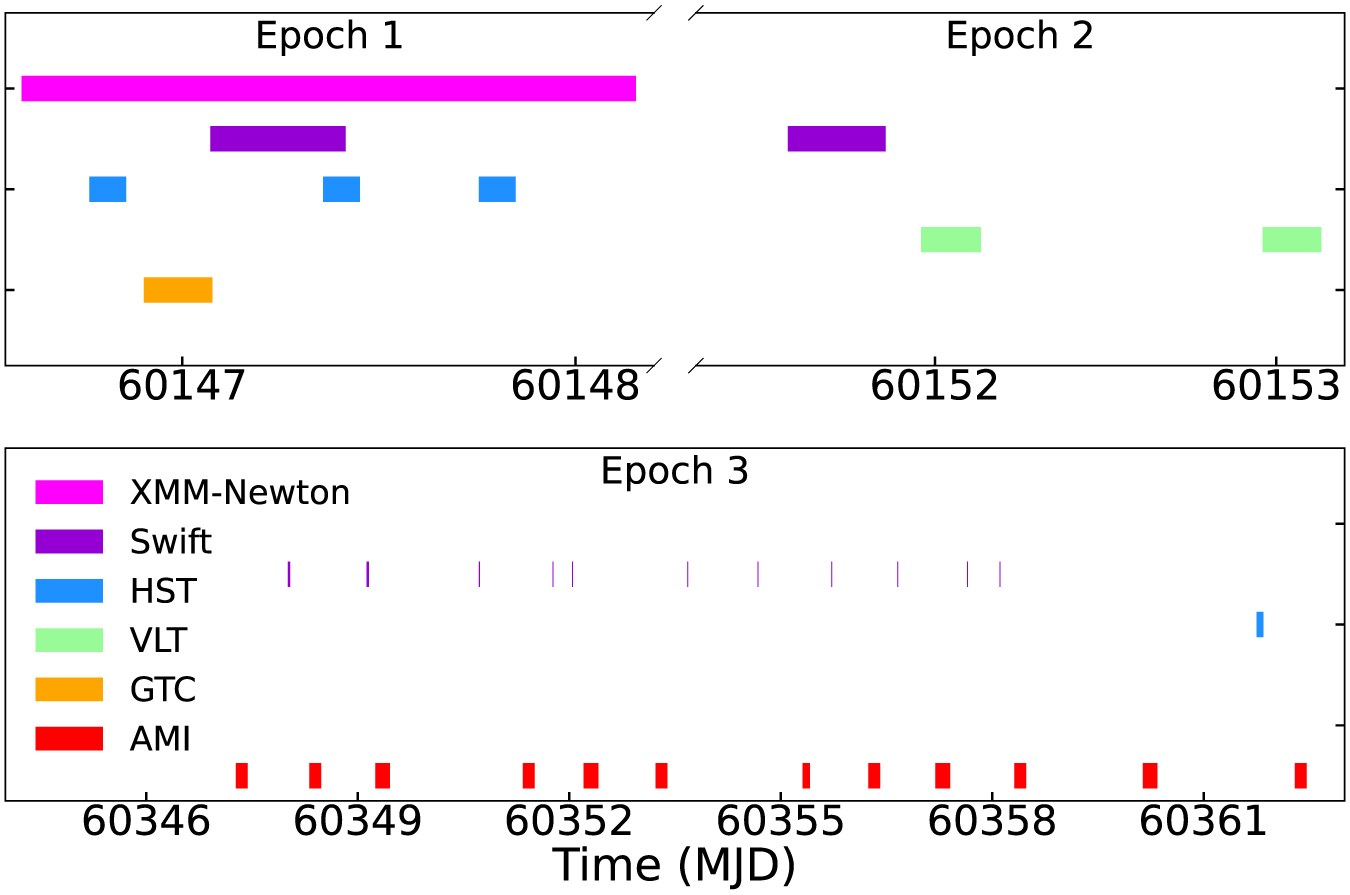
Overview of our multi-wavelength, multi-observatory monster campaign on UW CrB aiming to unravel the properties and nature of its outflows. The top panel shows the first two observing blocks of 2023 July during which we had X-ray, UV, optical and infrared coverage. The bottom panel shows the third observing block that was focused on radio monitoring, with supporting X-ray observations and a re-run of part of the HST UV observations.

An unexpected companion

The more gas neutron stars or black holes take in, the brighter they shine in X-rays. Many are glutenous, swallowing as much as 1018 (a million trillion!) of gas per second, which makes them the brightest X-ray sources in the sky. However, more and more neutron stars and black holes are discovered to emit only dim X-ray light, implying that these are not taking in a lot of gas from their companion star. It is not clear, however, why they don’t. The two leading theories are either that these neutron stars and black holes have very small companions and are hence just not very well fed, or that they have a normal gas supply but somehow spit much of this back into space. Charting the demographics of these dim X-ray binaries important for several areas of astrophysics, including the study of gravitational waves, supernova physics and binary evolution.

Many of the neutron stars and black holes that we have found in our Galaxy are not solitary but are instead orbiting through space with another star. Owing to their relentless gravitational pull, neutron stars and black holes are able to nibble gas from their companion. This makes them light up in X-rays and therefore these star pairs are called X-ray binaries. Studying X-ray binaries is important for a variety of reasons, including understanding how binaries with neutron stars and black holes are formed and evolve, how supernova explosions work, how black holes grow, and how matter behaves when subject to extreme conditions that cannot be mimicked in laboratory experiments on Earth (e.g. extreme magnetic fields, severe radiation, ultra-high densities, super-strong gravity).

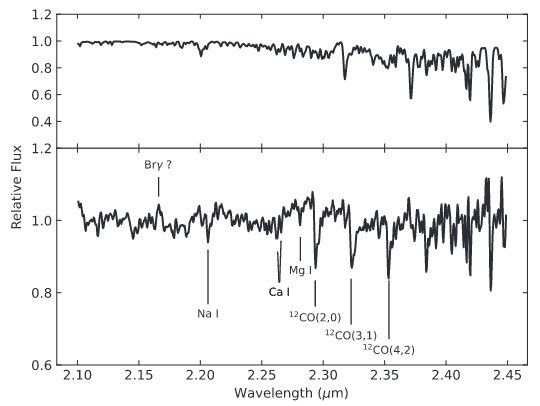
We tried to solve the riddle of dim X-ray emission for a neutron star called 1RXH J173523.7-354013. To do so, we turned to optical and near-infrared telescopes. In particular, we took a near-infrared spectrum using the Very Large Telescope (VLT) aiming to determine the type of companion star and used data from the Visible and Infrared Survey Telescope for Astronomy (VISTA) in an attempt to determine how long it takes for the two stars to orbit around each other (i.e. how wide the binary is). Expecting to find a very small (white dwarf) companion star and a very small orbital period (<1 hour), our studies instead revealed the complete opposite: a red giant star and an orbital period of about 8 days!

Since red giants can donate large amounts of gas to a neutron star or a black hole, it remains a puzzle why 1RXH J173523.7-354013 is such a dim X-ray source. We speculate that gas pulled off from the companion is accumulating in a reservoir near the companion and, as it becomes hotter and denser filling up, will at some point cross a critical threshold that allows all stored gas to suddenly stampede towards the neutron star. If our hypothesis is right, 1RXH J173523.7-354013 should one day become whoppingly bright in X-rays. Let’s see if this comes true! In mean time, we continue our quest to determine what companion stars dim X-ray binaries have, which may lead us to stumble across more of them having big companions and wide binary orbits like 1RXH J173523.7-354013. Stay tuned.

Shaw, Degenaar, Maccarone, Heinke, Wijnands, van den Eijnden 2024, MNRAS 527, 7603: The nature of very-faint X-ray binaries: near-infrared spectroscopy of 1RXH J173523.7-354013 reveals a giant companion

Paper link: ADS

Near-infrared (NIR) spectrum obtained with the SINFONI instrument on the Very Large Telescope (VLT) in Chile. Numerous lines can be seen that correspond to neutral atoms (e.g., Na I, Ca I and Mg I), as well as molecular bandheads (CO). All these are classic features seen in the NIR spectra of giant stars (of spectral type K or M), which came as a huge surprise! This is because objects like 1RXH J173523.7-354013 are generally thought to harbor very small donor stars (e.g. white dwarfs) instead.