The cosmic neighbor that kept us in the dark
Some X-ray binaries scream for attention, others just quietly hum along. 4U 1556–60 is one belonging to the latter category, known for over 50 years and thought to be a run-of-the-mill X-ray binary system living near the center of our Galaxy, like so many. But as it turns out, we were looking at it all wrong.
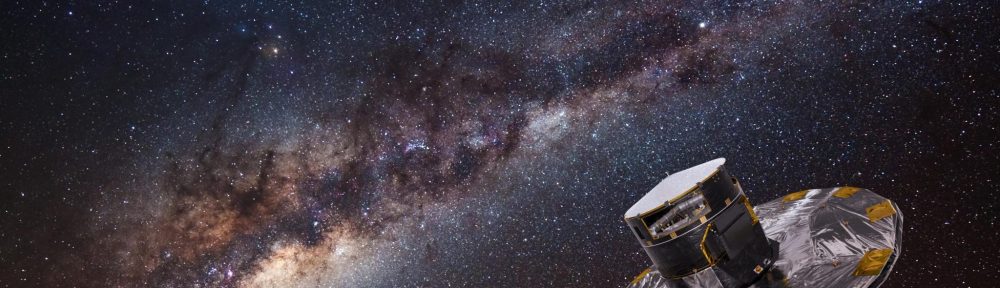
A surprising shortcut was delivered by the Gaia satellite, which measures the distances to billions of stars with incredible precision. Distilling the optical counterpart of 4U 1556–60 from the many stars Gaia has detected, we found that Instead of being roughly 25,000 light-years from Earth, this X-ray binary must actually be no less than ten times closer! At a distance of only 700 pc, it is one of the closest X-ray binaries ever discovered and this proximity drastically alters everything we thought we knew about it. To put it in perspective, it’s like thinking a faint light in the distance that you’ve seen forever is a massive lighthouse miles away, only to realize it’s a tiny candle right across the street.
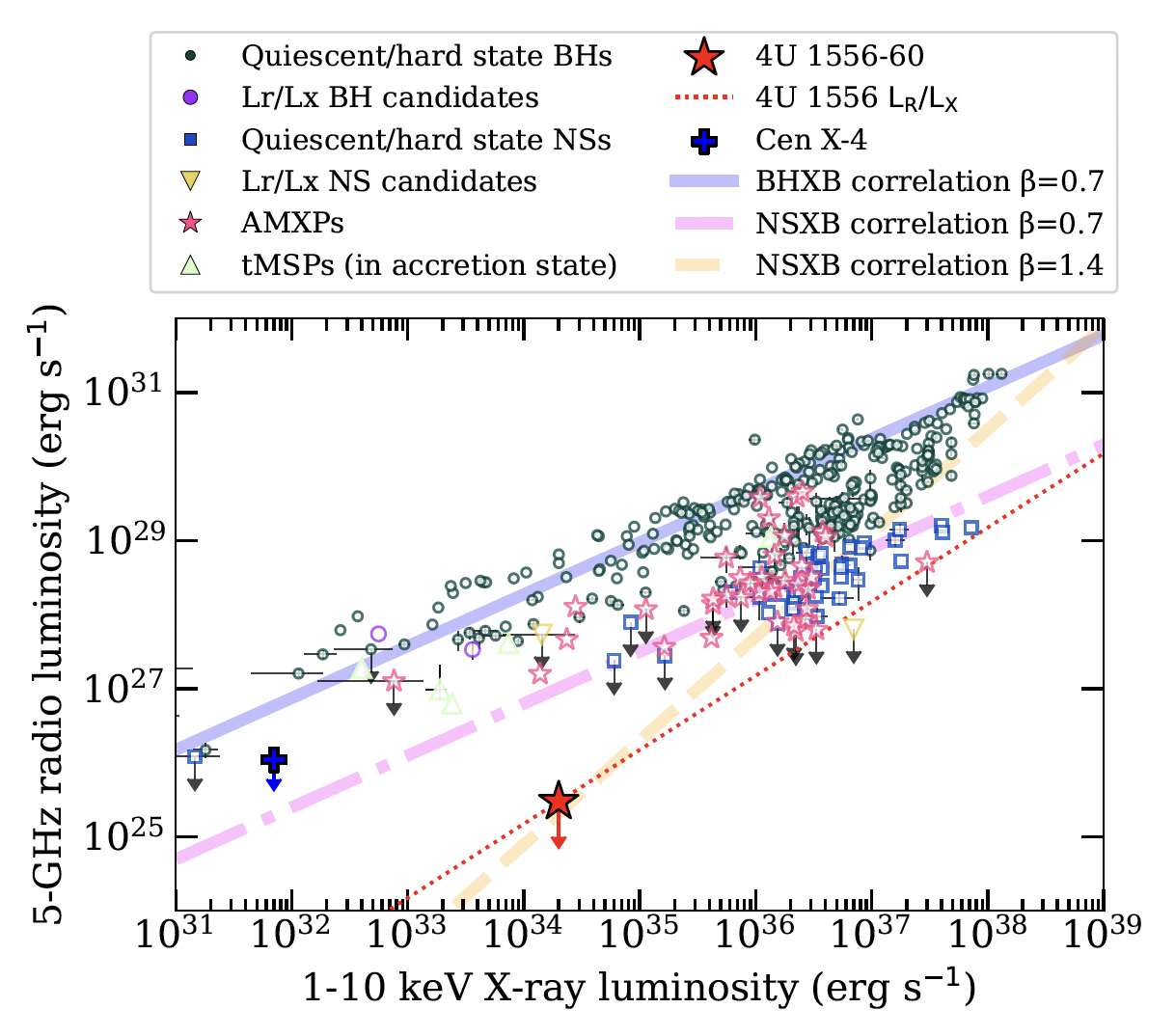
Because it is so much closer, we now know it is 100 times fainter than previously believed. Its persistent low luminosity is quite unusual for an X-ray binary: Usually, these systems either flare up brightly or remain dark in a state of quiescence, but 4U 1556–60 just quietly simmers at a very low level. To figure out if the system’s heart is a black hole or a neutron star, we used the Australia Telescope Compact Array (ATCA) to look for a radio jet. The result was absolutely nothing: one of the lowest radio limits ever recorded for an X-ray binary.
While black holes are notoriously noisy in radio waves, neutron stars produce much weaker jets, even when their X-ray emission shines similarly bright. The deep radio silence is the strongest evidence yet that 4U 1556-60 hosts a neutron star. Despite that no thermonuclear bursts, smoking-gun evidence for the presence of a neutron star, have ever been detected from the source this is likely because it is eating its companion so slowly that it takes months or even years to build up enough fuel for a single pop. The very low X-ray luminosity and low fueling rate likely implies that the neutron star in 4U 1556-60 is orbiting very closely to its companion that is just a tiny, stripped-down remnant of a star. While faint in X-rays, such ultra-compact X-ray binaries might actually be screaming in gravitational wave emission. Due to its close proximity, 4U 1556-60 is therefore a prime target for future gravitational wave detectors like LISA.
Paper link: NASA ADS
 Nathalie Degenaar
You must be logged in to post a comment.