
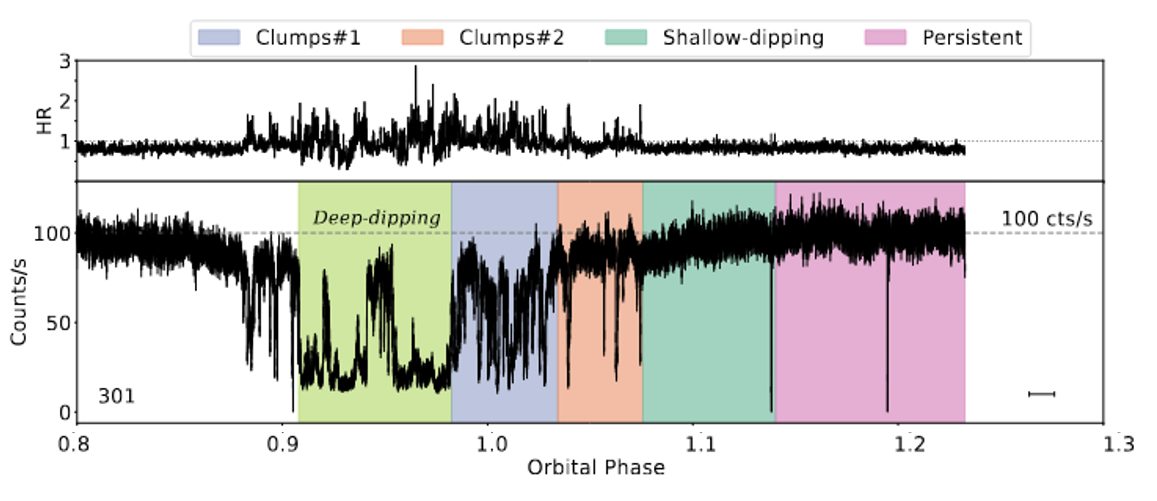
Everybody experiences a dip sometimes, but some X-ray binaries have a lot of dips. In the world of X-ray binaries, 4U 1624-490 is quite a legend. Known as Big Dipper, this binary system, consisting of a neutron star snacking on a nearby companion, is famous for the dramatic, periodic drops in its X-ray light. For long, these “dips” are thought to happen because a massive bulge of gas on the edge of the accretion disk swings into our line of sight, temporarily blocking the view. The properties of this bulge, such as its structure, size and temperature, remain largely unknown, however, and so is the role that these may play in setting the dynamics of the flow of accretion towards the neutron star.
A new, deep look with the XMM-Newton satellite has revealed that the bulge isn’t a solid wall of gas, but more like a cosmic sandstorm. Slicing the X-ray data into different segments revealed that the material hitting the disk is surprisingly complex. Instead of a uniform cloud, the bulge is a multi-phase mixture of both cold gas and highly ionized hot gas. The most striking discovery, however, is just how clumpy the system is. The dipping phenomena isn’t observed as a smooth fade-out and fade-in, but rather as a chaotic series of flickers caused by individual clumps of dense gas passing through our line of sight. By calculating the size of the bulge compared to the shortest flickers in the light curve, we estimated that this turbulent region contains at least 7,000 individual clumps.
Even during episodes that 4U 1624-490 is not dipping, we found evidence of a highly ionized atmosphere surrounding the entire disk. It seems that it is much messier than previously thought, with the impact of the gas stream potentially creating a splash so turbulent that it generates a swarm of thousands of mini-clouds that we detect as an atmosphere. This study shows that dipping light curves are powerful tracers that let us map out the hidden, chaotic structures of accretion disks in unprecedented detail.
Caruso, Costantini, Degenaar, Diaz Trigo 2026, Astronomy & Astrophysics 705, 176: An XMM-Newton long look at the accretion disk plasma in the dipping neutron star LMXB 4U 1624-490
Paper link: NASA ADS
 Nathalie Degenaar
You must be logged in to post a comment.