A windy surprise

Binary star systems that contain a neutron star are important for probing fundamental theories of physics and for studying a large variety of astrophysical processes. For instance, the most energetic explosive phenomena seen in the cosmos, such as supernovae, kilonovae, gamma-ray bursts, gravitational wave mergers and fast radio bursts, often involve neutron stars in binary systems. Furthermore, they serve as an important testbed for Einstein’s General Relativity Theory, and binaries containing neutron stars are also excellent laboratories to study the behavior of cold ultra-dense matter. Finally, studying populations of binaries with neutron stars further allow us to several key processes of stellar evolution.

A particularly important phase in the life and evolution of neutron stars in binary systems is when the neutron star accretes mass from its companion star. This is when the system manifests itself as an X-ray binary. However, neutron stars do not only swallow gas, they also blow matter and energy back into space via outflows. These can be observed as highly collimated streams that are called jets and thought to be shot out with velocities of tens to hundreds of thousands of kilometers per second, or dense winds that have a larger opening angle and travel at lower speeds of a few hundreds to thousands of kilometers per second.

As in any astrophysical system where accretion takes place, outflows are ubiquitous among neutron star X-ray binaries. However, two key aspects of jets and winds are not understood yet: how these outflows are actually launched and how much mass can be lost from the binary in this way. Determining the mass loss is important, for instance, for understanding how long it will take for the neutron star to close in on its companion star and eventually collide with it, generating a burst of gravitational waves. The amount of mass contained in a wind is closely related to the mechanism that drive the wind.

Studies of X-ray binaries containing black holes have shown that disk winds are likely driven by thermal processes: X-rays produced in the inner parts of the accretion disk heat the outerparts of the disk, causing these to puff up. If the disk is large enough, the gas may at some point in the disk puff up to such an extent that it’s able to escape the gravitational pull of the black hole and flow away as a disk wind. Based on theoretical knowledge, it is expected that black hole X-ray binaries should have orbital periods of more than 8 hours to be able to have large enough disks to launch thermal winds. So far, this was consistent with observations, since disk winds have almost exclusively been detected in X-ray binaries with orbital periods exceeding 8 hours.

Analysing far-UV spectra of a very small neutron star X-ray binary called UW CrB, with the aim to understand the composition of its accretion disk, we surprisingly discovered features of a wind. Since the orbital period of this binary is only 2 hours, it should not be able to launch a thermal wind. Based on this observational discovery, we performed preliminary simulations and actually found that the X-rays emitted from the surface of the neutron star make it possible to drive a wind from smaller accretion disks than would be possible in black hole X-ray binaries (since black holes to have a surface where they can emit X-rays from). The wind in UW CrB does remain mysterious, since it was detected in only a fraction of the data that we analysed. This suggests that winds can potentially switch on and off on a time scale of hours, which was not previously known.

To establish the nature and time-variability of the wind in UW CrB, we have been granted time on several big observing facilities: the space satellites Hubble Space Telescope, XMM-Newton and Swift, as well as the optical/near-infrared Very Large Telescope (VLT, in Chile) and Grantecan (on La Palma). It was a huge challenge to figure out at what exact time all these telescopes could point to UW CrB at exactly the same time, but this ambitious and exciting observing campaign is happening in mid July. Stay tuned for the outcome!

Fijma, Castro-Segura, Degenaar, Knigge, Higginbottom, Hernandez Santisteban, Maccarone 2023, submitted to MNRAS: A transient ultraviolet outflow in the short-period X-ray binary UW CrB

Paper link: ADS

Hubble Space Telescope far-UV lightcurve (left) and a Zoom of the spectrum (right) around the Si-iv emission line (at 1402 Angstrom). The Si line in the right plot shows a P-Cygni profile, which is the hallmark of an outflowing wind. However, this wind feature was seen in only part of the observation, namely in the time interval colored red in the left plot.

Gone with the wind

The discovery of a persistent UV outflow from a neutron star.


X-ray binaries consist of a neutron star or a black hole that are accompanied by another star (e.g. one like our Sun, a red giant, or a white dwarf). Neutron stars and black holes are not friendly neighbors, however, and will relentlessly rip gap from their companion and swallow it. This cannibalistic process is called accretion. At the same time, some of the gas inswirling is propelled back into space through dense winds or highly collimated jets.

The most common signatures of outflowing material from astronomical objects are associated with “warm” gas. Despite this, only winds of “hot” or “cold” gas have been observed in X-ray binaries… until now! In this new study, we observed the recent accretion eruption of the X-ray binary known as Swift J1858 with a menagerie of ground-based and space-based observatories, including NASA’s Hubble Space Telescope (HST), the European Space Agency’s XMM-Newton satellite (XMM), the European Southern Observatory Organisation’s Very Large Telescope (VLT) located in Chile and the Spanish Gran Telescopio Canarias (GTC) located at La Palma (Canary Islands).

The results of our campaign, which was a joint effort of a team of researchers from 11 countries and was published in the journal Nature, showed persistent signatures of a warm wind at ultraviolet wavelengths occurring at the same time as signatures of a cold wind at optical wavelengths and hints of a hot wind at X-ray wavelengths. This is the first time that winds from an X-ray binary have been seen across different bands of the electromagnetic spectrum. This new discovery provides key information about the messy eating patterns of these cosmic cookie monsters. It allows us, for instance, to better understand how much gas is blown away in winds and by what mechanism winds are produced.

Designing the an ambitious observing campaign, built around the best telescopes on Earth and in space, was a huge challenge. This is mainly because it requires coordinating different observatories located at different parts of the Earth and space to look at your target all at the same time. So, it is incredibly exciting that all this work has paid off and allowed us to make a key discovery that would not have been possible otherwise.

Some press coverage: Independent

Castro-Segura et al. 2022, Nature 603, 52: A persistent ultraviolet outflow from an accreting neutron star binary transient

Paper link: ADS

Artist’s impression of a wind blown from the inner part of the accretion disk around a neutron star devouring gas from a companion. Image credit: Gabriel Pérez (IAC).

Calling all telescopes for duty

In late 2018, the Neil Gehrels Swift observatory (Swift), discovered a new bright source lighting up the X-ray sky. It was called Swift J1858.6-0814, or shortly Swift J1858, and soon realized to be an X-ray binary: a system of two stars orbiting around each other where one of the two is a black hole or a neutron star and the other a regular star. These objects shine bright in X-rays (and at other wavelengths) when the black hole or neutron star is able to pull gas from its companion towards itself. Often this happens only sporadically during episodes that we call outbursts.

About two hundred X-ray binaries are currently known in our Galaxy and many of these have been extensively studied since the dawn of X-ray astronomy in the late 1960s. Swift J1858 immediately stood out, however, by displaying extreme behavior in which the X-ray emission changed by orders of magnitude on short (hours) time scales. Only a handful of other X-ray binaries had ever been observed to display similarly volatile behavior as Swift J1858. Perhaps the most prominent one of those is the infamous black hole V404 Cygni. Based on this analogy, Swift J1858 was therefore expected to habor a black hole too.

The extreme behavior of Swift J1858 drew a lot of attention in the X-ray binary community and motivated a massive multi-wavelength campaign involving many ground-based and space-based observatories. The fleet of facilities pointing to Swift J1858 involved, for instance, ESA’s XMM-Newton satellite (X-rays), NASA’s NICER mission located on the International Space Station (X-rays), the Hubble Space Telescope (UV), the Very Large Telescope in Chile (UV/optical/infrared), the 10-m Grantecan telescope on La Palma (optical/infrared), the Very Large Array in New Mexico USA (radio) and the Atacama Telescope Compact Array in Australia (radio). All these efforts allowed for an unprecedented characterization of the binary and its extreme variability.

X-ray studies suggested that Swift J1858 was very rapidly swallowing gas from its companion, but our radio studies showed that it was also blasting a bright collimated jet into space. Moreover, our X-ray and optical studies showed that it was also blowing material into space via a disk wind. One of the most surprising discoveries was that Swift J1858 turned out to harbor a neutron star rather than a black hole. This was established by the detection of a thermonuclear explosion from the source, a so-called type-I X-ray burst, which cannot be produced by a black hole because they lack a surface. Neutron stars might be tiny, but they can truly be as violent as black holes!

Swift J1858 is now dormant, but our ambitious multi-wavelength campaign has delivered an incredibly rich data set for us to analyze and interpret. A first series of papers reporting on the findings at different wavelengths has already been published, but the analysis is ongoing. In particular, correlating all the data sets obtained at different wavelengths is expected to result in new discoveries that will help us understand how accretion and associated outflows work, and why Swift J1858 showed such extreme behavior. So there is more to come!

Paper links (ADS):

ATCA light curve of Swift J1858 showing that is was also extremely variable in the radio band. This light curve is taken from van den Eijnden et al. 2020

Astrophysical pollution

The outflows, i.e. the jets and disk winds, that are produced by accreting black holes and neutron stars can potentially have a significant impact on the environment of X-ray binaries. The space in between stars and binary star systems is not empty: it’s filled with tenuous gas and dust that is referred to as the interstellar medium (ISM). Jets and disk winds can slam into this ISM, thereby stirring it and heating it. Moreover, extremely powerful thermonuclear X-ray bursts may eject material into the surroundings of the neutron star and create the same effect. These interactions can may have far-reaching consequences, perhaps influencing the formation of stars and thereby influence the evolution of the entire galaxy. However, it is not yet established if the majority of X-ray binaries truly impact their surroundings; this likely depends on the power of the outflows and the density of the ISM.

Whether or not an X-ray binary interacts with its environment may be determined by looking for shocks in the surrounding ISM. Such shocks produce ionized radiation that are characterized by strong emission lines, e.g. one produced by hydrogen gas at a wavelength of 650 nm (H-alpha emission). Some telescopes are equipped with filters that allow you to look at such a specific wavelength; by taking images with a H-alpha filter, shocked regions around X-ray binaries may be revealed. In addition, a camera with a very wide field of view is required, because the shocked regions may be lying quite far away from the X-ray binaries (and hence would be missed when looking with a camera that has a narrow field of view).

Determined to find out if X-ray binaries generally create shocks in their surroundings, we set up a very large campaign to take H-alpha images of many tens of X-ray binaries. For this purpose we are using the Wide Field Camera (WFC) mounted on the Isaac Newton Telescope that is located on La Palma, Spain. To be able to also access X-ray binaries that are located in the Southern hemisphere,  we are also using the Las Cumbres Observatory, which consists of network of telescopes located across the globe, and the Very Large Telescope located in Chile. To pull off this massive observing campaign, my group and I are joining forces with researchers from the University of Sounthampton in the United Kingdom, St Andrews University in Schotland, the Instituto de Astrofísica de Canarias in Spain, and New York University Abu Dhabi in the United Arab Emirates. Stay tuned for the results!

INT_bigger

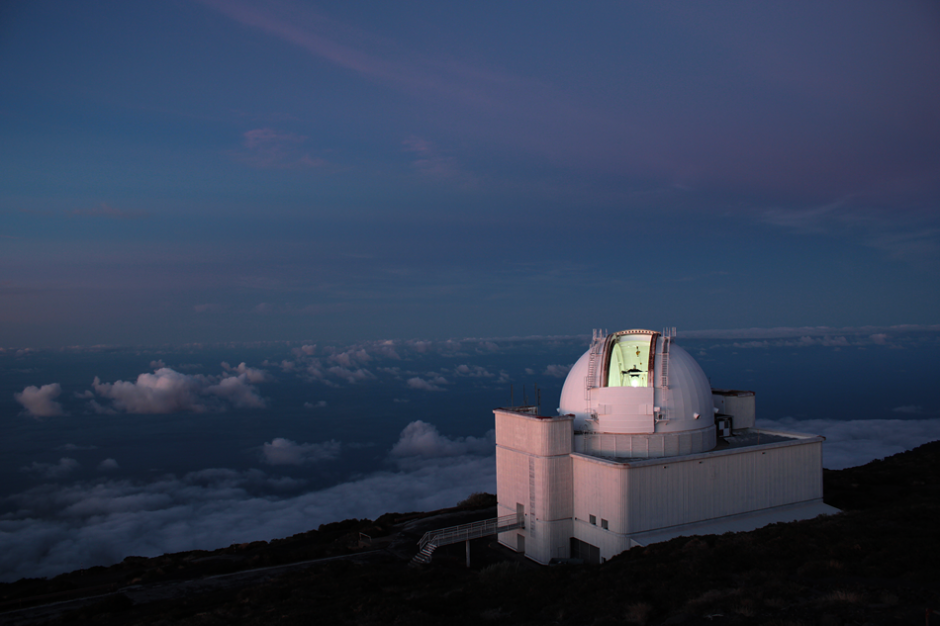
The Isaac Newton Telescope on La Palma. Photo credit: see here

Don’t overfeed the neutron star

The laws of physics dictate that there is a maximum amount of food that neutron stars and black holes can digest. Once you reach the so-called Eddington limit, the radiation that is produced by the consumption of gas becomes so strong that it blows away the in-falling material. Theoretically, it is therefore predicted that if you overfeed a neutron star or a black hole, strong outflows are produced: in the regime of super-Eddington accretion, we expect both jets and winds to be created. Jets are usually detected at radio wavelengths, whereas winds often reveal themselves as narrow absorption lines in high-resolution X-ray spectra.

There are a number of neutron stars and black holes identified that are likely accreting at very high rates. Most of these are located in other galaxies, and referred to as ultra-luminous X-ray sources (ULXs), because the high rate of food consumption makes them very bright X-ray emitters. For several of these ULXs, signatures of disk winds have been detected. A few other ULXs have radio bubbles around them that suggest that these objects are producing strong jets. However, to date there is no ULX known that is known to produce both winds and jets at the same time. It therefore remains to be established if super-Eddington accretion indeed causes both types of outflows.

Swift J0243.6+6124 is an accreting neutron star that is located in our Milky Way galaxy and was discovered in late 2017 when it suddenly started to feed of its companion star. Following its discovery, the object kept brightening until after a few weeks it reached super-Eddington accretion rates. We previously detected a jet from this neutron star using the Very Large Array (VLA) radio telescope. Following this detection, and known that the source was in the super-Eddington regime, we also requested high-resolution X-ray observations with the Chandra telescope with the aim to search for the presence of a disk wind.

Detecting a disk wind in Swift J0243.6+6124 was not an easy task because it was so overwhelmingly bright that it was causing issues for all X-ray satellites: just as the NS cannot eat fast enough, our X-ray detectors couldn’t process the light received from the source fast enough. Luckily, Chandra could be operated in a very special setting that allowed us to look at the source anyway. Excitingly, the spectra that we obtained with Chandra contained a number of narrow absorption lines that can arise from a disk wind. The properties of these absorption lines suggest that the wind is blown away from the neutron star at a dazzling speed of 20% of the speed of light: a speed of about 200 million kilometers per hour! Similar wind speeds have been measured for ULXs in other galaxies.

Our Chandra and VLA observations thus revealed that indeed jets and winds are produced at the same time in the super-Eddington accretion regime, just like theory predicts.

van den Eijnden, Degenaar, Schulz et al. 2019, MNRAS 487, 4355: Chandra reveals a possible ultrafast outflow in the super-Eddington Be/X-ray binary Swift J0243.6+6124 

Paper link: ADS

Spacecraft labled new 2019

Schematic overview of the Chandra X-ray satellite, with which we performed this research. Image credit: NASA

Characterizing a new neutron star

Since the dawn of X-ray astronomy over 50 years ago, more than 150 neutron stars swallowing gas from a nearby (Sun-like) companion star have been identified in our Galaxy. Still, every year a few new neutron stars are discovered when they suddenly start to devour their unfortunate neighbours. Different telescopes and satellites are then used to characterize such a previously unknown X-ray binary.

In February 2015, the X-ray emission of an object named 1RXS J180408.9-342058 was suddenly found to have brightened by more than 3 orders of magnitude. It was known to be an X-ray binary since 2012 when it displayed a thermonuclear X-ray burst; a devastating burp from a dining neutron star. At the time, however, it seemed that the neutron star was only taking a mid-night snack and had gone back to sleep before we could point our telescopes to investigate its eating patterns. Luckily, when it awoke in 2015 the neutron star clearly had much more appetite and kept swallowing gas from its companion for several months. This provided ample opportunity to study it in high detail.

We used three different X-ray satellites, namely NuSTAR, Chandra and Swift, to chart the geometry of this X-ray binary and the table manners of its neutron star. NuSTAR is a particularly powerful tool to study X-rays reflecting off the gaseous disk that surrounds and feeds the neutron star. Leveraging this, we determined that we view the binary at an angle of about 30 degrees, and that the gas disk was extending very close to the neutron star. In turn, this shows that the neutron star’s magnetic field is relatively weak and not able to keep the accretion flow at a distance. With Swift and Chandra we collected X-ray data when 1RXS J180408.9-342058 was at its brightest, and this suggested that the neutron star was eating rather messy; hints of narrow absorption lines suggest that part of the gas flowing towards the neutron star was blown away in a disk wind.

Degenaar, Altamirano, Parker et al. 2016, MNRAS 461, 4049: Disc reflection and a possible disc wind during a soft X-ray state in the neutron star low-mass X-ray binary 1RXS J180408.9-342058

Paper link: ADS

bh_binary_nasa_artistimpression_small

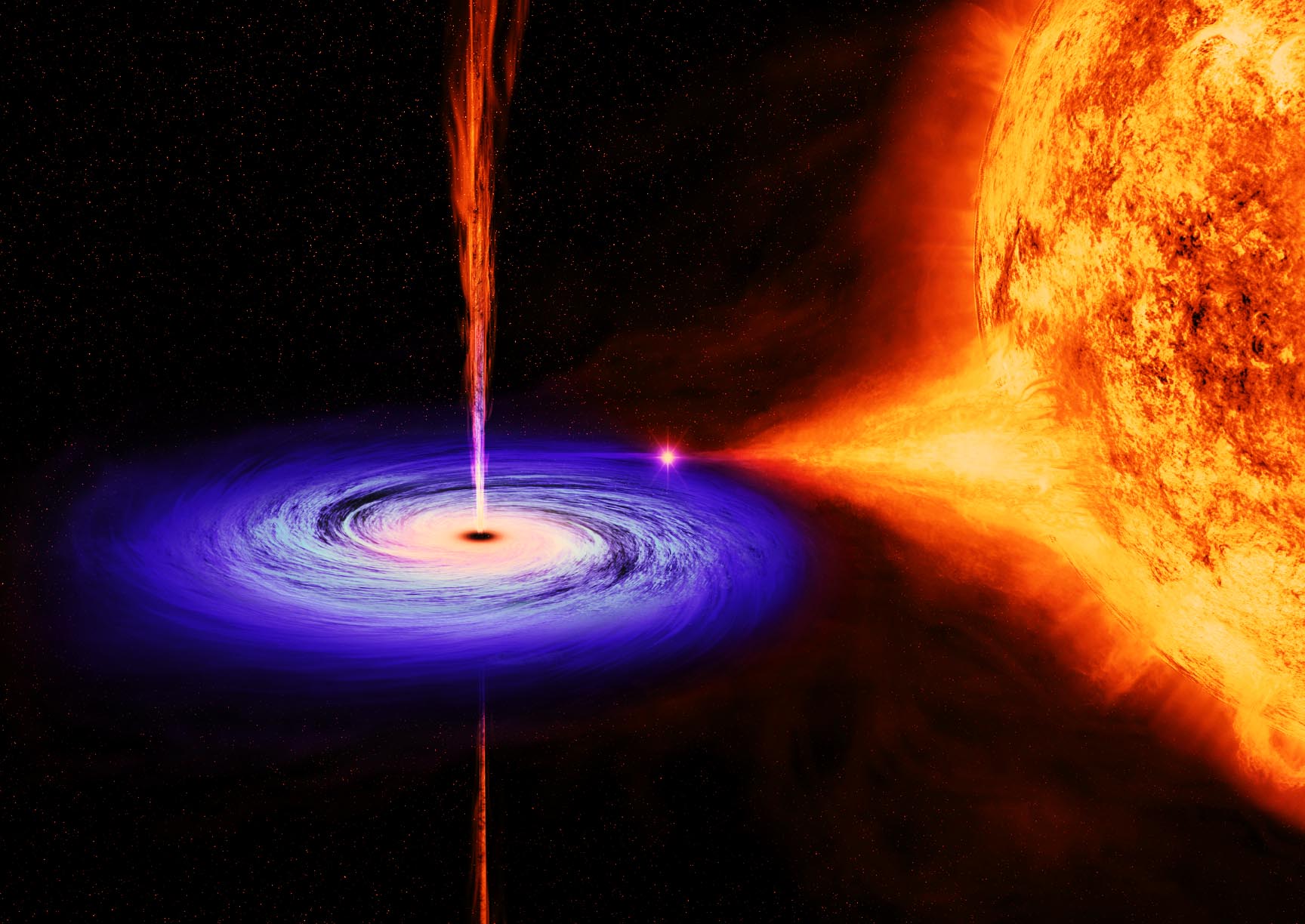
Artist impression of an X-ray binary. Image credit: NASA.

Blown away by an accretion disk wind

GRO J1744-28 is among the most puzzling neutron star X-ray binaries known in our Galaxy. How could the companion star have possibly reduced to its current small size without spinning the neutron star up to very high rotation rate or without strongly reducing its magnetic field? High-resolution Chandra X-ray observations may have solved this puzzle.

After remaining dormant for nearly 20 years, GRO J1744-28 suddenly exhibited a new accretion outburst in 2014. This provided the excellent opportunity to study this extraordinary X-ray binary with modern X-ray telescopes. Using high-resolution Chandra Grating Spectroscopic observations, we found evidence for X-ray absorption lines that could arise from a dense wind blowing off the accretion disk. Such winds are commonly seen for black hole X-ray binaries, although it is not established yet whether similarly strong winds can also form in the accretion disks that surround neutron stars.

If the absorption features in GRO J1744-28 indeed origin in a disk wind, then energetic considerations suggest that this wind may carry away a considerable amount of matter that is being transferred from the companion star. Therefore, a considerable amount of matter may be lost from the binary without accreting onto the neutron star. This could potentially solve the long-standing puzzle of how to reconcile the very low mass of the companion star in GRO J1744-28 with the slow rotation period and high magnetic field of the neutron star primary.

Degenaar, Miller, Harrison, Kennea, Kouveliotou, Younes 2014, ApJ Letters 796, L9: High-resolution X-Ray Spectroscopy of the Bursting Pulsar GRO J1744-28

Paper link: ADS

 Artist impression of an X-ray binary with a strong disk wind. Credit: NASA’s Goddard Space Flight Center / Chandra X-ray observatory / M. Weiss

Artist impression of an X-ray binary with a strong disk wind.
Credit: NASA’s Goddard Space Flight Center / Chandra X-ray observatory / M. Weiss