How to launch a jet

Whenever a gigantic explosion occurs in the cosmos, or an astrophysical object guzzles up matter from its surroundings, so-called jets are shot out: collimated streams of plasma that hurdle through space at speeds of hundreds of thousands to billions of kilometers per hour. As jets carry enormous energy and travel very large distances, they may significantly impact their cosmic environment, for instance enriching it with exotic chemical elements or compressing gas clouds to the extent that these start to contract to form new stars. Moreover, a jet might carry away significant amounts of energy, mass and rotation, from the object that launches it hence changing its properties and evolution.

Despite their prominent role in shaping our universe, how jets are actually produced has puzzled astronomers for over a century, ever since the first recording of an astrophysical jet in 1918. The answer to this seemingly basic question is, however, essential to fully understand the wide impact of jets. This is because the launch mechanism determines the physical properties of the jet, such as its power, speed, and composition. For neutron stars, pressing questions are whether the star’s magnetic field is involved in launching jets and to what extent their jet production mechanism resembles that of black holes.

A rather unique neutron star to study the role of the stellar magnetic field on jet production is one with the stage name The Rapid Burster (formally called MXB 1730-335). It is thought for this neutron star there is a tug-of-war between its magnetic field, pushing gas outwards, and its accretion disk through which gas flows from its companion star flows towards it. During so-called Type-II X-ray bursts, flashes of bright X-ray emission that last seconds to minutes, the magnetic field is thought to be temporarily pushed inwards, allowing a sudden strong increase in the gas supply to the neutron star. Seeing if, and how, the radio jet responds to these Type-II bursts thus provides an excellent setting to study the role of the stellar magnetic field in launching jets.

As with the thermonuclear burst / jet experiment, it was again an exciting challenge to design and execute the observing campaign to study the jet of the Rapid Burster. This is because this neutron star is dormant most of its time and only occasionally gobbles up gas from its companion star. Luckily, the Rapid Burster is a rare case where its meal times are rather regular, allowing to predict when a new episode of activity is about to occur. Making use of this, we devised a strategy that involved 4 different observatories. First, we monitored our target for signs of increased X-ray activity through the MAXI satellite, which is continuously scanning the sky in X-rays. When it detected the onset of a new accretion outburst, we started to monitor the source with the Swift satellite for accurate flux measurements and chart its X-ray bursts. As soon as Swift showed us that the Rapid Burster had become bright enough and had started showing type-II bursts, we initiated pre-arranged observations carried out simultaneously with the Very Large Array (radio) and Integral (X-rays).

During our observing campaign, the Rapid Burster showed both short, rapidly recurring Type-II bursts, as well as a much longer one that was followed by a burst-free episode. Interestingly, we witnessed that the jet of the neutron star was solidly on when displaying the short bursts, but appeared to switch off after the longer Type-II burst. This could point towards a crucial role for the stellar magnetic field in launching jets, at least for this particular neutron star. Having conducted this successful pilot experiment, we can confirm this hypothesis by conducting a more extensive campaign to catch more longer Type-II bursts and study the associated jet response. Comparing these results a more systematic radio study of other neutron stars that do not display Type-II bursts will further allow to understand the role of the magnetic field.

van den Eijnden, Robins, Sharma, Sánchez-Fernández, Russell, Degenaar, Miller-Jones, Maccarone 2024, MNRAS 533, 756: The variable radio jet of the accreting neutron star the Rapid Burster

Paper link: ADS
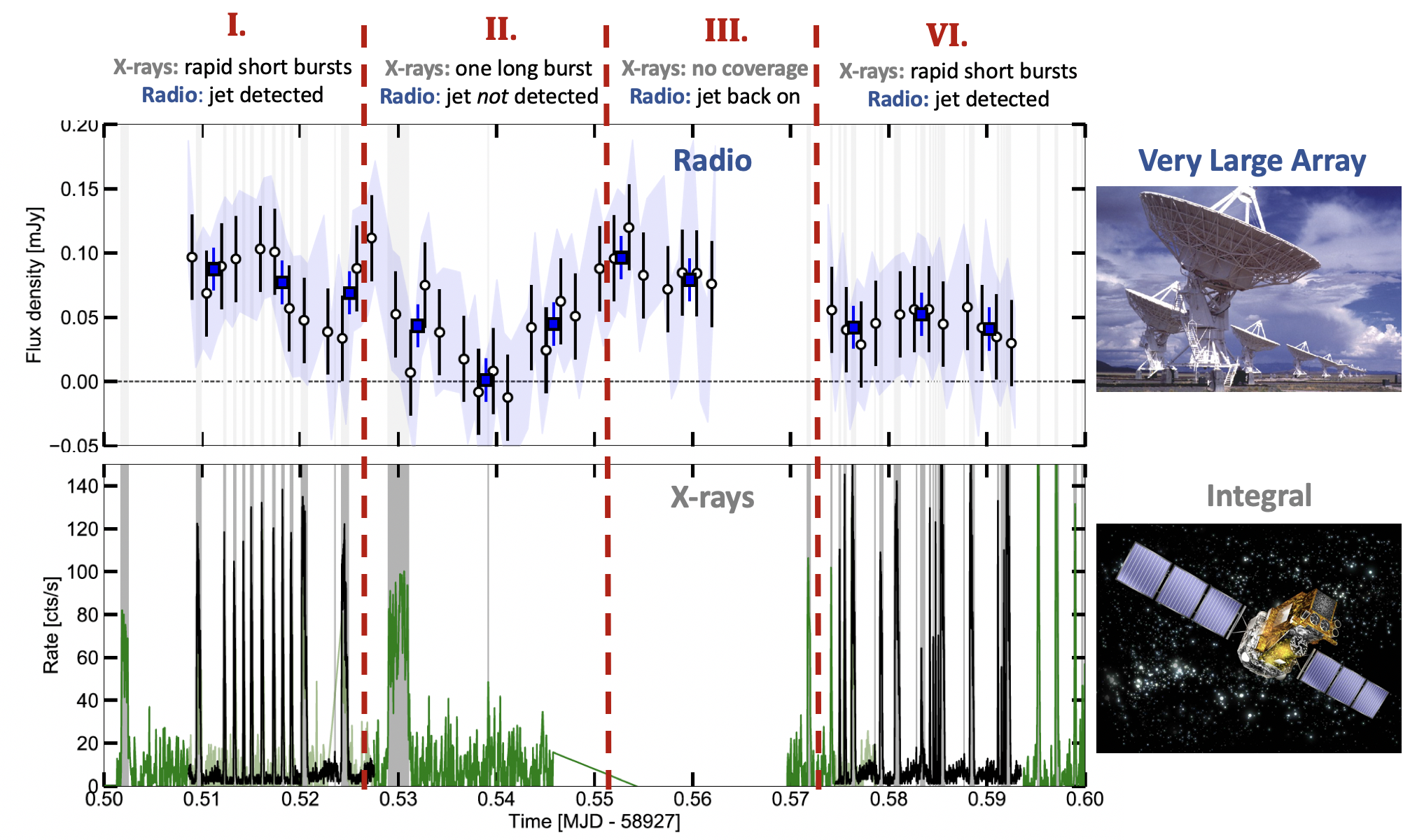
Results of the simultaneous VLA radio (top) and Integral X-ray (bottom) observations of the Rapid Burster in 2020. The jet seemed to on during episodes where short successive Type-II X-ray bursts were occurring (epochs I, III and IV; top label), but switched off after a stronger/longer Type-II X-ray burst (epoch II).

A cosmic speed camera

Jets are collimated streams of gas and energy that are produced by a variety of astrophysical objects and phenomena. Jets are, for instance, produced by young forming stars, by neutron stars and black holes in X-ray binaries, and by supermassive black holes that lurk in the centers of galaxies. Moreover, jets are seen during explosive, cataclysmic phenomena such as supernova explosions, gamma-ray bursts and bursts of gravitational waves produced by the mergers of compact stars. Despite that jets are so omnipresent in the universe, it is not understood yet how jets are launched in different circumstances and how fast they travel through space.

In an attempt to break new grounds in our understanding of jets, we designed an out-of-the-box experiment to test if thermonuclear explosions that regularly occur on the surface of neutron stars could cause measurable variations in their jets. Our thought was that the radiative power of such explosions would blow away the launch region of jets, causing them to temporarily break down and rebuild thereafter. Observing that would provide unique new insight into how neutron stars produce jets. Since it was not possible to predict how large any effect would be, hence if we would be able to detect anything at all, it was not feasible to obtain observing time for this experiment through regular routes of proposing our idea to a time-allocation committee. Therefore, we used a special opportunity provided by the Dutch national research council (NWO) to apply for a small grant to fund high risk research (the NWO XS grant). With this grant we bought 80 hours of observing time on the Australian Telescope Compact Array (ATCA) radio telescope to perform our crazy jet experiment.

To complement the purchased radio observations that can detect a jet, we obtained time on the INTEGRAL satellite from the European Space Agency (ESA) to detect thermonuclear bursts. Setting up these strictly simultaneous observations was quite a challenge, but we managed to do two runs (each lasting 3 days) on two different bursting neutron stars: 4U 1728-34 and 4U 1636-536. During both runs we detected many bursts and…. we did see a clear jet response!! But it was completely opposite of what we expected: instead of seeing the jets fade (from breaking down) in response to the explosions, we observed a marked brightening of the jet. The fact that the jets persist despite of the bursts provides key information on these outflows are launched and crucial constraints for computer simulations that model the launch of jets.

Another exciting implication from our successful experiment is that the timescale of the response of the jet allowed us to measure, for the first time, the speed of the jet from a neutron star. We found that it is blasted into space at a dazzling speed of 300 million kilometers per hour (or traveling about 90 thousand kilometers in just a single second!). While neutron star jets thus have an enormous velocity, it a factor of 2-3 slower than the velocity measurements that we have for a handful of black holes. This suggest that the properties of the jet-launching object (e.g. their mass, their rotation rate or their magnetic field strength) must play a role in how jets are launched and powered. The important breakthrough of this discovery has opened up a completely new window to understand how jets are connected to the individual properties of a system, which provides us with fundamental insight into the launching of jets on all physical scales.

Never before were we able to anticipate and directly watch how a certain amount of gas got channeled into a jet and accelerated into space. Only the explosions on the surface of the neutron star could give us the clean and isolated view of this process to perform these measurements. Because of the high scientific impact, our results will be published in the journal Nature. Moreover, with the successful demonstration of the experiment it will no longer be difficult to obtain observing time through regular routes to take the same measurements for (many) other neutron stars. Lastly, the spectacular results of our crazy jet experiment demonstrate how valuable it is for science that there are opportunities to support high-risk research. Such projects may, by their very nature, often fail, but it is exciting and fun to try and can turn out to be very high gain.

Russell, Degenaar, van den Eijnden, Maccarone, Tetarenko, Sanchez-Fernandez, Miller-Jones, Kuulkers, Del Santo 2024, Nature 627, 763: Thermonuclear explosions on neutron stars reveal the speed of their jets

Paper link: Nature, ADS

Press releases: ESA, NOVA

Animation: mp4 (source ESA)

Main result of the crazy jet experiment. The top panels a-c show the X-ray light curves obtained with INTEGRAL for 3 consecutive days. The bright spikes of X-ray emission are 9 thermonuclear X-ray bursts. The bottom panels d-f show the simultaneous radio light curves obtained with the ATCA telescope at two different radio frequencies (5.5 GHz in red, 9 GHz in blue). The vertical grey lines indicate the times of the thermonuclear bursts. It is clear that shortly after each burst the radio emission is brightening as a result from extra material being pumped into the jet during a burst.

A universal accretion instability

Shedding light on an old black hole mystery using… a neutron star!


Neutron stars and black holes are both remnants of massive stars that ended their lives in a supernova explosion. They also both exert very strong gravity and when they are part of a binary star system, this allows them to devour gas from their unfortunate companion star. This gas spirals towards the cannibal forming a disk that is incredibly hot, so hot that it emits X-ray radiation. As these cosmic dinner parties can be spotted as sudden eruptions of X-ray emission, these stellar binaries containing a black hole or a neutron star are called X-ray binaries. However, neutron stars and black holes are greedy and cannot swallow all gas they attract; some of it is flung into space through powerful collimated jets or dense winds.

Despite their similar behavior, there is a distinct difference between the two tribes of cannibals: whereas for neutron stars the attracted gas plunges into their solid surface or anchored magnetic field where it may create observable shocks or explosions, a black hole silently swallows the gas from view beyond its event horizon. However, it has not been established yet how this and other differences between the two types of objects, such as the higher mass and faster spin rate of black holes, affect their eating patterns. Vice versa, comparing how neutron stars and black holes take their meals in can teach us how accretion and the production of outflows fundamentally works.

In 2018, a X-ray binary called Swift J1858.6-0814 was discovered when it suddenly started consuming material from its companion star. Unlike other X-ray binaries, it did so in an incredibly violent way, showing bright sparks, called flares, visible from radio to X-ray wavelengths The origin of this “cosmic fireworks” was unknown, but since it was so extreme, the astronomical community was convinced that this was the work of a black hole. However, over a year after its discovery, Swift J1858.6-0814 suddenly ignited a thermonuclear explosion, which require the presence of a solid surface. This exposed the black hole imposter, revealing that this extreme X-ray binary, in fact, harbored a neutron star.

Because of its extreme behavior, Swift J1858.6-0814 was closely watched, using many different space-based and ground based telescopes, including NASA’s Hubble Space Telescope, ESO’s Very Large Telescope and ESA’s XMM-Newton satellite. For over a year, this suite of observing facilities was used to decipher the complex table matters of the neutron star. This led to the remarkable result that similar patters were found as seen in the notorious black hole X-ray binary GRS 1915+105, which had been standing out for decades because of its extreme behavior. Intense study suggests that the gaseous disk surrounding these compact objects must cyclically empty and fill, causing repeated spectacular ejections of matter into jets (seen at radio waves and infrared wavelengths). The discovery that both black holes and neutron stars experience this instability implies that it is a fundamental (i.e. unavoidable) process that occurs when compact objects are overfed.

Vincentelli et al. 2023, Nature 615, 45: A shared accretion instability for black holes and neutron stars

Paper link: Nature, ADS

Artist’s impression of an X-ray binary containing a black hole (left) and a neutron star (right) swallowing gas from a companion star through an accretion disk. The insets show how the intensity of the emission varies strongly as the inner disk cyclically empties and re-fills. Whereas the timescales are different for the two objects, the underlying mechanism is thought to be the same. Image credit: Gabriel Pérez Díaz (IAC).

The mystery of unbreakable radio jets

Black holes and neutron stars are notorious for sucking material from their surroundings towards themselves, a process that we call accretion. However, both types of objects also blast material back into space, for instance via highly collimated streams of gas and energy that we call jets. The material that is hurdling towards black holes and neutron stars, the accretion flow, is hot and emits heat radiation at X-ray wavelengths. The jets, on the other hand, emit radiation at radio wavelengths.

It is natural to assume that there is some kind of connection between how (much) material is flowing in and how (much) is pushed out in a radio jet. Indeed, a strong correlation between the X-ray and radio brightness is observed for both black holes and neutron stars, which points towards a strong connection. For black holes, it has also been observed that when material is flowing in extremely rapidly, it is no longer possible to push out a continuous jet. Rather, when matter is pushing in at high speed, it is spewed out in spurts while the continuous steady jet seen at low accretion rates disappears. The latter is observed as a sudden strong reduction in the radio brightness once the X-ray luminosity, hence the rate of matter inflow, climbs up to very high levels. Surprisingly, some neutron stars do not show a strong reduction of their radio brightness when we see them move up to high accretion rates. It therefore appears that, somehow, these neutron stars are able to sustain their continuous, steady radio jets. It is a long-standing puzzle why this is the case.

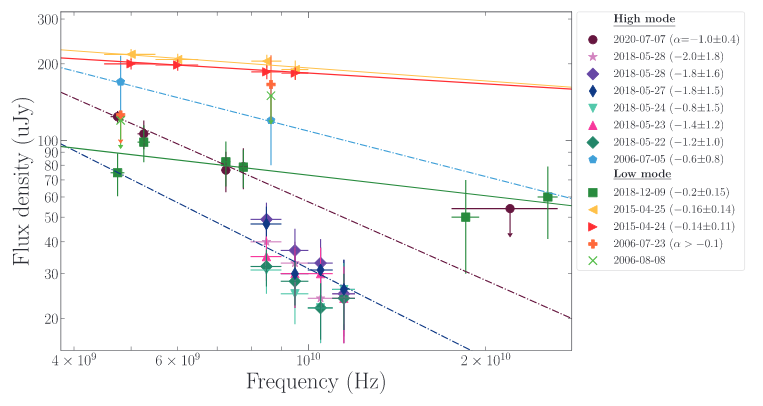
In a recent study, we investigated the coupled radio and X-ray behavior of the accreting neutron star 4U 1820-30. This is one of those few neutron stars that was thought to sustain its continuous radio jets because its radio brightness never becomes very low. What we found, however, is that the brightness at different radio frequencies does vary by a lot causing the radio energy spectrum to change strongly. In particular, we found that between X-ray “low and high modes” that differ a factor of about 10 in X-ray brightness, 4U 1820-30 is switching between sending out a steady continuous jet and ballistic ejections, represented by the two different radio spectra. Contrary to what was thought, the neutron star is thus not sustaining its steady jets, but behaving in the same way as black holes. These findings motivate similar studies of other neutron stars as well as a more detailed study of 4U 1820-30 itself to resolve the changes on shorter timescales (days or even hours) than we have done now (weeks).

Russell, Degenaar, van den Eijnden, Del Santo, Segreto, Altamirano, Beri, Diaz Trigo, Miller Jones 2020, MNRAS 508, L6: The evolving radio jet from the neutron star X-ray binary 4U 1820-30

Paper link: ADS

Radio observations of 4U1820 during its X-ray high and low modes. The figure shows that there is a clear difference in the radio spectrum between low modes (for instance the green, red and yellow data points+curves) and high modes (for instance the blue, purple and pink data points+curves). These large changes are highly surprising since the change in X-ray luminosity between the two modes is very small (a factor of 2 or so) and also the X-ray spectrum remains largely the same.

Calling all telescopes for duty

In late 2018, the Neil Gehrels Swift observatory (Swift), discovered a new bright source lighting up the X-ray sky. It was called Swift J1858.6-0814, or shortly Swift J1858, and soon realized to be an X-ray binary: a system of two stars orbiting around each other where one of the two is a black hole or a neutron star and the other a regular star. These objects shine bright in X-rays (and at other wavelengths) when the black hole or neutron star is able to pull gas from its companion towards itself. Often this happens only sporadically during episodes that we call outbursts.

About two hundred X-ray binaries are currently known in our Galaxy and many of these have been extensively studied since the dawn of X-ray astronomy in the late 1960s. Swift J1858 immediately stood out, however, by displaying extreme behavior in which the X-ray emission changed by orders of magnitude on short (hours) time scales. Only a handful of other X-ray binaries had ever been observed to display similarly volatile behavior as Swift J1858. Perhaps the most prominent one of those is the infamous black hole V404 Cygni. Based on this analogy, Swift J1858 was therefore expected to habor a black hole too.

The extreme behavior of Swift J1858 drew a lot of attention in the X-ray binary community and motivated a massive multi-wavelength campaign involving many ground-based and space-based observatories. The fleet of facilities pointing to Swift J1858 involved, for instance, ESA’s XMM-Newton satellite (X-rays), NASA’s NICER mission located on the International Space Station (X-rays), the Hubble Space Telescope (UV), the Very Large Telescope in Chile (UV/optical/infrared), the 10-m Grantecan telescope on La Palma (optical/infrared), the Very Large Array in New Mexico USA (radio) and the Atacama Telescope Compact Array in Australia (radio). All these efforts allowed for an unprecedented characterization of the binary and its extreme variability.

X-ray studies suggested that Swift J1858 was very rapidly swallowing gas from its companion, but our radio studies showed that it was also blasting a bright collimated jet into space. Moreover, our X-ray and optical studies showed that it was also blowing material into space via a disk wind. One of the most surprising discoveries was that Swift J1858 turned out to harbor a neutron star rather than a black hole. This was established by the detection of a thermonuclear explosion from the source, a so-called type-I X-ray burst, which cannot be produced by a black hole because they lack a surface. Neutron stars might be tiny, but they can truly be as violent as black holes!

Swift J1858 is now dormant, but our ambitious multi-wavelength campaign has delivered an incredibly rich data set for us to analyze and interpret. A first series of papers reporting on the findings at different wavelengths has already been published, but the analysis is ongoing. In particular, correlating all the data sets obtained at different wavelengths is expected to result in new discoveries that will help us understand how accretion and associated outflows work, and why Swift J1858 showed such extreme behavior. So there is more to come!

Paper links (ADS):

ATCA light curve of Swift J1858 showing that is was also extremely variable in the radio band. This light curve is taken from van den Eijnden et al. 2020

Crazy jet experiment

Neutron stars and black holes are notorious for their strong gravity that allows them pull gas from their surrounds. However, apart from swallowing material, these stellar cannibals also spit large amounts of it back into space via so-called jets.

Jets are streams of gas and energy that are being blown into space by an astronomical body that is accreting. X-ray binaries are a prime example of accreting systems that produce jets, but these outflows are seen in a wide variety of astronomical systems, including young forming stars, white dwarfs and supermassive black holes that lurk in the centers of galaxies. Jets play a fundamental role throughout the universe, including the birth and death of stars, the growth and evolution of galaxies, and the formation of large-scale structures (the cosmic web).

X-ray binary jets have an enormous impact on a variety of processes. Firstly, jets remove mass from an X-ray binary. This strongly affects how the accreting object and its companion star revolve around each other, moving closer on a timescale of billions of years until they eventually collide and produce a burst of gravitational waves. Secondly, jets slam into the interstellar medium; the gas that fills the space between stars in galaxies and in which new stars are born. As jets plough through the interstellar medium, the gas is stirred up, heated, and magnetized. This affects the birth rate of new stars and how the galaxy evolves over time. Despite their omnipresence and undisputed importance, however, it remains a mystery how and where jets are launched.

Owing to a Klein-XS grant from NWO, a funding scheme recently installed to support high risk/high gain research, we are going to conduct a very exciting experiment that can potentially shed new light on how jets form. Considering that change is a very powerful diagnostic in astrophysics, my co-workers and I are going to test whether jets may be temporarily destroyed and rebuild in response to thermonuclear X-ray bursts.

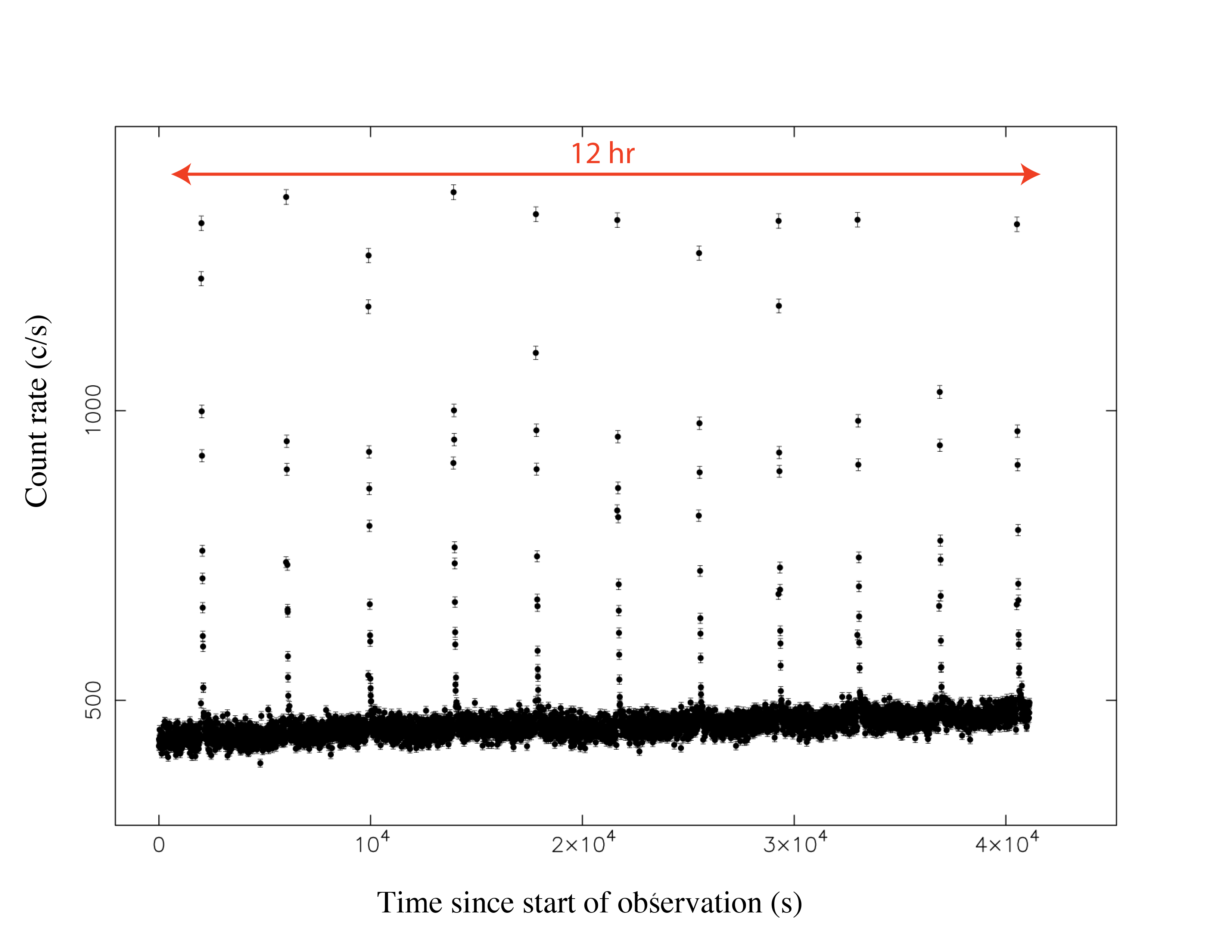
Thermonuclear X-ray bursts are brief flashes of X-ray emission that result from runaway nuclear fusion reactions in the gas that accumulates on the surface of an accreting neutron star. These explosions have a devastating power of 1032 Joule (equal to 1015 nuclear bombs!), last a few seconds and repeat every few hours. Recent calculations suggests that thermonuclear bursts can blow away the region where a jet is launched. This could cause the jet to weaken or disappear during a thermonuclear X-ray burst, and rebuild once the explosion has passed. If we can truly detect an response of the radio jet to a thermonuclear bursts, this can prove to be a completely new and powerful way to watch in real time how jets are formed.

Jets emit their energy mainly at radio wavelengths, and are best studied at frequencies of about 8 GHz with sensitive radio telescopes. With the awarded NWO grant, we will buy observing time on the Australia Telescope Compact Array (ATCA)  telescope to study the radio jets of a few neutron stars that regularly fire off thermonuclear X-ray bursts. We will perform simultaneously X-ray observations with the Integral satellite to know at what times the thermonuclear bursts are occurring. If we see any change in the radio emission at those times, this implies that the explosions can indeed affect the radio jet. Stay tuned!

News items: NWO and NOVA

rxsj1804_xmm_bursts

An X-ray observation of an accreting neutron star that shows highly repetitive thermonuclear X-ray bursts. The 11 distinct spikes of X-ray emission each represent a single thermonuclear X-ray burst. These powerful explosions can likely repeatedly destruct or weaken the radio jet.

Astrophysical pollution

The outflows, i.e. the jets and disk winds, that are produced by accreting black holes and neutron stars can potentially have a significant impact on the environment of X-ray binaries. The space in between stars and binary star systems is not empty: it’s filled with tenuous gas and dust that is referred to as the interstellar medium (ISM). Jets and disk winds can slam into this ISM, thereby stirring it and heating it. Moreover, extremely powerful thermonuclear X-ray bursts may eject material into the surroundings of the neutron star and create the same effect. These interactions can may have far-reaching consequences, perhaps influencing the formation of stars and thereby influence the evolution of the entire galaxy. However, it is not yet established if the majority of X-ray binaries truly impact their surroundings; this likely depends on the power of the outflows and the density of the ISM.

Whether or not an X-ray binary interacts with its environment may be determined by looking for shocks in the surrounding ISM. Such shocks produce ionized radiation that are characterized by strong emission lines, e.g. one produced by hydrogen gas at a wavelength of 650 nm (H-alpha emission). Some telescopes are equipped with filters that allow you to look at such a specific wavelength; by taking images with a H-alpha filter, shocked regions around X-ray binaries may be revealed. In addition, a camera with a very wide field of view is required, because the shocked regions may be lying quite far away from the X-ray binaries (and hence would be missed when looking with a camera that has a narrow field of view).

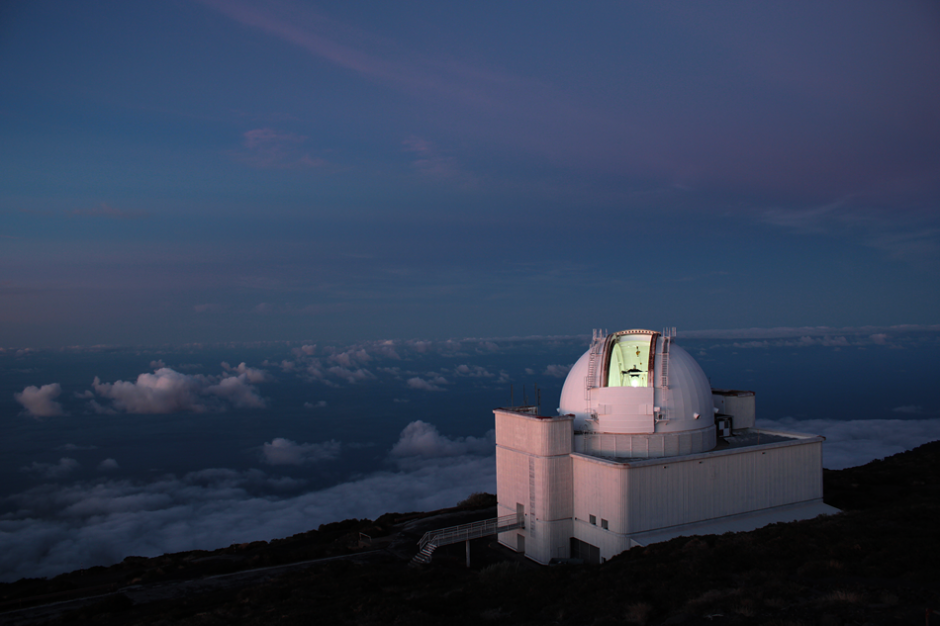
Determined to find out if X-ray binaries generally create shocks in their surroundings, we set up a very large campaign to take H-alpha images of many tens of X-ray binaries. For this purpose we are using the Wide Field Camera (WFC) mounted on the Isaac Newton Telescope that is located on La Palma, Spain. To be able to also access X-ray binaries that are located in the Southern hemisphere,  we are also using the Las Cumbres Observatory, which consists of network of telescopes located across the globe, and the Very Large Telescope located in Chile. To pull off this massive observing campaign, my group and I are joining forces with researchers from the University of Sounthampton in the United Kingdom, St Andrews University in Schotland, the Instituto de Astrofísica de Canarias in Spain, and New York University Abu Dhabi in the United Arab Emirates. Stay tuned for the results!

INT_bigger

The Isaac Newton Telescope on La Palma. Photo credit: see here

A very radio-bright neutron star

Black holes and neutron stars are notorious for swallowing gas from their surroundings. However, these extreme objects also spit large amounts of matter and energy back into space via collimated streams of gas that are called jets. These jets emit radio emission that can be detected with large radio telescopes such as the Australian Telescope Compact Array (ATCA) that is located in Australia. Black holes seem better at producing jets, since their radio emission is on average a factor ~10 brighter than that emitted by neutron stars.

In 2018 August, the X-ray telescopes orbiting the Earth detected a new X-ray source in the Sky that was named IGR J17591-2342 (after its position in the Sky and after the telescope that discovered it, ESA’s INTEGRAL mission). Within a few days after this discovery, we observed this new X-ray source with ATCA, to investigate if it was producing a jet. We detected such bright radio emission that we suggested that this object was likely a black hole. However, a pulsed X-ray signal was detected from IGR J17591-2342; such a signal requires an object with a solid surface and therefore rules out that this source contains a black hole. The detection of X-ray pulsations instead showed that IGR J17591-2342 contains a neutron star, spinning at a dazzling rate of 527 rotations per second, that is swallowing gas from a nearby companion star.

The distance to the new X-ray source IGR J17591-2342 is unknown, but its X-ray emission is strongly absorbed by interstellar gas, which would suggest that the source is relatively distant. For distances larger than 3 kpc, the radio brightness of IGR J17591-2342 is very similar to that of black holes and much brighter than that of neutron stars. It is not yet understood why this neutron star is able to produce such a bright radio jet.

Russell, Degenaar, Wijnands, van den Eijnden, Gusinskaia, Hessels, Miller-Jones 2018, ApJ Letters 869, L16: The Radio-bright Accreting Millisecond X-Ray Pulsar IGR J17591-2342

Paper link: ADS

Lx_Lr_IGRJ1759_russel2018

Radio and X-ray luminosities of a large collection of black holes (black circles) and different classes of neutron stars (grey circles, pink squares and cyan triangles). The location of IGR J17591-2342 in this diagram depends on its unknown distance and is indicated by the different coloured symbols. Unless the source is very nearby (less than 3 kpc), it is unusually radio bright for a neutron star.

A new class of jet sources

Accretion is a fundamental physical process that plays an important role at all spatial scales encountered in the universe. Whenever accretion occurs, it appears to be inevitable that jets are produced; collimated beams of matter and energy that are spit into space by the astrophysical object that is accreting. For decades, strongly magnetized neutron stars stood out as the only objects that accreted and did not seem to produce jets. This led to the paradigm that their strong magnetic fields prevent the formation of jets. Earlier this year, we made a ground-breaking discovery that disproves this.

Despite decades of jet studies of X-ray binaries, strikingly, no radio emission was ever detected from accreting neutron stars that have strong magnetic fields. For decades, it was therefore assumed that these objects do not produce radio emission because they are incapable of producing jets. Originally set out to provide more stringent upper limits on the radio emission, we exploited the upgraded sensitivity of the Very Large Array (VLA) radio telescope to perform deep radio observations of two strongly magnetic neutron stars, Her X-1 and GX 1+4. Somewhat surprisingly, we detected radio from both objects for this first time. Though very exciting, we were not able to prove that these  detections pointed to the presence of a jet, since other emission processes could produce the observed radio emission. Nevertheless, this motivated us to dig deeper into the question if strongly magnetic neutron stars could produce jets after all.

In late 2017, we were fortunate to run into an ideal test case. A previously unknown X-ray binary suddenly exhibited an accretion outburst, making it shine very bright in X-rays. When it was discovered that the accreting object in this newly discovered source, dubbed Swift J0243.6+6124, was a strongly magnetic neutron star, we requested observations with the VLA to search for radio emission from a jet. And this is exactly what we found.

Our observations of Swift J0243.6+6124 unambiguously proved that we were watching an evolving radio jet. Firstly, we clearly observed a coupling between the radio emission and the X-ray emission, as is seen in black holes and weakly magnetic neutron stars. Secondly, by performing the radio emission in multiple frequency bands, we were able to measure the radio spectral index and evolution therein, which too followed exactly the same behavior as seen for other X-ray binaries. Our observations thus disproved the long-lasting paradigm that strongly magnetic neutron stars cannot produce jets, which has far-reaching consequences.

This discovery opens up a completely new regime to study astrophysical jets. In particular is can shed new light on the open question how these outflows are launched. This is because strongly magnetic neutrons stars have a completely different accretion geometry than black holes and weakly magnetic neutron stars, because their strong magnetic field pushes the accretion disk out to hundreds of kilometers. Any jet launching model must thus be able to explain that material is accelerated into a jet from such large distances. Moreover, several models prescribe that the power of a jet should scale with the rotation rate of the accreting object. This has been very difficult to test with black holes, because their spin rates cannot be unambiguously measured, or with weakly magnetic neutron stars, because these exhibit only a very narrow range in spin rates. Neutron stars with strong magnetic fields, however, are observed with a very wide range of accurately measured rotation rates, from sub-seconds to thousands of seconds. This finally allows to test the predicted correlation between that the radio brightness and the spin rate.

Because of the important scientific impact for jet studies, our results are published in the October issue of Nature (2018). Following up on our discovery, we have already started to perform a large,  systematic radio survey of accreting strongly magnetized neutron stars. The important next steps are to test if, and how, these jets are coupled to the properties of the accretion flow, and if we can detect any dependence of the jet properties on the spin of the neutron star. Stay tuned.

van den Eijnden, Degenaar, Russell, Wijnands, Miller-Jones, Sivakoff, Hernández Santisteban 2018, Nature 562, 233: An evolving jet from a strongly magnetized accreting X-ray pulsar

Paper link: ADS
Selection of press items: NOVA and NRAO
Explanatory movie (English): youtube

lc_swj0432_short

Discovery of a radio jet launched by the strongly magnetic neutron star in Swift J0243.6+6124. Shown is the X-ray light curve from Swift/BAT in black together with our radio observations from VLA in red. After an initial non-detection in the radio, we detected the jet emission during the peak of the outburst and watched it fade in tandem with the decrease in X-rays.

Facts and myths about neutron star jets

Jets are collimated outflows of matter and energy produced by accreting astrophyical objects. Such jets are found on many different scales in the universe, ranging from young stars to supermassive black holes in the centers of galaxies. Black holes and neutron stars that accrete gas from a companion star in an X-ray binary are prominent jet producers too. In these systems, the collimated jets are most prominently detected at radio wavelengths.

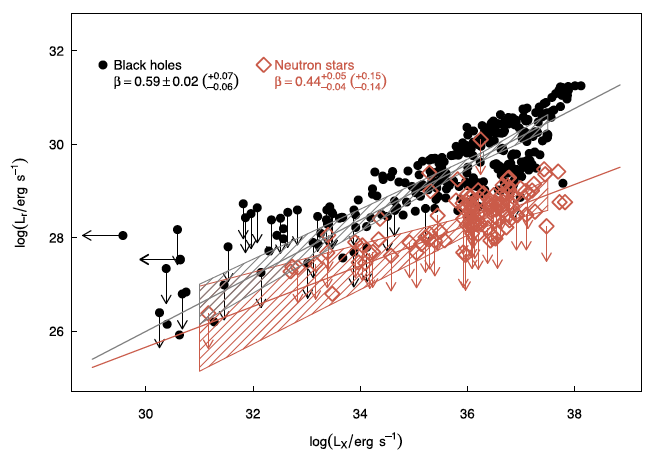
Starting in the 1970s, the radio jets of X-ray binaries have been studied in great detail. One key characteristic is that there is a very strong correlation between the radio brightness and the X-ray luminosity, which suggests a strong coupling between the inflow of matter (traced by the X-rays) and the outflow (traced by the radio emission). Early studies suggested, however, that the coupling between the X-rays and the radio emission, parametrized by the coupling index beta, is different for black holes and neutron stars. A plausible explanation for this difference could be that neutron stars have a solid surface; whereas gas that reaches a black hole can be carried across the event horizon without emitting any radiation, all energy contained by the gas will be converted into X-ray radiation when it hits the surface of a neutron star. This could translate into a different X-ray/radio correlation.

Collecting the largest sample of radio/X-ray points of X-ray binaries to date, we set out to perform a rigorous statistical analysis to investigate if the jets of neutrons stars are  fundamentally different from those of black holes. Our analysis contained a total of 35 individual black holes, and 41 neutron stars and let to several important conclusions. Several common conjectures about neutron star jets were disproved by our analysis, while others were strengthened, leading to the following facts and myths:

Facts:

Our rigorous analysis reinforces previous conjectures that the radio emission of neutron stars is fainter, by a factor ~20, than that of black holes accreting at similar X-ray luminosity. Correcting for different factors that might influence the comparison (e.g. their difference in mass, different bolometric correction factors and the extra X-ray emission of neutron stars coming from their surface) does not lift this difference. Therefore, we are left to conclude that, in general, neutron stars produce less bright radio emission than black holes accreting at similar rates.

Myths:

1) For decades, the number of neutron stars observed in the radio band was much more modest than that of black holes, partly driven by the fact (see above) that neutron stars were considerably fainter in the radio band, hence more difficult to observe. However, exploiting the current generation of upgraded radio facilities, much more neutron stars have been observed in the radio band. In fact, our study included 41 different neutron stars, compared to 35 different black holes. Neutron stars are thus no longer underrepresented in radio studies.

2) It is commonly said that neutron stars display a larger scatter in the radio/X-ray plane, i.e. display more chaotic behavior. However, in our study we found that the statistical scatter in the neutron star sample is similar to that in the black hole sample.

3) It is often assumed that neutron stars, in general, show a different (namely steeper) correlation between their radio and X-ray luminosity. However, this conjecture is largely based on a detailed study of one individual neutron star. Considering the sample as a whole, we obtained a coupling index for the neutron stars that was consistent with being the same as that of the black hole sample. It thus appears that neutron stars do not show a different radio/X-ray coupling than black holes.

Apart from comparing the neutron star and black hole samples, we also investigated if  sub-samples among the neutron stars may behave differently. Interestingly, we found that the sub-population of transitional millisecond radio pulsars, statistically behaves differently from the other neutron stars. This suggest that their jet properties are fundamentally different.

Gallo, Degenaar & van den Eijnden 2018, MNRAS Letters 478, L132: Hard state neutron star and black hole X-ray binaries in the radio:X-ray luminosity plane

Paper link: ADS

gallo2018_Lx_Lr

Radio versus X-ray luminosity of about 36 black holes (black filled circles) and 41 neutron stars (red open diamonds). The solid lines and shaded areas represent statistical fits to the correlation between the radio and X-ray luminosity. The resulting coupling index beta is quoted for both populations and is consistent with being the same within the errors.