Unknown's avatar

About degenaar

Astrophysicist (associate professor) at the University of Amsterdam

How to launch a jet

Whenever a gigantic explosion occurs in the cosmos, or an astrophysical object guzzles up matter from its surroundings, so-called jets are shot out: collimated streams of plasma that hurdle through space at speeds of hundreds of thousands to billions of kilometers per hour. As jets carry enormous energy and travel very large distances, they may significantly impact their cosmic environment, for instance enriching it with exotic chemical elements or compressing gas clouds to the extent that these start to contract to form new stars. Moreover, a jet might carry away significant amounts of energy, mass and rotation, from the object that launches it hence changing its properties and evolution.

Despite their prominent role in shaping our universe, how jets are actually produced has puzzled astronomers for over a century, ever since the first recording of an astrophysical jet in 1918. The answer to this seemingly basic question is, however, essential to fully understand the wide impact of jets. This is because the launch mechanism determines the physical properties of the jet, such as its power, speed, and composition. For neutron stars, pressing questions are whether the star’s magnetic field is involved in launching jets and to what extent their jet production mechanism resembles that of black holes.

A rather unique neutron star to study the role of the stellar magnetic field on jet production is one with the stage name The Rapid Burster (formally called MXB 1730-335). It is thought for this neutron star there is a tug-of-war between its magnetic field, pushing gas outwards, and its accretion disk through which gas flows from its companion star flows towards it. During so-called Type-II X-ray bursts, flashes of bright X-ray emission that last seconds to minutes, the magnetic field is thought to be temporarily pushed inwards, allowing a sudden strong increase in the gas supply to the neutron star. Seeing if, and how, the radio jet responds to these Type-II bursts thus provides an excellent setting to study the role of the stellar magnetic field in launching jets.

As with the thermonuclear burst / jet experiment, it was again an exciting challenge to design and execute the observing campaign to study the jet of the Rapid Burster. This is because this neutron star is dormant most of its time and only occasionally gobbles up gas from its companion star. Luckily, the Rapid Burster is a rare case where its meal times are rather regular, allowing to predict when a new episode of activity is about to occur. Making use of this, we devised a strategy that involved 4 different observatories. First, we monitored our target for signs of increased X-ray activity through the MAXI satellite, which is continuously scanning the sky in X-rays. When it detected the onset of a new accretion outburst, we started to monitor the source with the Swift satellite for accurate flux measurements and chart its X-ray bursts. As soon as Swift showed us that the Rapid Burster had become bright enough and had started showing type-II bursts, we initiated pre-arranged observations carried out simultaneously with the Very Large Array (radio) and Integral (X-rays).

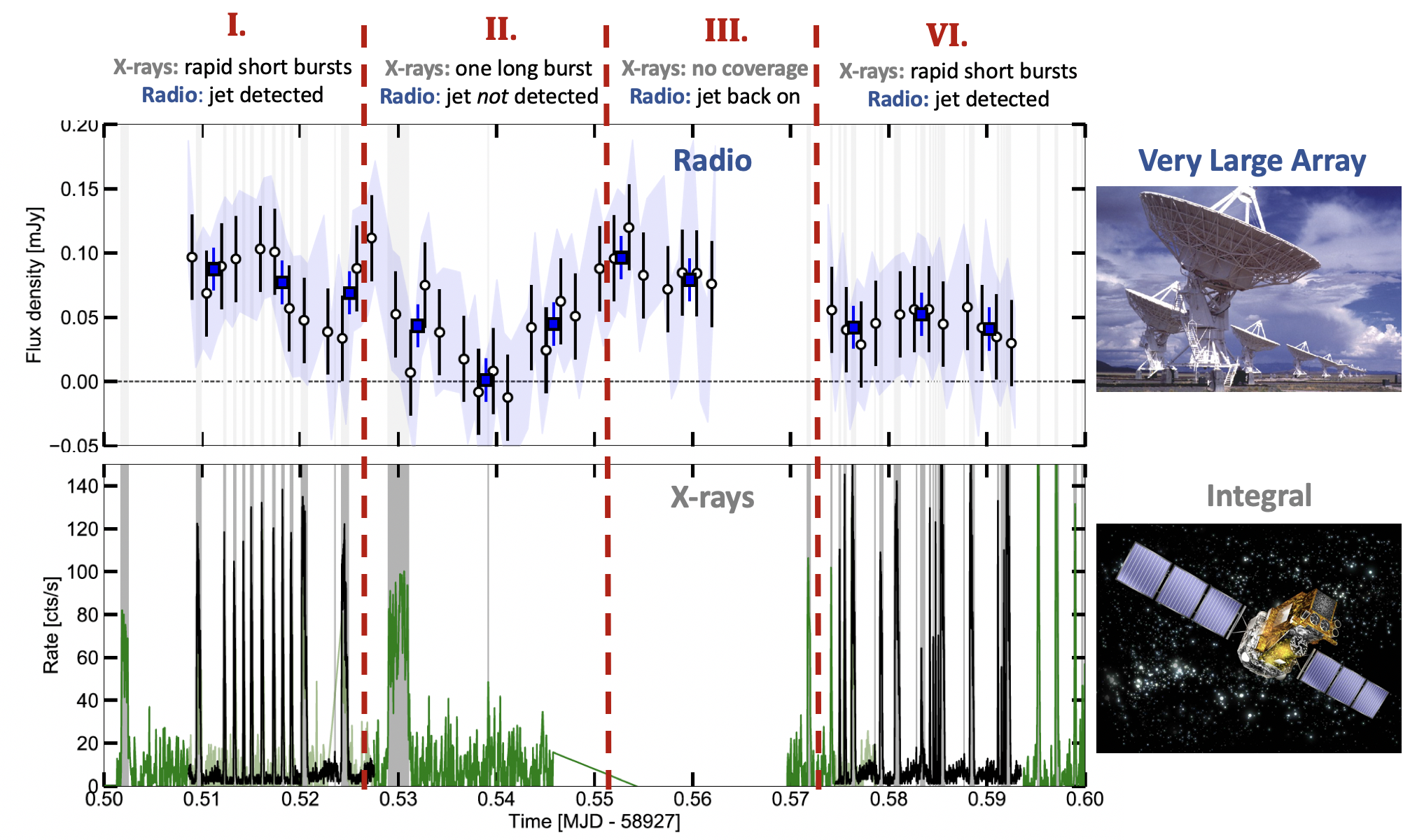
During our observing campaign, the Rapid Burster showed both short, rapidly recurring Type-II bursts, as well as a much longer one that was followed by a burst-free episode. Interestingly, we witnessed that the jet of the neutron star was solidly on when displaying the short bursts, but appeared to switch off after the longer Type-II burst. This could point towards a crucial role for the stellar magnetic field in launching jets, at least for this particular neutron star. Having conducted this successful pilot experiment, we can confirm this hypothesis by conducting a more extensive campaign to catch more longer Type-II bursts and study the associated jet response. Comparing these results a more systematic radio study of other neutron stars that do not display Type-II bursts will further allow to understand the role of the magnetic field.

van den Eijnden, Robins, Sharma, Sánchez-Fernández, Russell, Degenaar, Miller-Jones, Maccarone 2024, MNRAS 533, 756: The variable radio jet of the accreting neutron star the Rapid Burster

Paper link: ADS

Results of the simultaneous VLA radio (top) and Integral X-ray (bottom) observations of the Rapid Burster in 2020. The jet seemed to on during episodes where short successive Type-II X-ray bursts were occurring (epochs I, III and IV; top label), but switched off after a stronger/longer Type-II X-ray burst (epoch II).

A cosmic speed camera

Jets are collimated streams of gas and energy that are produced by a variety of astrophysical objects and phenomena. Jets are, for instance, produced by young forming stars, by neutron stars and black holes in X-ray binaries, and by supermassive black holes that lurk in the centers of galaxies. Moreover, jets are seen during explosive, cataclysmic phenomena such as supernova explosions, gamma-ray bursts and bursts of gravitational waves produced by the mergers of compact stars. Despite that jets are so omnipresent in the universe, it is not understood yet how jets are launched in different circumstances and how fast they travel through space.

In an attempt to break new grounds in our understanding of jets, we designed an out-of-the-box experiment to test if thermonuclear explosions that regularly occur on the surface of neutron stars could cause measurable variations in their jets. Our thought was that the radiative power of such explosions would blow away the launch region of jets, causing them to temporarily break down and rebuild thereafter. Observing that would provide unique new insight into how neutron stars produce jets. Since it was not possible to predict how large any effect would be, hence if we would be able to detect anything at all, it was not feasible to obtain observing time for this experiment through regular routes of proposing our idea to a time-allocation committee. Therefore, we used a special opportunity provided by the Dutch national research council (NWO) to apply for a small grant to fund high risk research (the NWO XS grant). With this grant we bought 80 hours of observing time on the Australian Telescope Compact Array (ATCA) radio telescope to perform our crazy jet experiment.

To complement the purchased radio observations that can detect a jet, we obtained time on the INTEGRAL satellite from the European Space Agency (ESA) to detect thermonuclear bursts. Setting up these strictly simultaneous observations was quite a challenge, but we managed to do two runs (each lasting 3 days) on two different bursting neutron stars: 4U 1728-34 and 4U 1636-536. During both runs we detected many bursts and…. we did see a clear jet response!! But it was completely opposite of what we expected: instead of seeing the jets fade (from breaking down) in response to the explosions, we observed a marked brightening of the jet. The fact that the jets persist despite of the bursts provides key information on these outflows are launched and crucial constraints for computer simulations that model the launch of jets.

Another exciting implication from our successful experiment is that the timescale of the response of the jet allowed us to measure, for the first time, the speed of the jet from a neutron star. We found that it is blasted into space at a dazzling speed of 300 million kilometers per hour (or traveling about 90 thousand kilometers in just a single second!). While neutron star jets thus have an enormous velocity, it a factor of 2-3 slower than the velocity measurements that we have for a handful of black holes. This suggest that the properties of the jet-launching object (e.g. their mass, their rotation rate or their magnetic field strength) must play a role in how jets are launched and powered. The important breakthrough of this discovery has opened up a completely new window to understand how jets are connected to the individual properties of a system, which provides us with fundamental insight into the launching of jets on all physical scales.

Never before were we able to anticipate and directly watch how a certain amount of gas got channeled into a jet and accelerated into space. Only the explosions on the surface of the neutron star could give us the clean and isolated view of this process to perform these measurements. Because of the high scientific impact, our results will be published in the journal Nature. Moreover, with the successful demonstration of the experiment it will no longer be difficult to obtain observing time through regular routes to take the same measurements for (many) other neutron stars. Lastly, the spectacular results of our crazy jet experiment demonstrate how valuable it is for science that there are opportunities to support high-risk research. Such projects may, by their very nature, often fail, but it is exciting and fun to try and can turn out to be very high gain.

Russell, Degenaar, van den Eijnden, Maccarone, Tetarenko, Sanchez-Fernandez, Miller-Jones, Kuulkers, Del Santo 2024, Nature 627, 763: Thermonuclear explosions on neutron stars reveal the speed of their jets

Paper link: Nature, ADS

Press releases: ESA, NOVA

Animation: mp4 (source ESA)

Main result of the crazy jet experiment. The top panels a-c show the X-ray light curves obtained with INTEGRAL for 3 consecutive days. The bright spikes of X-ray emission are 9 thermonuclear X-ray bursts. The bottom panels d-f show the simultaneous radio light curves obtained with the ATCA telescope at two different radio frequencies (5.5 GHz in red, 9 GHz in blue). The vertical grey lines indicate the times of the thermonuclear bursts. It is clear that shortly after each burst the radio emission is brightening as a result from extra material being pumped into the jet during a burst.

An unexpected companion

The more gas neutron stars or black holes take in, the brighter they shine in X-rays. Many are glutenous, swallowing as much as 1018 (a million trillion!) of gas per second, which makes them the brightest X-ray sources in the sky. However, more and more neutron stars and black holes are discovered to emit only dim X-ray light, implying that these are not taking in a lot of gas from their companion star. It is not clear, however, why they don’t. The two leading theories are either that these neutron stars and black holes have very small companions and are hence just not very well fed, or that they have a normal gas supply but somehow spit much of this back into space. Charting the demographics of these dim X-ray binaries important for several areas of astrophysics, including the study of gravitational waves, supernova physics and binary evolution.

Many of the neutron stars and black holes that we have found in our Galaxy are not solitary but are instead orbiting through space with another star. Owing to their relentless gravitational pull, neutron stars and black holes are able to nibble gas from their companion. This makes them light up in X-rays and therefore these star pairs are called X-ray binaries. Studying X-ray binaries is important for a variety of reasons, including understanding how binaries with neutron stars and black holes are formed and evolve, how supernova explosions work, how black holes grow, and how matter behaves when subject to extreme conditions that cannot be mimicked in laboratory experiments on Earth (e.g. extreme magnetic fields, severe radiation, ultra-high densities, super-strong gravity).

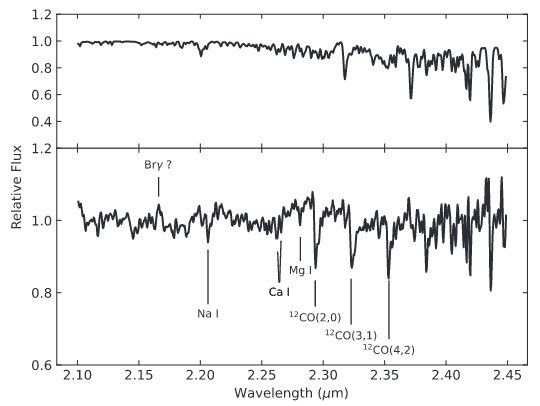
We tried to solve the riddle of dim X-ray emission for a neutron star called 1RXH J173523.7-354013. To do so, we turned to optical and near-infrared telescopes. In particular, we took a near-infrared spectrum using the Very Large Telescope (VLT) aiming to determine the type of companion star and used data from the Visible and Infrared Survey Telescope for Astronomy (VISTA) in an attempt to determine how long it takes for the two stars to orbit around each other (i.e. how wide the binary is). Expecting to find a very small (white dwarf) companion star and a very small orbital period (<1 hour), our studies instead revealed the complete opposite: a red giant star and an orbital period of about 8 days!

Since red giants can donate large amounts of gas to a neutron star or a black hole, it remains a puzzle why 1RXH J173523.7-354013 is such a dim X-ray source. We speculate that gas pulled off from the companion is accumulating in a reservoir near the companion and, as it becomes hotter and denser filling up, will at some point cross a critical threshold that allows all stored gas to suddenly stampede towards the neutron star. If our hypothesis is right, 1RXH J173523.7-354013 should one day become whoppingly bright in X-rays. Let’s see if this comes true! In mean time, we continue our quest to determine what companion stars dim X-ray binaries have, which may lead us to stumble across more of them having big companions and wide binary orbits like 1RXH J173523.7-354013. Stay tuned.

Shaw, Degenaar, Maccarone, Heinke, Wijnands, van den Eijnden 2024, MNRAS 527, 7603: The nature of very-faint X-ray binaries: near-infrared spectroscopy of 1RXH J173523.7-354013 reveals a giant companion

Paper link: ADS

Near-infrared (NIR) spectrum obtained with the SINFONI instrument on the Very Large Telescope (VLT) in Chile. Numerous lines can be seen that correspond to neutral atoms (e.g., Na I, Ca I and Mg I), as well as molecular bandheads (CO). All these are classic features seen in the NIR spectra of giant stars (of spectral type K or M), which came as a huge surprise! This is because objects like 1RXH J173523.7-354013 are generally thought to harbor very small donor stars (e.g. white dwarfs) instead.

A windy surprise

Binary star systems that contain a neutron star are important for probing fundamental theories of physics and for studying a large variety of astrophysical processes. For instance, the most energetic explosive phenomena seen in the cosmos, such as supernovae, kilonovae, gamma-ray bursts, gravitational wave mergers and fast radio bursts, often involve neutron stars in binary systems. Furthermore, they serve as an important testbed for Einstein’s General Relativity Theory, and binaries containing neutron stars are also excellent laboratories to study the behavior of cold ultra-dense matter. Finally, studying populations of binaries with neutron stars further allow us to several key processes of stellar evolution.

A particularly important phase in the life and evolution of neutron stars in binary systems is when the neutron star accretes mass from its companion star. This is when the system manifests itself as an X-ray binary. However, neutron stars do not only swallow gas, they also blow matter and energy back into space via outflows. These can be observed as highly collimated streams that are called jets and thought to be shot out with velocities of tens to hundreds of thousands of kilometers per second, or dense winds that have a larger opening angle and travel at lower speeds of a few hundreds to thousands of kilometers per second.

As in any astrophysical system where accretion takes place, outflows are ubiquitous among neutron star X-ray binaries. However, two key aspects of jets and winds are not understood yet: how these outflows are actually launched and how much mass can be lost from the binary in this way. Determining the mass loss is important, for instance, for understanding how long it will take for the neutron star to close in on its companion star and eventually collide with it, generating a burst of gravitational waves. The amount of mass contained in a wind is closely related to the mechanism that drive the wind.

Studies of X-ray binaries containing black holes have shown that disk winds are likely driven by thermal processes: X-rays produced in the inner parts of the accretion disk heat the outerparts of the disk, causing these to puff up. If the disk is large enough, the gas may at some point in the disk puff up to such an extent that it’s able to escape the gravitational pull of the black hole and flow away as a disk wind. Based on theoretical knowledge, it is expected that black hole X-ray binaries should have orbital periods of more than 8 hours to be able to have large enough disks to launch thermal winds. So far, this was consistent with observations, since disk winds have almost exclusively been detected in X-ray binaries with orbital periods exceeding 8 hours.

Analysing far-UV spectra of a very small neutron star X-ray binary called UW CrB, with the aim to understand the composition of its accretion disk, we surprisingly discovered features of a wind. Since the orbital period of this binary is only 2 hours, it should not be able to launch a thermal wind. Based on this observational discovery, we performed preliminary simulations and actually found that the X-rays emitted from the surface of the neutron star make it possible to drive a wind from smaller accretion disks than would be possible in black hole X-ray binaries (since black holes to have a surface where they can emit X-rays from). The wind in UW CrB does remain mysterious, since it was detected in only a fraction of the data that we analysed. This suggests that winds can potentially switch on and off on a time scale of hours, which was not previously known.

To establish the nature and time-variability of the wind in UW CrB, we have been granted time on several big observing facilities: the space satellites Hubble Space Telescope, XMM-Newton and Swift, as well as the optical/near-infrared Very Large Telescope (VLT, in Chile) and Grantecan (on La Palma). It was a huge challenge to figure out at what exact time all these telescopes could point to UW CrB at exactly the same time, but this ambitious and exciting observing campaign is happening in mid July. Stay tuned for the outcome!

Fijma, Castro-Segura, Degenaar, Knigge, Higginbottom, Hernandez Santisteban, Maccarone 2023, submitted to MNRAS: A transient ultraviolet outflow in the short-period X-ray binary UW CrB

Paper link: ADS

Hubble Space Telescope far-UV lightcurve (left) and a Zoom of the spectrum (right) around the Si-iv emission line (at 1402 Angstrom). The Si line in the right plot shows a P-Cygni profile, which is the hallmark of an outflowing wind. However, this wind feature was seen in only part of the observation, namely in the time interval colored red in the left plot.

A universal accretion instability

Shedding light on an old black hole mystery using… a neutron star!


Neutron stars and black holes are both remnants of massive stars that ended their lives in a supernova explosion. They also both exert very strong gravity and when they are part of a binary star system, this allows them to devour gas from their unfortunate companion star. This gas spirals towards the cannibal forming a disk that is incredibly hot, so hot that it emits X-ray radiation. As these cosmic dinner parties can be spotted as sudden eruptions of X-ray emission, these stellar binaries containing a black hole or a neutron star are called X-ray binaries. However, neutron stars and black holes are greedy and cannot swallow all gas they attract; some of it is flung into space through powerful collimated jets or dense winds.

Despite their similar behavior, there is a distinct difference between the two tribes of cannibals: whereas for neutron stars the attracted gas plunges into their solid surface or anchored magnetic field where it may create observable shocks or explosions, a black hole silently swallows the gas from view beyond its event horizon. However, it has not been established yet how this and other differences between the two types of objects, such as the higher mass and faster spin rate of black holes, affect their eating patterns. Vice versa, comparing how neutron stars and black holes take their meals in can teach us how accretion and the production of outflows fundamentally works.

In 2018, a X-ray binary called Swift J1858.6-0814 was discovered when it suddenly started consuming material from its companion star. Unlike other X-ray binaries, it did so in an incredibly violent way, showing bright sparks, called flares, visible from radio to X-ray wavelengths The origin of this “cosmic fireworks” was unknown, but since it was so extreme, the astronomical community was convinced that this was the work of a black hole. However, over a year after its discovery, Swift J1858.6-0814 suddenly ignited a thermonuclear explosion, which require the presence of a solid surface. This exposed the black hole imposter, revealing that this extreme X-ray binary, in fact, harbored a neutron star.

Because of its extreme behavior, Swift J1858.6-0814 was closely watched, using many different space-based and ground based telescopes, including NASA’s Hubble Space Telescope, ESO’s Very Large Telescope and ESA’s XMM-Newton satellite. For over a year, this suite of observing facilities was used to decipher the complex table matters of the neutron star. This led to the remarkable result that similar patters were found as seen in the notorious black hole X-ray binary GRS 1915+105, which had been standing out for decades because of its extreme behavior. Intense study suggests that the gaseous disk surrounding these compact objects must cyclically empty and fill, causing repeated spectacular ejections of matter into jets (seen at radio waves and infrared wavelengths). The discovery that both black holes and neutron stars experience this instability implies that it is a fundamental (i.e. unavoidable) process that occurs when compact objects are overfed.

Vincentelli et al. 2023, Nature 615, 45: A shared accretion instability for black holes and neutron stars

Paper link: Nature, ADS

Artist’s impression of an X-ray binary containing a black hole (left) and a neutron star (right) swallowing gas from a companion star through an accretion disk. The insets show how the intensity of the emission varies strongly as the inner disk cyclically empties and re-fills. Whereas the timescales are different for the two objects, the underlying mechanism is thought to be the same. Image credit: Gabriel Pérez Díaz (IAC).

Discovery of a hyperburst

A once-in-a-lifetime explosion inside a neutron star!

One of the many spectacular phenomena displayed by neutron stars are thermonuclear bursts. These events are observed from neutron stars that live their lives with a companion star which they steal gas from. Neutron stars can remove gas from their companion star at a startling rate of about 40 trillion kilograms per second. This gas accumulates on the surface of the neutron star, where the temperature and pressure increase as more and more matter piles up. Within hours, so much material builds up that nuclear reactions start occurring in the accumulated gas layer. This leads to the explosive ignition of the layer, causing it to burn away within seconds, somewhat like the head of a matchstick at stroke. The energy that is released in the explosion causes a bright flash of X-ray emission called a thermonuclear X-ray burst.

The most common type of thermonuclear bursts are the result of the ignition of a thin layer of hydrogen and/or helium, which are visible as flashes that last about 1 minute. Despite their short duration, an enormous amount of energy is produced in each of such bursts: about 1032 J (1039 erg). This is roughly as much as 1015 , which is one thousand trillion, nuclear bombs! Still, even more energetic bursts have been observed. The so-called superbursts are 1000x more energetic than common bursts, last for several hours and are the result of the ignition of a thick layer of carbon that was build up below the surface of the neutron star.

Recently we found evidence for the existence of yet another type of explosion from neutron stars that even diminishes the superbursts. This new kid in town, the hyperburst, is thought to be the result of the explosive burning of a deep layer of oxygen or neon, that has been steadily building up in the neutron star over hundreds or thousands of years of stealing gas from its companion. Hyperbursts would be the most energetic neutron star thermonuclear explosion known. releasing as much energy in about three minutes as the Sun releases in 800 years!

What does a hyperbursts look like? The tricky thing with hyperbursts is that they would not be directly visible as X-ray flashes, like the superbursts and common burst are detected. This is because the layer that ignites lies so deep inside the neutron star that all the energy that is released in the explosion gets absorbed by the layers above it and hence won’t escape through the stellar surface into our view.

So how did we discover a hyperburst then? Even if a hyperburst may not be directly visible, the enormous amount of energy it releases should leave its imprint on the neutron star, in particular on its outer layers that absorb the explosion. This is what we think we observed in the neutron star MAXI 0556–332. This source spend about a year feasting on its companion star in 2010-2011 and when we measured its temperature afterwards it turned out to be incredibly hot. We had taken similar measurements of 10 other neutron stars before, but MAXI 0556-332 was much more hot than any of them. Its unusually high temperature puzzled astrophysicists for many years, as it was difficult to understand why this neutron star was so different then the rest.

Over the past decade we observed MAXI 0556-332 to gradually cool down as the neutron star is radiating heat from its surface. From its cooling trajectory we can infer how much heat must have been injected into it when it was swallowing gas and also at what depth that energy must have been generated. We then realized that at this depth we to find layers of oxygen and neon and when we calculated how much energy the ignition of such a layer would generate, that turned out to match the energy that was needed to heat MAXI 0556-332 to its observed high temperature. So we indirectly observed what we coined a hyperburst.

When will we observe the next hyperburst? Igniting any type of explosion requires very high pressure and temperatures. We estimate that the temperature and pressure needed to ignite a deep layer of oxygen or neon may only be reached once in 1,000 years in any neutron star. Hyperbursts should thus be exceedingly rare and we might just never see one again. If this is indeed the case is what we hope to answer next as we launch new investigations to understand precisely under what circumstances hyperbursts can occur.

Some press coverage: New Scientist and Sci Physics

Page et al. 2022, the Astrophysical Journal 933, 216: A “Hyperburst” in the MAXI J0556-332 Neutron Star: Evidence for a New Type of Thermonuclear Explosion

Paper link: ADS

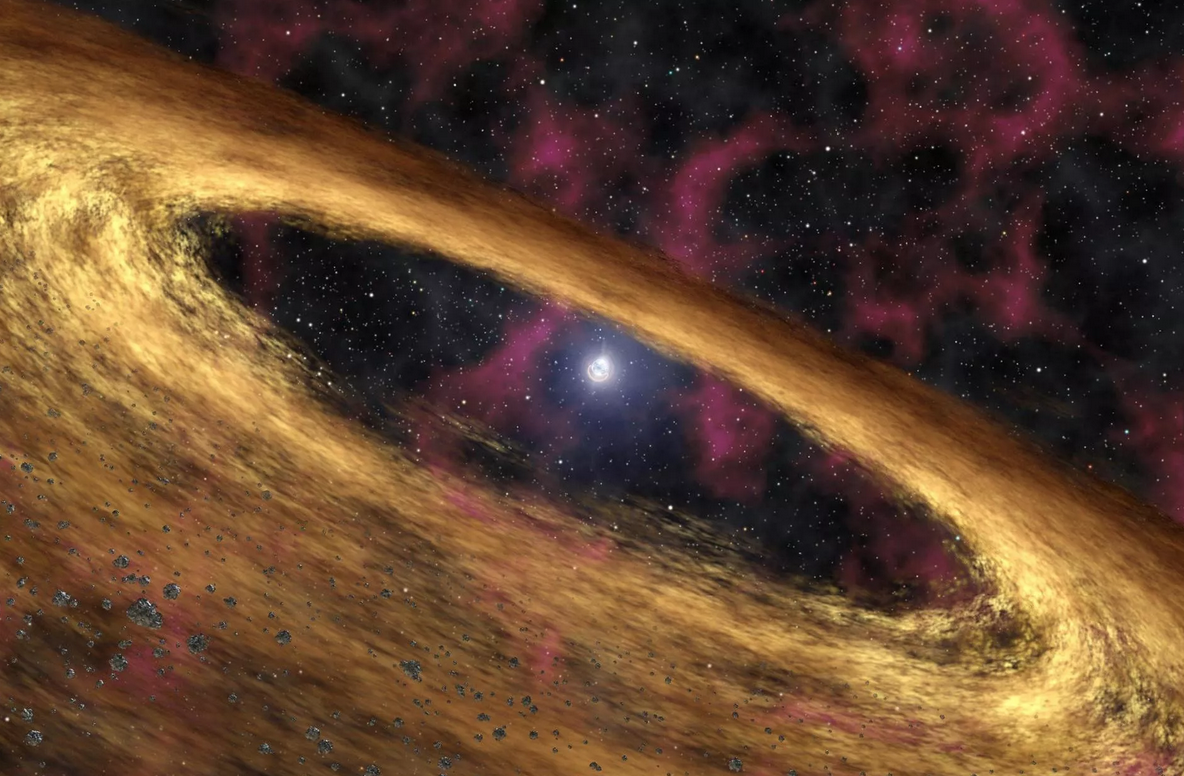
Artist’s impression of a neutron star lying in the center of a gaseous accretion disk. During quiescent episodes the disk is cold and residing far away from the neutron star, preventing it from swallowing gas from it. During such quiescent episodes, sensitive X-ray satellites can detect the thermal glow of the hot neutron star, which allows to measure its temperature.

Gone with the wind

The discovery of a persistent UV outflow from a neutron star.


X-ray binaries consist of a neutron star or a black hole that are accompanied by another star (e.g. one like our Sun, a red giant, or a white dwarf). Neutron stars and black holes are not friendly neighbors, however, and will relentlessly rip gap from their companion and swallow it. This cannibalistic process is called accretion. At the same time, some of the gas inswirling is propelled back into space through dense winds or highly collimated jets.

The most common signatures of outflowing material from astronomical objects are associated with “warm” gas. Despite this, only winds of “hot” or “cold” gas have been observed in X-ray binaries… until now! In this new study, we observed the recent accretion eruption of the X-ray binary known as Swift J1858 with a menagerie of ground-based and space-based observatories, including NASA’s Hubble Space Telescope (HST), the European Space Agency’s XMM-Newton satellite (XMM), the European Southern Observatory Organisation’s Very Large Telescope (VLT) located in Chile and the Spanish Gran Telescopio Canarias (GTC) located at La Palma (Canary Islands).

The results of our campaign, which was a joint effort of a team of researchers from 11 countries and was published in the journal Nature, showed persistent signatures of a warm wind at ultraviolet wavelengths occurring at the same time as signatures of a cold wind at optical wavelengths and hints of a hot wind at X-ray wavelengths. This is the first time that winds from an X-ray binary have been seen across different bands of the electromagnetic spectrum. This new discovery provides key information about the messy eating patterns of these cosmic cookie monsters. It allows us, for instance, to better understand how much gas is blown away in winds and by what mechanism winds are produced.

Designing the an ambitious observing campaign, built around the best telescopes on Earth and in space, was a huge challenge. This is mainly because it requires coordinating different observatories located at different parts of the Earth and space to look at your target all at the same time. So, it is incredibly exciting that all this work has paid off and allowed us to make a key discovery that would not have been possible otherwise.

Some press coverage: Independent

Castro-Segura et al. 2022, Nature 603, 52: A persistent ultraviolet outflow from an accreting neutron star binary transient

Paper link: ADS

Artist’s impression of a wind blown from the inner part of the accretion disk around a neutron star devouring gas from a companion. Image credit: Gabriel Pérez (IAC).

Meet the micronova!

A new type of cosmic explosion discovered.


Staring up at the night sky, it may appear that the endless universe is calm and serene. However, the vastness of space harbors many extreme objects like black holes, neutron stars and white dwarfs. Despite being dead stars, their extreme properties causes them to produce all kinds of violent explosions like gravitational wave mergers, supernovae, gamma-ray bursts, X-ray bursts, fast radio bursts and what not. As of 2022, we can add a new type of explosion to this menagerie: the micronova.

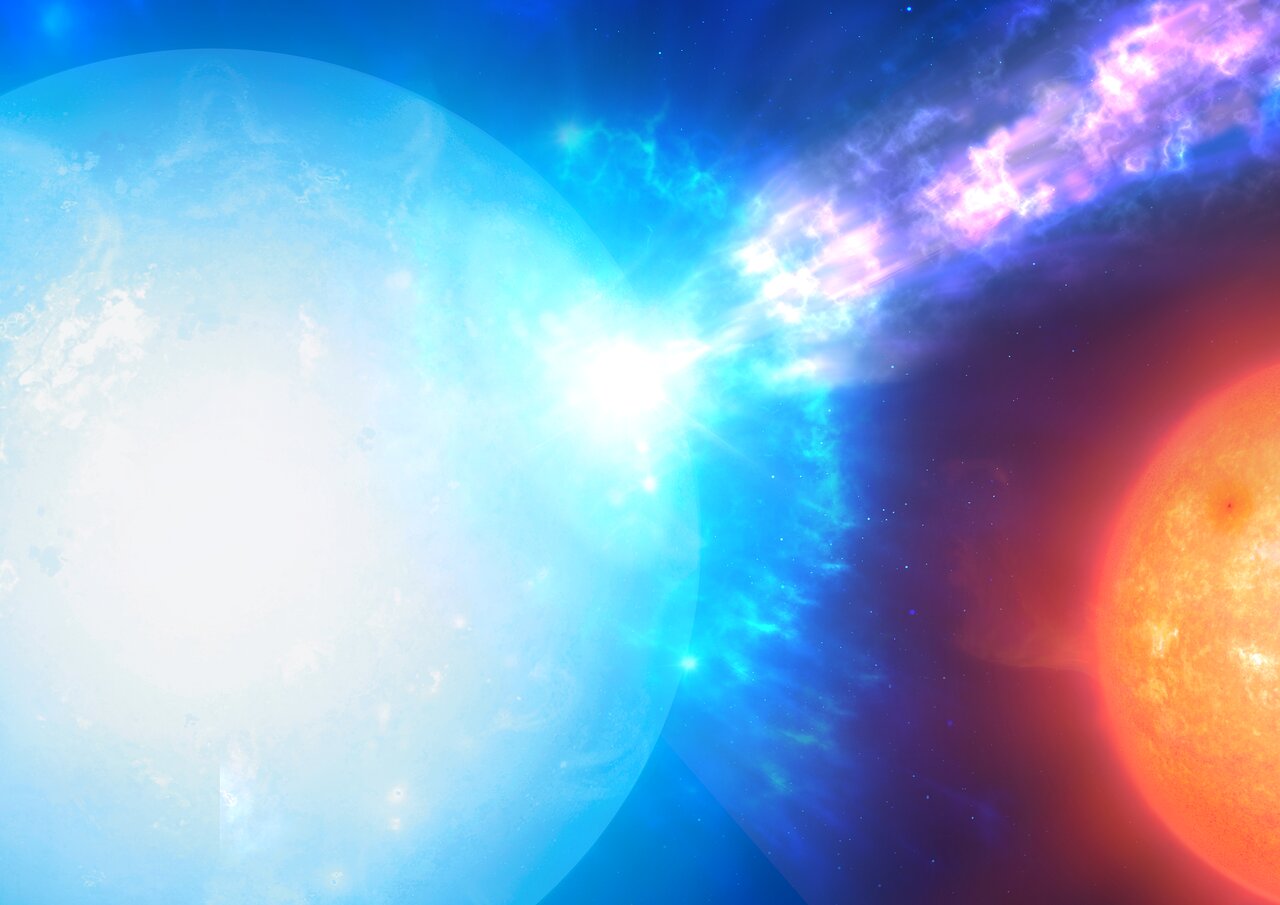
Micronova are thermonuclear explosions that occur on the surface of a white dwarf. In just a matter of hours, an amount of matter equivalent to 3.5 billion Great Pyramids of Giza is burned into flames. Despite being so magnificent, micronovae are just tiny explosions on astrophysical context. In particular, micronovae are about a million times smaller than the common nova explosions that have been known for many decades. Nova explosions occur when a white dwarf slurps gas from a nearby companion; when accumulating on the surface of the cannibal, this gas gets so enormously hot that hydrogen atoms explosively fuse together to form helium. The energy released in this process makes the entire surface of the white dwarf light up and shine bright for several weeks. This makes it easy to spot and study novae. Micronovae, however, are both shorter and less intense, which explains why they went undiscovered for so long.

The mysterious micronovae were spotted in data collected with NASA’s Transiting Exoplanet Survey Satellite (TESS), which takes highly frequent snapshots of large part of the sky. While designed to find new planets around other stars, its high-cadence optical monitoring can reveal many other interesting phenomena to the keen observer. It is in this way that a bright flash of optical light lasting for a few hours was found from a known white dwarf binary. Searching further revealed similar signals in two other systems. Their origin remained a puzzle until subsequent follow-up observations with ESO’s Very Large Telescope revealed a common denominator for the three binaries showing the hours-long optical flashes: all contained white dwarfs with magnetic fields strong enough to channel the siphoned gas onto the magnetic poles rather than it splashing over the entire surface. Putting things together and working out the energetics of the optical flashes revealed that these can be thermonuclear explosions that are confined to the magnetic poles, opposed to the well-known nova explosions that happen over the entire white dwarf surface. The smaller area involved in the explosion explains both the shorter duration and the lower energy output.

The discovery of micronovae shows for the first time that detonations apparently can happen in confined regions, which was not known before. The challenge is now to find more micronovae and to study them in detail to learn more about thermonuclear explosions on stellar cannibals.

Press release: ESO

Scaringi et al. 2022, Nature 604, 447: Localized thermonuclear bursts from accreting magnetic white dwarfs

Paper link: ADS

Artist’s impression of a localized explosion on the surface of a white dwarf that is swallowing gas from a companion star. Image credit: Mark Garlick

Volatile flickering…

…of the Milky Way’s supermassive black hole.

At the heart of our Milky Way galaxy lurks a supermassive black hole. It is called Sagittarius A*, or Sgr A* for short, and contains as much mass as 4 million Suns together. Our Milky Way is not unique in this respect: it is thought that every galaxy in our Universe harbors a supermassive black hole in its center. As they are notorious for, black holes suck up material from their surroundings, but they also blast large amounts of gas and energy into space. By doing so, the monstrous black holes in the centers of galaxies play an important role in how galaxies evolve over cosmic timescales and also how large-scale structures formed in our Universe. Studying the table manners of supermassive black holes is therefore a very active area of research.

The material that is irrevocably dragged towards a black hole lights up and provides us with a measure of how (much) the black hole is eating. Our very own supermassive black hole does not appear to have a large appetite as we see relatively little light coming from its surroundings compared to other supermassive black holes. However, roughly once a day we see a flare of (X-ray) emission coming from the position of Sgr A*. Despite that this flickering has long been known, we do not know yet what is causing it. Possibly, these are instances that the supermassive black hole is taking a gollup of material for instance a comet or some other small astrophysical object. Another possibility is that magnetic fields that must be treading the material swirling around Sgr A* are playing up.

Over the past two decades there have been many different efforts to understand the flickering behavior of Sgr A*, for instance by studying the energy of flares, to map out the distribution of flare properties, or attempting to constrain how often they occur. A challenge for the latter is that the flares are relatively sporadic. It therefore requires a lot of staring with telescopes to collect a sufficiently large number of flares to be able to draw firm conclusions on their recurrence rate. Most telescopes do not allow for such studies, either because it is technically not possible to take long stares at a single point in the sky, because their detectors do not have sufficient angular resolution to separate Sgr A* from the many nearby stars, or because the competition for telescope time is so high that long stares can usually not be granted.

The Neil Gehrels Swift observatory, shortly called Swift, is a satellited that was launched by NASA in 2005 and was specifically designed to be able to rapidly point to different positions in the sky. Because of this rapid slewing capability, it is no trouble for Swift to very frequently visit a certain position in the sky, hence effectively build up a long stare at that position. Taking advantage of this exceptional capability, Swift has been taking brief (about 20-min long) snapshots of the center of our Milky Way galaxy with its onboard X-ray telescope nearly every day since 2006. Having accumulated over 2000 X-ray pictures of Sgr A* by now, these Swift data provide a truly unique opportunity to study its flickering behavior over a 15 year baseline.

In the summer of 2019, Alexis Andes, an undergraduate student in El Salvador at the time, came to Amsterdam as part of the ASPIRE program. This program provides research opportunities for students that cannot easily study astrophysics in their home country. Alexis’ research project was to perform a statistical analysis of Swift’s X-ray data of Sgr A* to understand if its flickering behavior is constant over time. Excitingly, this turned out not to be the case! Our study revealed that there are sequences of years in which our supermassive black hole is frequently flickering but also stretches of years in which it is much more quiet. It was not known before that Sgr A* changes its behavior in this way.

Our results do not provide a conclusive answer on the cause of the flickering just jet. However, we noted that years of enhanced flickering seemed to occur after orbiting stars closely passed Sgr A*, such as the object G2 did a few years ago. Possibly, this can stir up the gas swirling around the supermassive black hole, causing it to be more restless for some period of time. While this is highly speculative at present, we can test this idea with continued Swift monitoring of Sgr A*: we predict that the flickering will become more quiet again within 1-2 years as the gas flow settles again after G2’s passage. So stay tuned!

Press release (English): NOVA

Andes, van den Eijnden, Degenaar, Evans, Chatterjee, Reynolds, Miller, Kennea, Wijnands, Markoff, Altamirano, Heinke, Bahramian, Ponti, Haggard 2022, MNRAS 510, 285: A Swift study of long-term changes in the X-ray flaring properties of Sagittarius A*

Paper link: ADS

Three-color accumulated Swift X-ray Telescope Image of the Galactic center (2006-2014).

To be or not to be superfluid

Neutron stars have masses up to about 2.5 times the mass of our Sun, but their radii are nearly 50 thousand times smaller. This means that the matter that makes up neutron stars must be squeezed incredibly close together. In fact, neutron stars present the densest observable form of matter in the Universe. While in black holes matter is even more tightly packed, it is all hidden behind an event horizon and hence beyond our reach. For neutron stars, however, we can observe radiation from their surface and use that to infer what they look like on the inside. Neutron stars allow us to study how matter behaves when it is crushed to enormously high densities, conditions that we cannot replicate and study in laboratories on Earth.

Neutron stars are thought to have a 1-km thick solid crust, below which matter occurs in liquid form. It is generally thought that this liquid must be superfluid, meaning that it swirls around freely without experiencing any friction. On Earth, such fascinating, odd behavior is observed when liquid helium is cooled down to extremely low temperatures of about -270 degrees Celsius. There are, however, many uncertainties about how a superfluid works at the millions of degrees Celsius temperatures inside neutron stars. As a result, it is far from understood what the superfluid properties of neutron stars are exactly. This is very important to establish, as it likely has a profound effect on how various neutron star properties, such as their magnetic field strength, spin and interior temperature, evolve over their lifetime. Moreover, several observable phenomena of neutron stars, such as occasional distortions in their rotation called glitches or sudden cracking of their crust analogous to Earth quakes, likely depend on the detailed properties of their interior superfluid.

Since we cannot perform experiments on Earth that teach us how superfluids inside neutron stars may work, we need to reverse the problem. One promising way to do this is to track how a neutron star cools down after it has been heated up by gobbling up gas from a companion star. We call this cannibalistic action accretion and often this happens in spurts that we call  outbursts. The superfluid properties of its interior should influence both the extend to which the neutron star can be heated during accretion outbursts, and how its temperature then subsequently decreases when accretion stops and hence there is no more heat generation. One such neutron star that we previously established to be heated and subsequently cooling down is called HETE J1900.1-2455. In a previous study we tracked its temperature decrease and our modeling suggested that the neutron star would cool further. After having waited a few years, we took a new observation of the source with the Chandra X-ray satellite to verify this.

Chandra pointed towards our neutron star for over half a day and surprisingly saw almost nothing! HETE J1900.1-2455 turned out to have cooled so much that it was hardly generating any detectable X-ray emission, even for the very sensitive X-ray detector of Chandra. In the 16 hours that Chandra started at it, a mere 5 X-ray light particles were capture from the neutron star. In order words, only every 3 hours was the Chandra detector hit by an X-ray light particle from HETE J1900.1-2455. Perhaps somewhat counter-intuitive, the fact that we detected so little light from the source actually provides us with very interesting constraints on its interior properties. Performing a rigorous and conservative analysis (based on those 5 light particles!) we inferred the likely temperature of the neutron star and performed highly advanced simulations that take into account the physical properties of neutron stars, including their interior superfluid.

Our analysis revealed that the low temperature of HETE J1900.1-2455 must imply that it is able to cool its interior extremely rapidly. Two exciting possibilities that would allow for this is either that the neutron star is very massive or that a large fraction of its core is not superfluid. The latter option would contrast the general belief and would have profound implications for our understanding of many observable properties of neutron stars. The former option would be a very important finding because the most massive neutron stars put the strongest constraints on the behavior of ultra-dense matter.  Although both options are equally exciting, our current observations do not allow us to distinguish between the two. However, because of the significant science impact, Chandra will again point towards HETE J1900.1-2455 to allow us to obtain a new temperature measurement. This time, it will not stare at the neutron star for 16 hours, but for 6 full days!! If its temperature remained stable, we will then collect 50 X-ray light particles and be able to obtain a much more reliable temperature estimate. If it cooled further, however, we might not see any light at all. Ironically, the latter case would be the most exciting outcome. Part of the data has recently been taken and the remaining observations will come in soon. I can wait to find out what we will (not) see in those new Chandra observations!

Degenaar, Page, van den Eijnden, Beznogov, Renolds, Wijnands 2021, MNRAS 508, 882: Constraining the properties of dense neutron star cores: the case of the low-mass X-ray binary HETE J1900.1-2455

Paper link: ADS

Observations (green points) and simulations (colored curves) of the temperature evolution of the neutron star in HETE J1900 during and after its 11-year long accretion outburst. Whereas we derive an ultra-low temperature of around 35 eV from our 2018 observation, the simulations predict that the neutron star may cool even further to an all-time low of about 15 eV.