A mysterious source of heat

Understanding how neutron stars look like on the inside, i.e. what their structure is and what they are made of, is one of the main challenges of modern astrophysics. There are several different ways through which we try to unravel this. One avenue is to measure how the temperature of neutron stars evolve after they have been eating.

Humans gain energy by eating and so do neutron stars. The meal of a neutron star consists of gas that is supplied by a companion star. By consuming this gas, the outer layers of a neutron star get heated up. Once they stop eating, this gained energy is  radiated away and therefore the neutron star cools down again. How hot neutron stars become during their dinners, and how quickly they cool afterwards, depends strongly on their interior properties.

We use sensitive X-ray telescopes to measure how the temperature of neutron stars evolve after they have been consuming gas from their companion. Such studies have revealed that many neutron stars are much more strongly heated during their dinners than is predicted by theoretical models. This is referred to as the shallow heating problem, because the heat appears to be generated just below the surface of the neutron star. It has puzzled us for over a decade now where this shallow heat comes from.

In a previous study, we proposed that the well-known neutron star X-1 in the constellation Aquila, aka Aql X-1, could provide the key to unravel the mysterious source of shallow heat. This neutron star feasts off its companion about once a year and its heating and cooling can thus be studied and compared after multiple dinners.

Using the Chandra and Swift satellites, we studied Aql X-1 after three meals (in 2011, 2013 and 2016) that were very similar. Since the neutron star consumed approximately the same amount of gas during these three episodes, we expected that it would have been heated to similar extend and hence cool in the same way. However, we found that the temperature of the neutron star was strikingly different after its 2016 dinner than after the other two. Within our current understanding of heating and cooling of neutron stars, it is very difficult to understand why its temperature should be so different.

Instead of unraveling the mysterious source of shallow heat, our dedicated study of Aql X-1 seems to have further complicated the picture. We thus have to go back to the drawing board to think of a new experiment to find out what causes the shallow heat inside of neutron stars.

Degenaar, Ootes, Page et al. 2019, MNRAS in press: Crust cooling of the neutron star in Aql X-1: Different depth and magnitude of shallow heating during similar accretion outbursts

Paper link: ADS

aqlx1_cool_3outbursts

The observed temperature of the neutron star in Aql X-1 after three different outbursts. Although the outbursts were very similar and we thus expected the neutron star to heat up and cool down in the same way, the temperature evolution after the 2016 outburst (black stars) was very different from that seen after the 2011 (red circles) and 2013 (blue squares) outbursts.

Don’t overfeed the neutron star

The laws of physics dictate that there is a maximum amount of food that neutron stars and black holes can digest. Once you reach the so-called Eddington limit, the radiation that is produced by the consumption of gas becomes so strong that it blows away the in-falling material. Theoretically, it is therefore predicted that if you overfeed a neutron star or a black hole, strong outflows are produced: in the regime of super-Eddington accretion, we expect both jets and winds to be created. Jets are usually detected at radio wavelengths, whereas winds often reveal themselves as narrow absorption lines in high-resolution X-ray spectra.

There are a number of neutron stars and black holes identified that are likely accreting at very high rates. Most of these are located in other galaxies, and referred to as ultra-luminous X-ray sources (ULXs), because the high rate of food consumption makes them very bright X-ray emitters. For several of these ULXs, signatures of disk winds have been detected. A few other ULXs have radio bubbles around them that suggest that these objects are producing strong jets. However, to date there is no ULX known that is known to produce both winds and jets at the same time. It therefore remains to be established if super-Eddington accretion indeed causes both types of outflows.

Swift J0243.6+6124 is an accreting neutron star that is located in our Milky Way galaxy and was discovered in late 2017 when it suddenly started to feed of its companion star. Following its discovery, the object kept brightening until after a few weeks it reached super-Eddington accretion rates. We previously detected a jet from this neutron star using the Very Large Array (VLA) radio telescope. Following this detection, and known that the source was in the super-Eddington regime, we also requested high-resolution X-ray observations with the Chandra telescope with the aim to search for the presence of a disk wind.

Detecting a disk wind in Swift J0243.6+6124 was not an easy task because it was so overwhelmingly bright that it was causing issues for all X-ray satellites: just as the NS cannot eat fast enough, our X-ray detectors couldn’t process the light received from the source fast enough. Luckily, Chandra could be operated in a very special setting that allowed us to look at the source anyway. Excitingly, the spectra that we obtained with Chandra contained a number of narrow absorption lines that can arise from a disk wind. The properties of these absorption lines suggest that the wind is blown away from the neutron star at a dazzling speed of 20% of the speed of light: a speed of about 200 million kilometers per hour! Similar wind speeds have been measured for ULXs in other galaxies.

Our Chandra and VLA observations thus revealed that indeed jets and winds are produced at the same time in the super-Eddington accretion regime, just like theory predicts.

van den Eijnden, Degenaar, Schulz et al. 2019, MNRAS 487, 4355: Chandra reveals a possible ultrafast outflow in the super-Eddington Be/X-ray binary Swift J0243.6+6124 

Paper link: ADS

Spacecraft labled new 2019

Schematic overview of the Chandra X-ray satellite, with which we performed this research. Image credit: NASA

A very radio-bright neutron star

Black holes and neutron stars are notorious for swallowing gas from their surroundings. However, these extreme objects also spit large amounts of matter and energy back into space via collimated streams of gas that are called jets. These jets emit radio emission that can be detected with large radio telescopes such as the Australian Telescope Compact Array (ATCA) that is located in Australia. Black holes seem better at producing jets, since their radio emission is on average a factor ~10 brighter than that emitted by neutron stars.

In 2018 August, the X-ray telescopes orbiting the Earth detected a new X-ray source in the Sky that was named IGR J17591-2342 (after its position in the Sky and after the telescope that discovered it, ESA’s INTEGRAL mission). Within a few days after this discovery, we observed this new X-ray source with ATCA, to investigate if it was producing a jet. We detected such bright radio emission that we suggested that this object was likely a black hole. However, a pulsed X-ray signal was detected from IGR J17591-2342; such a signal requires an object with a solid surface and therefore rules out that this source contains a black hole. The detection of X-ray pulsations instead showed that IGR J17591-2342 contains a neutron star, spinning at a dazzling rate of 527 rotations per second, that is swallowing gas from a nearby companion star.

The distance to the new X-ray source IGR J17591-2342 is unknown, but its X-ray emission is strongly absorbed by interstellar gas, which would suggest that the source is relatively distant. For distances larger than 3 kpc, the radio brightness of IGR J17591-2342 is very similar to that of black holes and much brighter than that of neutron stars. It is not yet understood why this neutron star is able to produce such a bright radio jet.

Russell, Degenaar, Wijnands, van den Eijnden, Gusinskaia, Hessels, Miller-Jones 2018, ApJ Letters 869, L16: The Radio-bright Accreting Millisecond X-Ray Pulsar IGR J17591-2342

Paper link: ADS

Lx_Lr_IGRJ1759_russel2018

Radio and X-ray luminosities of a large collection of black holes (black circles) and different classes of neutron stars (grey circles, pink squares and cyan triangles). The location of IGR J17591-2342 in this diagram depends on its unknown distance and is indicated by the different coloured symbols. Unless the source is very nearby (less than 3 kpc), it is unusually radio bright for a neutron star.

A new class of jet sources

Accretion is a fundamental physical process that plays an important role at all spatial scales encountered in the universe. Whenever accretion occurs, it appears to be inevitable that jets are produced; collimated beams of matter and energy that are spit into space by the astrophysical object that is accreting. For decades, strongly magnetized neutron stars stood out as the only objects that accreted and did not seem to produce jets. This led to the paradigm that their strong magnetic fields prevent the formation of jets. Earlier this year, we made a ground-breaking discovery that disproves this.

Despite decades of jet studies of X-ray binaries, strikingly, no radio emission was ever detected from accreting neutron stars that have strong magnetic fields. For decades, it was therefore assumed that these objects do not produce radio emission because they are incapable of producing jets. Originally set out to provide more stringent upper limits on the radio emission, we exploited the upgraded sensitivity of the Very Large Array (VLA) radio telescope to perform deep radio observations of two strongly magnetic neutron stars, Her X-1 and GX 1+4. Somewhat surprisingly, we detected radio from both objects for this first time. Though very exciting, we were not able to prove that these  detections pointed to the presence of a jet, since other emission processes could produce the observed radio emission. Nevertheless, this motivated us to dig deeper into the question if strongly magnetic neutron stars could produce jets after all.

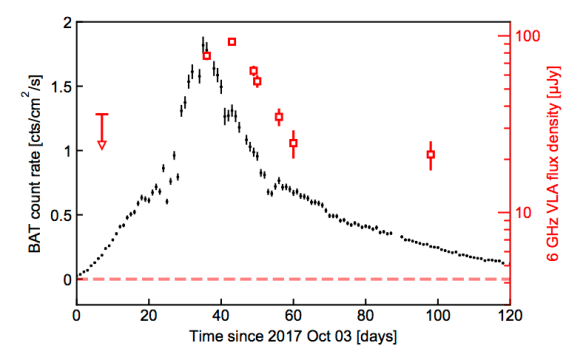
In late 2017, we were fortunate to run into an ideal test case. A previously unknown X-ray binary suddenly exhibited an accretion outburst, making it shine very bright in X-rays. When it was discovered that the accreting object in this newly discovered source, dubbed Swift J0243.6+6124, was a strongly magnetic neutron star, we requested observations with the VLA to search for radio emission from a jet. And this is exactly what we found.

Our observations of Swift J0243.6+6124 unambiguously proved that we were watching an evolving radio jet. Firstly, we clearly observed a coupling between the radio emission and the X-ray emission, as is seen in black holes and weakly magnetic neutron stars. Secondly, by performing the radio emission in multiple frequency bands, we were able to measure the radio spectral index and evolution therein, which too followed exactly the same behavior as seen for other X-ray binaries. Our observations thus disproved the long-lasting paradigm that strongly magnetic neutron stars cannot produce jets, which has far-reaching consequences.

This discovery opens up a completely new regime to study astrophysical jets. In particular is can shed new light on the open question how these outflows are launched. This is because strongly magnetic neutrons stars have a completely different accretion geometry than black holes and weakly magnetic neutron stars, because their strong magnetic field pushes the accretion disk out to hundreds of kilometers. Any jet launching model must thus be able to explain that material is accelerated into a jet from such large distances. Moreover, several models prescribe that the power of a jet should scale with the rotation rate of the accreting object. This has been very difficult to test with black holes, because their spin rates cannot be unambiguously measured, or with weakly magnetic neutron stars, because these exhibit only a very narrow range in spin rates. Neutron stars with strong magnetic fields, however, are observed with a very wide range of accurately measured rotation rates, from sub-seconds to thousands of seconds. This finally allows to test the predicted correlation between that the radio brightness and the spin rate.

Because of the important scientific impact for jet studies, our results are published in the October issue of Nature (2018). Following up on our discovery, we have already started to perform a large,  systematic radio survey of accreting strongly magnetized neutron stars. The important next steps are to test if, and how, these jets are coupled to the properties of the accretion flow, and if we can detect any dependence of the jet properties on the spin of the neutron star. Stay tuned.

van den Eijnden, Degenaar, Russell, Wijnands, Miller-Jones, Sivakoff, Hernández Santisteban 2018, Nature 562, 233: An evolving jet from a strongly magnetized accreting X-ray pulsar

Paper link: ADS
Selection of press items: NOVA and NRAO
Explanatory movie (English): youtube

lc_swj0432_short

Discovery of a radio jet launched by the strongly magnetic neutron star in Swift J0243.6+6124. Shown is the X-ray light curve from Swift/BAT in black together with our radio observations from VLA in red. After an initial non-detection in the radio, we detected the jet emission during the peak of the outburst and watched it fade in tandem with the decrease in X-rays.

Facts and myths about neutron star jets

Jets are collimated outflows of matter and energy produced by accreting astrophyical objects. Such jets are found on many different scales in the universe, ranging from young stars to supermassive black holes in the centers of galaxies. Black holes and neutron stars that accrete gas from a companion star in an X-ray binary are prominent jet producers too. In these systems, the collimated jets are most prominently detected at radio wavelengths.

Starting in the 1970s, the radio jets of X-ray binaries have been studied in great detail. One key characteristic is that there is a very strong correlation between the radio brightness and the X-ray luminosity, which suggests a strong coupling between the inflow of matter (traced by the X-rays) and the outflow (traced by the radio emission). Early studies suggested, however, that the coupling between the X-rays and the radio emission, parametrized by the coupling index beta, is different for black holes and neutron stars. A plausible explanation for this difference could be that neutron stars have a solid surface; whereas gas that reaches a black hole can be carried across the event horizon without emitting any radiation, all energy contained by the gas will be converted into X-ray radiation when it hits the surface of a neutron star. This could translate into a different X-ray/radio correlation.

Collecting the largest sample of radio/X-ray points of X-ray binaries to date, we set out to perform a rigorous statistical analysis to investigate if the jets of neutrons stars are  fundamentally different from those of black holes. Our analysis contained a total of 35 individual black holes, and 41 neutron stars and let to several important conclusions. Several common conjectures about neutron star jets were disproved by our analysis, while others were strengthened, leading to the following facts and myths:

Facts:

Our rigorous analysis reinforces previous conjectures that the radio emission of neutron stars is fainter, by a factor ~20, than that of black holes accreting at similar X-ray luminosity. Correcting for different factors that might influence the comparison (e.g. their difference in mass, different bolometric correction factors and the extra X-ray emission of neutron stars coming from their surface) does not lift this difference. Therefore, we are left to conclude that, in general, neutron stars produce less bright radio emission than black holes accreting at similar rates.

Myths:

1) For decades, the number of neutron stars observed in the radio band was much more modest than that of black holes, partly driven by the fact (see above) that neutron stars were considerably fainter in the radio band, hence more difficult to observe. However, exploiting the current generation of upgraded radio facilities, much more neutron stars have been observed in the radio band. In fact, our study included 41 different neutron stars, compared to 35 different black holes. Neutron stars are thus no longer underrepresented in radio studies.

2) It is commonly said that neutron stars display a larger scatter in the radio/X-ray plane, i.e. display more chaotic behavior. However, in our study we found that the statistical scatter in the neutron star sample is similar to that in the black hole sample.

3) It is often assumed that neutron stars, in general, show a different (namely steeper) correlation between their radio and X-ray luminosity. However, this conjecture is largely based on a detailed study of one individual neutron star. Considering the sample as a whole, we obtained a coupling index for the neutron stars that was consistent with being the same as that of the black hole sample. It thus appears that neutron stars do not show a different radio/X-ray coupling than black holes.

Apart from comparing the neutron star and black hole samples, we also investigated if  sub-samples among the neutron stars may behave differently. Interestingly, we found that the sub-population of transitional millisecond radio pulsars, statistically behaves differently from the other neutron stars. This suggest that their jet properties are fundamentally different.

Gallo, Degenaar & van den Eijnden 2018, MNRAS Letters 478, L132: Hard state neutron star and black hole X-ray binaries in the radio:X-ray luminosity plane

Paper link: ADS

gallo2018_Lx_Lr

Radio versus X-ray luminosity of about 36 black holes (black filled circles) and 41 neutron stars (red open diamonds). The solid lines and shaded areas represent statistical fits to the correlation between the radio and X-ray luminosity. The resulting coupling index beta is quoted for both populations and is consistent with being the same within the errors.

What do neutron stars look like inside?

Everything around us is constructed of atoms, which themselves consist of electrons and nucleons (i.e. protons and neutrons). This familiar structure of matter is, however, disrupted when matter is compressed to very high densities that reach beyond the density of an atom, called the nuclear density. It is one of the prime pursuits of modern physics to understand what happens to matter beyond this point. It is not possible to generate supra-nuclear densities in terrestrial laboratories on Earth. However, neutron stars are extreme objects in which matter is compressed to enormously high densities. These stellar bodies therefore serve as exciting, natural laboratories to further our understanding of the fundamental behavior of matter.

Neutron stars are the remnants of once massive stars that ended their life in a supernova explosion. A defining property of neutron stars is that these objects are very compact; while being roughly a factor of 1.5 more massive than our Sun, their radius is almost 100.000 times smaller. Due to their extreme compactness, neutron stars are the densest, directly observable stellar objects in our universe. These fascinating objects come in a wide range of manifestations, e.g. as single stars or as part of a binary, and can be detected at different wavelengths.

Unfortunately it is not possible to travel to a neutron star to conduct experiments of how their interiors look like. However, the macroscopic properties of neutron stars, such as their mass, radius and rotation rate, provide indirect yet powerful information about their interiors. The electromagnetic radiation coming directly from the surface of neutron stars, or from matter that revolves around them, can be used to measure these macroscopic properties. These observational constraints can then be used to infer for instance how high their central density is, what kind of particles are present, and what the superfluid properties of their interior are.

We recently reviewed how different types of electromagnetic observations can be employed to learn more about the interior of neutron stars. This included commonly used techniques of combining radio pulsar timing with optical spectroscopic studies to measure neutron star masses, as well as various techniques to measure neutron star radii from X-ray data. In addition, we touched upon various techniques that have not yielded strong constraints to date, but have great potential to be further developed in the future and can be particularly interesting when combined with other methods. Finally, we provided an outlook of the potential for neutron star research of the future generation of ground-based  observatories such as the Square Kilometer Array and the new class of 30-m telescopes, as well as new and upcoming X-ray facilities such as NICER, eXTP, Athena and X-ray polarimetry missions.

Degenaar & Suleimanov 2018, book chapter in The Physics and Astrophysics of Neutron Stars, Springer Astrophysics and Space Science Library: Testing the equation of state of neutron stars with electromagnetic observations

Paper link: ADS

SKA

Artist impression of the Square Kilometer Array (SKA), which is currently in the design phase. This radio facility is expected to be transformable in many areas of science, including measuring the masses (and spins) of neutron stars.

A new regime to study jets?


Accretion is an important physical process in which an astronomical body gravitationally attracts material from its surroundings. This leads to growth and to the release of gravitational energy. We encounter accretion throughout the universe, on many different scales and in widely varying environments. For instance, stars and planets are formed through accretion, and the accretion behavior of a super-massive black hole determines how its host galaxy evolves over time.

Regardless of the nature of the object that is accreting (e.g. star, black hole), or the environment in which accretion occurs, it seems inevitable that part of the attracted material is spit back into space. This occurs to powerful collimated streams called jets. Despite being ubiquitous, exactly how jets are formed and being powered remains a mystery. To understand this, it is key to study jets in different types of accreting systems. This is one of the prime pursuits of modern astrophysics.

Strikingly, the only accreting systems for which jets had never been detected were neutron stars with strong magnetic fields (over a trillion times – a one with twelve zero’s that is – more powerful than the Earth’s magnetic field). This led to the long-standing paradigm that the presence of very strong magnetic field prevent jets from being formed.

Jets from accreting black holes and neutron stars with low magnetic fields (only a billion times the strength of the Earth’s magnetic field, i.e. a one with only nine zero’s) are most commonly detected at radio wavelengths. Despite various searches, radio emission had never been detected from accreting neutron stars with strong magnetic fields. Luckily, the Very Large Array (VLA) radio facility in New Mexico underwent major technical upgrades in recent years that greatly improved its sensitivity. We therefore decided to revisit if strong magnetic field neutron stars truly do not produce radio jets.

Somewhat to our surprise, Jakob made the startling discovery that the two strong-magnetic field neutron stars that we observed with the VLA, the well-studied sources GX 1+4 and Her X-1, were both detected in the radio band (at 8 GHz). While for GX 1+4 the radio properties allow for a different origin than a jet (e.g. shocks in the magnetosphere of the neutron star), the radio properties of Her X-1 more strongly suggest a jet origin. If confirmed, it would show that high-magnetic field neutron stars can launch jets after all. These findings would have important implications for understanding jet formation in general.

Press release

van den Eijnden, Degenaar, Russell, Miller-Jones, Wijnands, Miller, King, Rupen 2018, MNRAS Letters 473, L141: Radio emission from the X-ray pulsar Her X-1: a jet launched by a strong magnetic field neutron star?

Paper link Her X-1: ADS

van den Eijnden, Degenaar, Russell, Miller-Jones, Wijnands, Miller, King, Rupen 2018, MNRAS Letters 474, L91: Discovery of radio emission from the symbiotic X-ray binary system GX 1+4

Paper link GX 1+4: ADS


jakob_radio_gx14

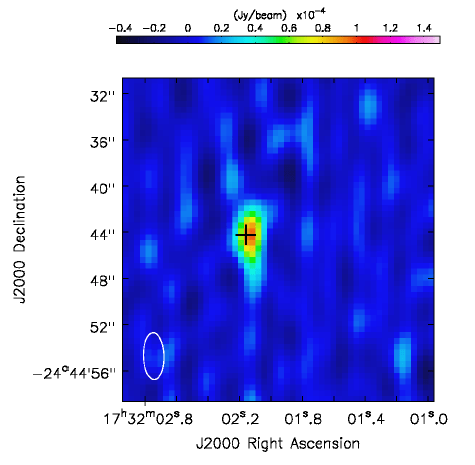
VLA radio image (9 GHz) of GX 1+4. The cross indicates the position of this high-magnetic neutron star. The color scaling indicates the radio brightness. GX 1+4 is clearly detected.

The devastating impact of X-ray bursts

When plasma falls onto a neutron star it undergoes thermo-nuclear reactions that can cause an extremely energetic explosion called an X-ray burst. Such explosions are extremely common: tens of thousands of X-ray bursts have been recorded to date with different X-ray detectors and on some neutron stars the explosions repeat every few hours.

X-ray bursts occur on neutron stars that are surrounded by a gaseous disk in which material that is pulled off the companion star spirals at increasing speed until it finally plunges into the neutron star. Apart from this accretion disk, a neutron star is also surrounded by a hot plasma, called a corona. The formation and properties of accretion disks are much better understood than that of the corona.

It has long been appreciated that the properties of the accretion flow (i.e. the accretion disk and the corona) affect the observable properties of X-ray bursts such as their peak brightness, duration, recurrence rate and variability properties. However, in recent years evidence for the reverse interaction have been accumulating too: the devastating power of X-rays bursts can destruct the accretion disk and corona that surround the neutron star. Shortly after the surge of energy from the X-ray burst is over, the disk and corona should return to their original status.

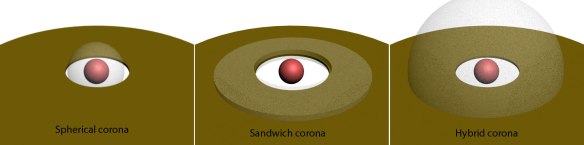
Change is always a very powerful diagnostic in astronomy. The destruction and re-formation of accretion disks and coronae in response to an X-ray burst can therefore reveal intriguing new insight in the properties of accretion flows. Given that X-ray bursts are very common, they can thus serve as a powerful, repeating probe to study the poorly known properties of coronae (such as their geometry) and how an accretion disk responds to a sudden shower of intense radiation.

We recently reviewed all the observational evidence for X-ray bursts interacting with the accretion flow. Based on our current understanding of these interactions, we looked ahead and studied how new and concept X-ray missions such as ASTROSAT (launched in 2015), NICER and HXMT (both launched in 2017), eXTP and STROBE-X (mission concepts currently under study) can further this research field. We also proposed various multi-wavelength strategies can be leveraged to learn more about accretion flows using X-ray bursts.

Degenaar, Ballantyne, Belloni et al. 2018, Space Science Reviews 214, 15: Accretion Disks and Coronae in the X-Ray Flashlight

Paper link: ADS

corona

Schematic overview of three different possible geometries for the corona in an X-ray binary. The neutron star is indicated as the red ball, the accretion disk as the brown surface, and the corona as the grey structure.

New clues to an old mystery?

MXB 1730-335, also known as “the rapid burster”, is a neutron star that is located in the Galactic globular cluster Liller 1 and swallows gas from a companion star. It is infamous for displaying a peculiar phenomena called type-II X-ray bursts. These brief, bright flashes of X-ray emission are likely caused by a short-lived increase in the amount of gas that falls onto the neutron star, but over 40 years after the discovery the exact nature of these tantalizing X-ray flashes remains unknown. One of the puzzles is that there are only two neutron stars in our entire Galaxy that exhibit these flashes; the other is “the bursting pulsar” GRO J1744-28.

The rapid burster exhibits accretion outbursts that lasts a few weeks and recur about every 100 days. It so happened that in 2015 October an outburst was anticipated at a time that both NuSTAR and XMM-Newton could observe the object. This provided the unique opportunity to leverage the strengths of both instruments — high sensitivity at soft photon energies (0.3-3 keV) for XMM-Newton and high sensitivity to reflection features for NuSTAR — to study this peculiar neutron star. To this end, rapid-burster expert and former Amsterdam/SRON PhD student Tullio Bagnoli designed a novel observing campaign with Swift to catch a new outburst and trigger observations with NuSTAR and XMM-Newton accordingly. Jakob analyzed these data and may have found new clues to the old, unsolved mystery of the origin of type-II X-ray bursts.

Accretion disks normally extend close to the surface of the neutron star. However, analysis of reflected X-ray light in the rapid burster reveals that the inner accretion disk is strongly truncated; it lies about a factor of 5 further away from the neutron star than is typically seen in other objects. A plausible explanation for this finding is that the rapid burster has magnetic field strong enough to prevent the accretion disk from coming closer to the neutron star. Since we obtained a similar result for GRO J1744-28, this could indicate that the type-II phenomenon is related to the magnetic field of the neutron stars.

van den Eijnden, Bagnoli, Degenaar et al. 2017, MNRAS Letters 466, L98: A strongly truncated inner accretion disc in the Rapid Burster

Paper link: ADS
Press release: ESA
Dutch news article: astronomie.nl

liller1_gems_gemini

Near-infrared (J,K) images of the Galactic globular cluster Liller 1 obtained with the GeMS camera mounted on the 8-m Gemini telescope in Chile. The inset shows a zoom of the core of the cluster, spanning 1.9 light year across. Image credit: F.R. Ferraro/E. Dalessandro (Cosmic-Lab / University of Bologna, Italy)

A very cool neutron star

HETE J1900.1-2455 is a neutron star that swallows material from a small companion star that a mass of only about 10% of our Sun. It was discovered in 2006 with NASA’s Rossi X-ray Timing Explorer and exhibits some exceptional properties.

Firstly, HETE J1900.1-2455 showed pulses of X-rays every 2.65 millisecond. This shows that the magnetic field of the neutron star is channeling plasma to its magnetic poles which are then heated and lighting up in X-rays. As the neutron star rotates around its own axis a dazzling 377 times per second, this bundle of X-rays sweeps across our line of sight like a light house. Approximately 10% of all neutron stars with low-mass companions show such X-ray pulsations. Secondly, unlike most neutron stars that are eating for only a few weeks at a time, HETE J1900.1-2455 continued to be active for over a decade. Until 2015…

In 2015 November, HETE J1900.1-2455 suddenly dropped off the radar of the Japanese X-ray detector MAXI, which is mounted on the International Space Station and continuously scans the X-ray sky. The sudden drop of X-ray emission indicated that this neutron star had finally stopped eating. To test this, we observed this neutron star with two X-ray satellites that are more sensitive than MAXI and can thus detected much fainter X-ray light, Chandra and Swift. Our observations were carried out a few months after it had disappeared from the daily MAXI scans.

We found that the neutron star had indeed peacefully gone back to sleep. The X-rays observed during quiescent episodes are usually due to heat that radiated by the neutron star. Somewhat surprisingly, we found that HETE J1900.1-2455 was much colder, about 600 000 degrees Celsius, than we typically see for neutron stars after they have been active for many years (>1 million degrees Celsius). The reason that neutron stars are so hot after long meals is because consuming gas generates energy that heats their interior.

The fact that our temperature measurement of HETE J1900.1-2455 was so low, despite 10 years of activity, places exciting constraints on its interior properties. In particular, it requires that the central, liquid part of the neutron star is strongly superfluid. A superfluid is very peculiar liquid that has zero viscosity and freely moves without experiencing any friction. In laboratory experiments on Earth, liquid helium can be made superfluid when it is cooled down to nearly zero temperature. It is quite amazing that in neutron stars superfluidity can be achieved at temperatures of nearly a million degrees Celsius.

The constraints on the intriguing interior properties of HETE J1900.1-2455 will become even stronger if the neutron star cools further down now that it has stopped eating. We therefore plan further temperature measurements of this neutron star in the future.

Degenaar, Ootes, Renolds, Wijnands, Page 2017, MNRAS Letters 465, L10: A cold neutron star in the transient low-mass X-ray binary HETE J1900.1-2455 after 10 yr of active accretion

Paper link: ADS

neutron_star_e

Schematic representation of the structure of a neutron star.