Meet the micronova!

A new type of cosmic explosion discovered.


Staring up at the night sky, it may appear that the endless universe is calm and serene. However, the vastness of space harbors many extreme objects like black holes, neutron stars and white dwarfs. Despite being dead stars, their extreme properties causes them to produce all kinds of violent explosions like gravitational wave mergers, supernovae, gamma-ray bursts, X-ray bursts, fast radio bursts and what not. As of 2022, we can add a new type of explosion to this menagerie: the micronova.

Micronova are thermonuclear explosions that occur on the surface of a white dwarf. In just a matter of hours, an amount of matter equivalent to 3.5 billion Great Pyramids of Giza is burned into flames. Despite being so magnificent, micronovae are just tiny explosions on astrophysical context. In particular, micronovae are about a million times smaller than the common nova explosions that have been known for many decades. Nova explosions occur when a white dwarf slurps gas from a nearby companion; when accumulating on the surface of the cannibal, this gas gets so enormously hot that hydrogen atoms explosively fuse together to form helium. The energy released in this process makes the entire surface of the white dwarf light up and shine bright for several weeks. This makes it easy to spot and study novae. Micronovae, however, are both shorter and less intense, which explains why they went undiscovered for so long.

The mysterious micronovae were spotted in data collected with NASA’s Transiting Exoplanet Survey Satellite (TESS), which takes highly frequent snapshots of large part of the sky. While designed to find new planets around other stars, its high-cadence optical monitoring can reveal many other interesting phenomena to the keen observer. It is in this way that a bright flash of optical light lasting for a few hours was found from a known white dwarf binary. Searching further revealed similar signals in two other systems. Their origin remained a puzzle until subsequent follow-up observations with ESO’s Very Large Telescope revealed a common denominator for the three binaries showing the hours-long optical flashes: all contained white dwarfs with magnetic fields strong enough to channel the siphoned gas onto the magnetic poles rather than it splashing over the entire surface. Putting things together and working out the energetics of the optical flashes revealed that these can be thermonuclear explosions that are confined to the magnetic poles, opposed to the well-known nova explosions that happen over the entire white dwarf surface. The smaller area involved in the explosion explains both the shorter duration and the lower energy output.

The discovery of micronovae shows for the first time that detonations apparently can happen in confined regions, which was not known before. The challenge is now to find more micronovae and to study them in detail to learn more about thermonuclear explosions on stellar cannibals.

Press release: ESO

Scaringi et al. 2022, Nature 604, 447: Localized thermonuclear bursts from accreting magnetic white dwarfs

Paper link: ADS
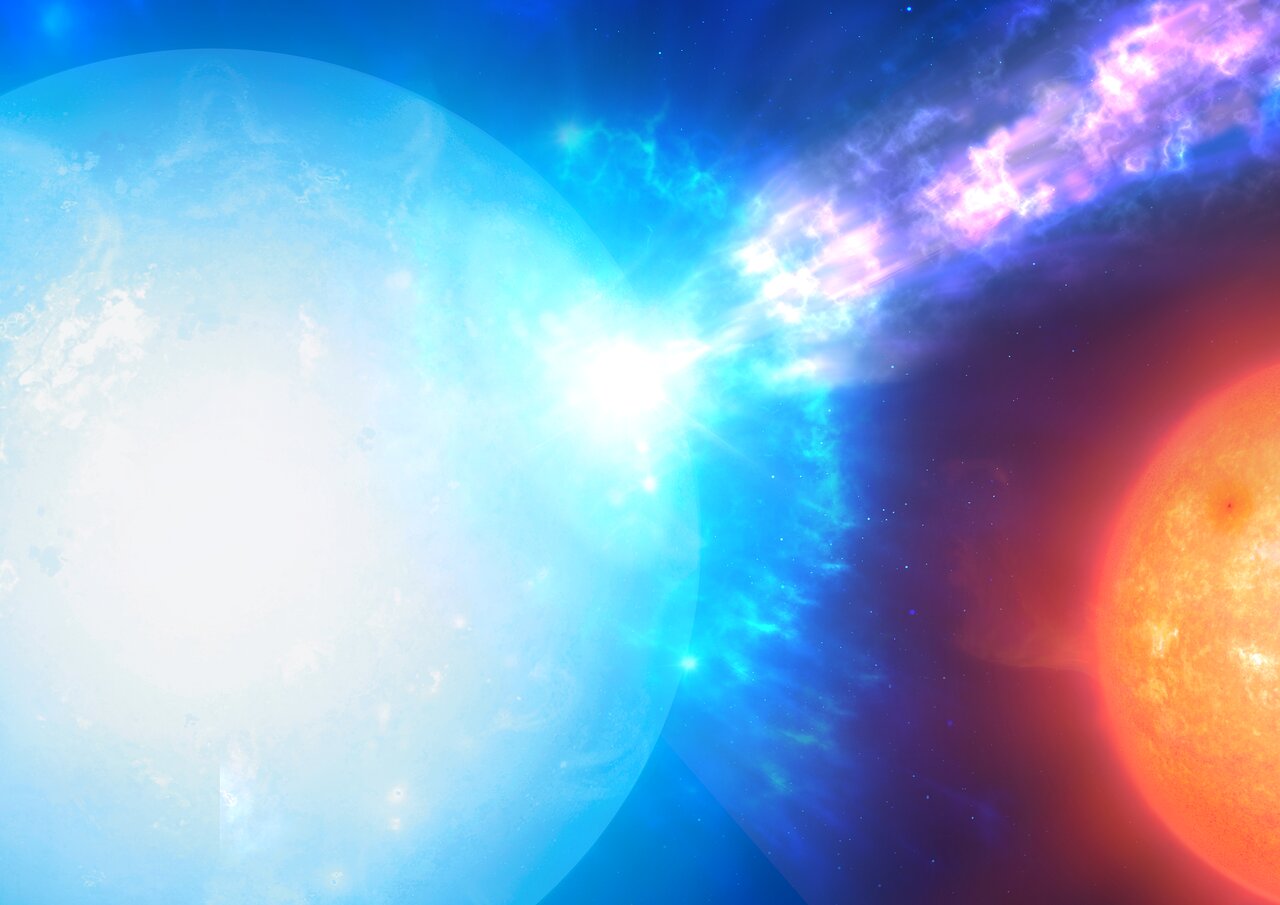
Artist’s impression of a localized explosion on the surface of a white dwarf that is swallowing gas from a companion star. Image credit: Mark Garlick

Crazy jet experiment

Neutron stars and black holes are notorious for their strong gravity that allows them pull gas from their surrounds. However, apart from swallowing material, these stellar cannibals also spit large amounts of it back into space via so-called jets.

Jets are streams of gas and energy that are being blown into space by an astronomical body that is accreting. X-ray binaries are a prime example of accreting systems that produce jets, but these outflows are seen in a wide variety of astronomical systems, including young forming stars, white dwarfs and supermassive black holes that lurk in the centers of galaxies. Jets play a fundamental role throughout the universe, including the birth and death of stars, the growth and evolution of galaxies, and the formation of large-scale structures (the cosmic web).

X-ray binary jets have an enormous impact on a variety of processes. Firstly, jets remove mass from an X-ray binary. This strongly affects how the accreting object and its companion star revolve around each other, moving closer on a timescale of billions of years until they eventually collide and produce a burst of gravitational waves. Secondly, jets slam into the interstellar medium; the gas that fills the space between stars in galaxies and in which new stars are born. As jets plough through the interstellar medium, the gas is stirred up, heated, and magnetized. This affects the birth rate of new stars and how the galaxy evolves over time. Despite their omnipresence and undisputed importance, however, it remains a mystery how and where jets are launched.

Owing to a Klein-XS grant from NWO, a funding scheme recently installed to support high risk/high gain research, we are going to conduct a very exciting experiment that can potentially shed new light on how jets form. Considering that change is a very powerful diagnostic in astrophysics, my co-workers and I are going to test whether jets may be temporarily destroyed and rebuild in response to thermonuclear X-ray bursts.

Thermonuclear X-ray bursts are brief flashes of X-ray emission that result from runaway nuclear fusion reactions in the gas that accumulates on the surface of an accreting neutron star. These explosions have a devastating power of 1032 Joule (equal to 1015 nuclear bombs!), last a few seconds and repeat every few hours. Recent calculations suggests that thermonuclear bursts can blow away the region where a jet is launched. This could cause the jet to weaken or disappear during a thermonuclear X-ray burst, and rebuild once the explosion has passed. If we can truly detect an response of the radio jet to a thermonuclear bursts, this can prove to be a completely new and powerful way to watch in real time how jets are formed.

Jets emit their energy mainly at radio wavelengths, and are best studied at frequencies of about 8 GHz with sensitive radio telescopes. With the awarded NWO grant, we will buy observing time on the Australia Telescope Compact Array (ATCA)  telescope to study the radio jets of a few neutron stars that regularly fire off thermonuclear X-ray bursts. We will perform simultaneously X-ray observations with the Integral satellite to know at what times the thermonuclear bursts are occurring. If we see any change in the radio emission at those times, this implies that the explosions can indeed affect the radio jet. Stay tuned!

News items: NWO and NOVA

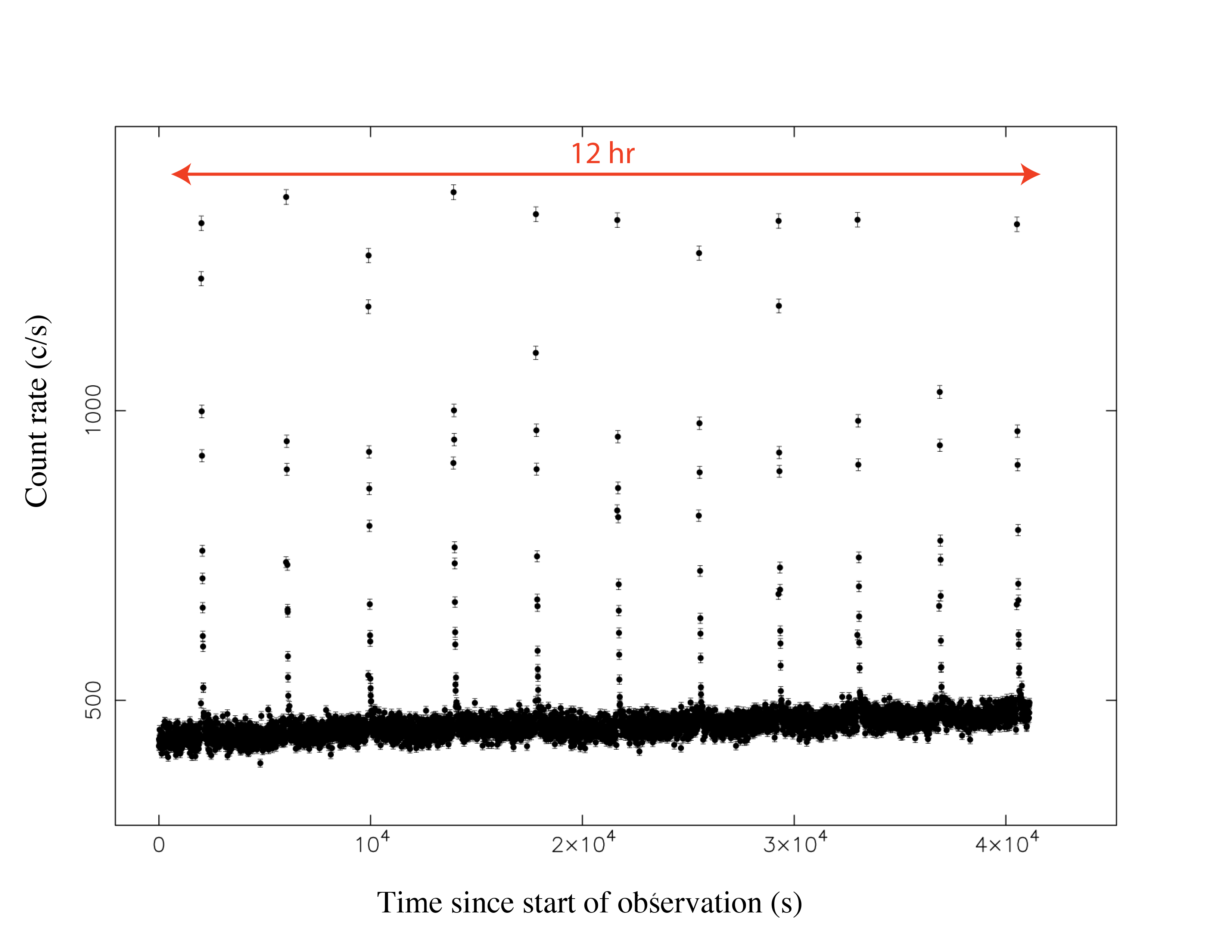
rxsj1804_xmm_bursts

An X-ray observation of an accreting neutron star that shows highly repetitive thermonuclear X-ray bursts. The 11 distinct spikes of X-ray emission each represent a single thermonuclear X-ray burst. These powerful explosions can likely repeatedly destruct or weaken the radio jet.

The devastating impact of X-ray bursts

When plasma falls onto a neutron star it undergoes thermo-nuclear reactions that can cause an extremely energetic explosion called an X-ray burst. Such explosions are extremely common: tens of thousands of X-ray bursts have been recorded to date with different X-ray detectors and on some neutron stars the explosions repeat every few hours.

X-ray bursts occur on neutron stars that are surrounded by a gaseous disk in which material that is pulled off the companion star spirals at increasing speed until it finally plunges into the neutron star. Apart from this accretion disk, a neutron star is also surrounded by a hot plasma, called a corona. The formation and properties of accretion disks are much better understood than that of the corona.

It has long been appreciated that the properties of the accretion flow (i.e. the accretion disk and the corona) affect the observable properties of X-ray bursts such as their peak brightness, duration, recurrence rate and variability properties. However, in recent years evidence for the reverse interaction have been accumulating too: the devastating power of X-rays bursts can destruct the accretion disk and corona that surround the neutron star. Shortly after the surge of energy from the X-ray burst is over, the disk and corona should return to their original status.

Change is always a very powerful diagnostic in astronomy. The destruction and re-formation of accretion disks and coronae in response to an X-ray burst can therefore reveal intriguing new insight in the properties of accretion flows. Given that X-ray bursts are very common, they can thus serve as a powerful, repeating probe to study the poorly known properties of coronae (such as their geometry) and how an accretion disk responds to a sudden shower of intense radiation.

We recently reviewed all the observational evidence for X-ray bursts interacting with the accretion flow. Based on our current understanding of these interactions, we looked ahead and studied how new and concept X-ray missions such as ASTROSAT (launched in 2015), NICER and HXMT (both launched in 2017), eXTP and STROBE-X (mission concepts currently under study) can further this research field. We also proposed various multi-wavelength strategies can be leveraged to learn more about accretion flows using X-ray bursts.

Degenaar, Ballantyne, Belloni et al. 2018, Space Science Reviews 214, 15: Accretion Disks and Coronae in the X-Ray Flashlight

Paper link: ADS

corona

Schematic overview of three different possible geometries for the corona in an X-ray binary. The neutron star is indicated as the red ball, the accretion disk as the brown surface, and the corona as the grey structure.

A mathematical tool to study X-ray bursts

Neutron stars can rip off gas from a nearby companion star and pull this material towards them; a process called accretion. The material that is accreted on to the neutron star undergoes nuclear reactions that can cause detonations generating more energy than an atomic bomb. Such thermonuclear bursts are observed as brief, bright flashes of X-ray emission that last for seconds to hours and repeat on a timescale of hours to months.

Not surprisingly, these violent explosions can be destructive to the surroundings of a neutron star. Indeed, evidence has been accumulating that X-ray bursts have a profound effect on the  accretion flow that transports material toward the neutron star. For example, the explosions can cool, blow away, or accelerate the in-falling flow of material. One way to investigate this is by studying how the X-ray energy spectrum of the accretion flow changes during an X-ray burst. This is not an easy task, however, because the X-ray burst emission typically outshines that of the accretion flow. Small changes in the weak accretion emission are therefore swamped by the bright burst emission.

Mathematical techniques that involve decomposing complex data into matrices (e.g., “non-negative matrix factorization”) have been previously applied to reveal subtle changes in the X-ray emission of super-massive and stellar-mass black holes. Motivated by those successes, we investigated the applicability of such techniques to study changes in the accretion emission induced by X-ray bursts.

For this purpose we used high-quality data obtained with the NuSTAR satellite of a well-known neutron star X-ray binary and thermonuclear burster 4U 1608-52. Our case study revealed that these mathematical techniques can be a very powerful tool to reveal changes in the accretion emission that remain hidden in conventional spectral analysis. Applying these techniques to NuSTAR data is particularly promising, as this instrument can provide valuable information on the  accretion geometry, that helps interpret the results from the X-ray burst analysis.

Degenaar, Koljonen, Chakrabarty, Kara, Altamirano, Miller, Fabian 2016, MNRAS 456, 4256: Probing the effects of a thermonuclear X-ray burst on the neutron star accretion flow with NuSTAR

Paper link: ADS

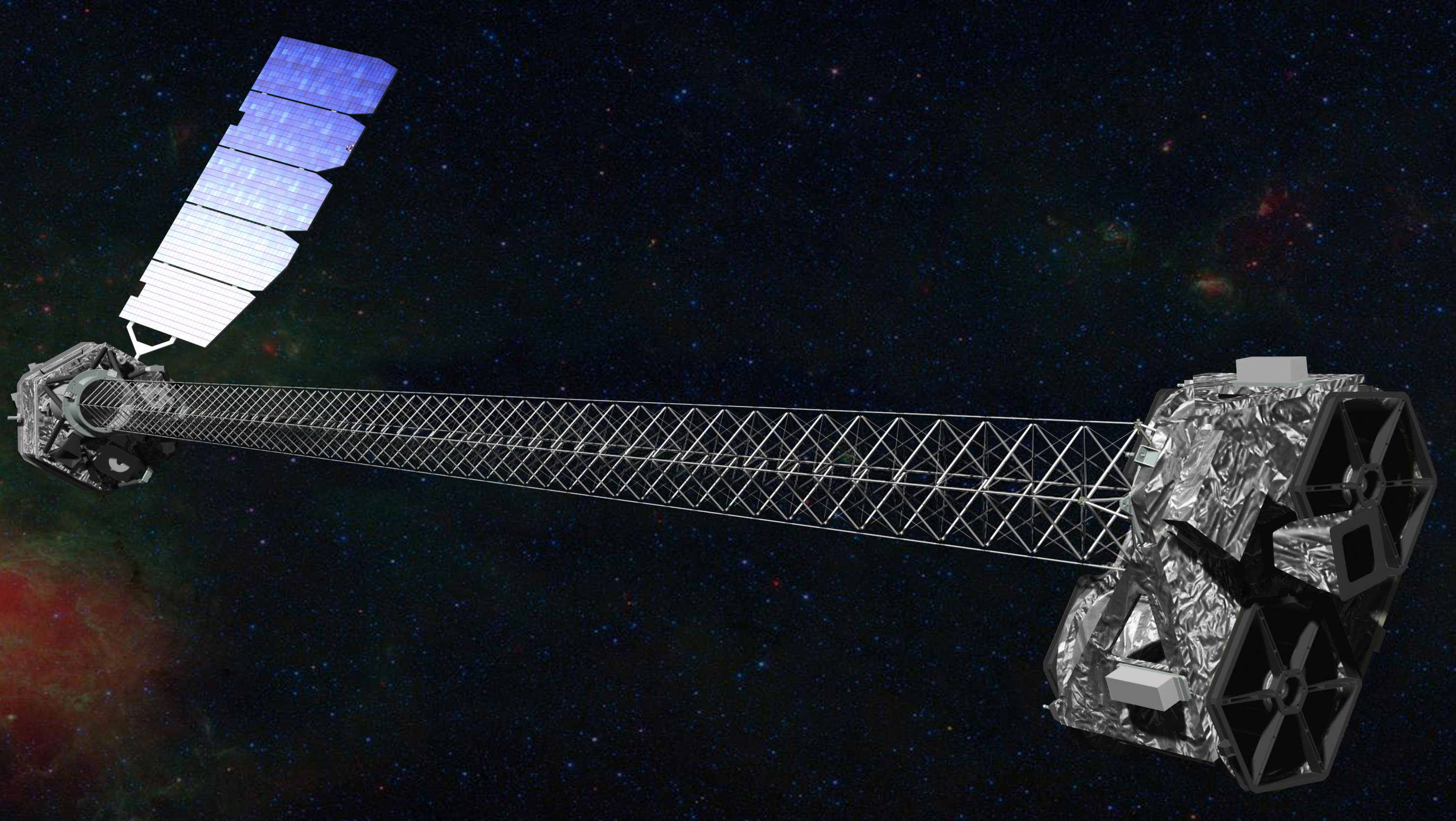
nustar_nasa

Artist impression of NASA’s NuSTAR mission (launched in 2012). Image credits: NASA.

An ultra-magnetized neutron star awakes

These days, astronomers all over the world sleep with one eye open, keeping a close watch of of the supermassive black hole located in the center of our Milky Way Galaxy: Sagittarius A* (Sgr A*). A mysterious gas cloud called “G2” is on a collision course with our Galactic nucleus and may produce some fireworks in the near future (read all about it here).

Imagine the excitement when on April 24 (2013), our daily observations performed with Swift’s X-ray Telescope suddenly detected enhanced activity at the position of Sgr A*. An Astronomer’s Telegram was readily distributed to instantly notify the astronomical community. To everybody’s surprise, however, rapid follow-up observations at infrared and radio wavelengths did not detect anything out of the ordinary and in stead suggested the supermassive black hole remained quiet as always.

The mystery was resolved when right next day, Swift’s Burst Alert Telescope detected a very short (less than a second) and energetic burst of gamma-ray emission. Together with the detection of a pulsed X-ray signal using the brand-new high-energy telescope NuSTAR, this revealed that an otherwise dormant neutron star, located very close to the supermassive black hole, had been revived. This neutron star, named SGR J1745-29, has an extremely strong magnetic field and belongs to the rare class of “magnetars”. So far it is only the magnetar that continues to show fireworks, whereas Sgr A* remains as quiet as it has ever been.

Kennea et al. 2013, ApJ Letters 770, L24: Swift Discovery of a New Soft Gamma Repeater, SGR J1745-29, near Sagittarius A*

Paper link: ADS

Press item: Sky&Telescope feature

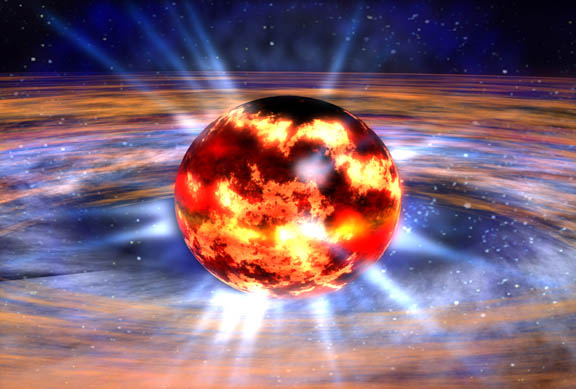
Artist’s concept of an explosion on the surface of a neutron star. Credit: NASA/Dana Berry.

Artist’s concept of an explosion on the surface of a neutron star.
Credit: NASA/Dana Berry.

The effects of a violent thermonuclear burst

Thermonuclear X-ray bursts manifest themselves as intense flashes of X-ray emission that have a duration of seconds to hours, during which a total energy of approximately 1039 to 1042 erg is radiated. These events are caused by unstable thermonuclear burning that transforms hydrogen and/or helium that has falling onto the surface of a neutron star into heavier chemical elements. X-ray bursts are a unique signature of neutron stars in low-mass X-ray binaries. In such interacting binary star systems, a Roche-lobe overflowing late-type companion star feeds matter to the compact object via an accretion disk.

There is a delicate connection between the properties of X-ray bursts and that of the accretion flow. On the one hand, the rate at which mass is accreted onto the neutron star determines the duration, recurrence time, and radiated energy of the X-ray bursts, whereas the accretion geometry can strongly influence the observable properties. On the other hand, it has been proposed that particularly powerful X-ray bursts may be able to influence the accretion flow.

IGR J17062-6143 is an X-ray source that was discovered in 2006, but remained unclassified until the Burst Alert Telescope onboard the Swift satellite detected an X-ray burst in 2012. This unambiguously identified IGR J17062-6143 as a neutron star low-mass X-ray binary. But not just any ordinary neutron star. The X-ray burst was highly energetic (classifying as a so-called intermediately long X-ray burst), and displayed three very unique features that indicate that the explosion was violent enough to disrupt the accretion disk surrounding the neutron star.

Firstly, the 18-min long X-ray burst displayed dramatic, irregular intensity variations that were clearly visible in the X-ray light curve. Similar fluctuations have only been seen on a handful of occasions. They are likely caused by swept-up clouds of gas or puffed-up structures in the accretion disk. The time-scale of the fluctuations suggest this gas is located at a distance of approximately 103 km from the neutron star. Secondly, the X-ray spectrum of the X-ray burst showed a highly significant emission line around an energy of 1 keV (most likely a Fe-L shell line). This emission feature can be explained as irradiation of relatively cold gas. The width of the line suggests that this material is located at a distance of 103 km from the neutron star. Thirdly, significant absorption features near 8 keV were present in the X-ray spectrum (in the Fe-K band). These likely result from hot, ionized gas along the line of sight. Fitting these features with photo-ionization models points towards a similar radial distance as inferred from the emission line and the light curve fluctuations. Spectral emission and absorption features have never been (unambiguously) detected during an X-ray burst, making this a highly exciting discovery.

In conclusion, three independent observational features suggest that the energetic X-ray burst from IGR J17062-6143 swept up gas along our line of sight, out to a distance of roughly 1000 km from the neutron star (approximately 50 gravitational radii). This provides strong evidence  that powerful X-ray bursts can indeed disrupt the (inner) accretion disk.

Degenaar, Miller, Wijnands, Altamirano, Fabian 2013, ApJ 767, L37: X-Ray Emission and Absorption Features during an Energetic Thermonuclear X-Ray Burst from IGRJ17062-6143

Paper link: ADS

An artist impression of an interacting binary. Image credits: David. A. Hardy / STFC

An artist impression of an interacting binary.
Image credits: David. A. Hardy / STFC

Swift: A neutron star finding machine

Many neutron stars reside in X-ray binaries, where they pull off and consume matter from a companion star. As the accreted material accumulates on the surface of the neutron star, the temperature and pressure rise, what can eventually lead to a gigantic explosion: a thermonuclear X-ray burst. These are very energetic, bright flashes of X-ray emission that can last from a few seconds to a few hours. These are a unique characteristic of neutron stars.

NASA’s Swift satellite carries instruments that can detect X-ray, ultra-violet and optical emission from astronomical objects. In addition, it is equipped with a Burst Alert Telescope (BAT). This instrument has a very wide field of view of about 2 steradians and monitors a large part of the sky with the aim to detect (rare) energetic events. The BAT has proven to be an very suitable instrument to detect thermonuclear X-ray bursts from accreting neutron stars.

Some neutron stars display X-ray bursts only very rarely (maybe only once every year). These events can be easily missed, so that the neutron star can remain hidden for a very long time. Indeed, Swift’s BAT has detected several thermonuclear X-ray bursts from previously unknown X-ray sources. In some cases, the BAT picked up an X-ray burst from an X-ray sources that had been discovered before, but was not known to harbor a neutron star. At present, approximately 100 X-ray bursting neutron stars are known (see this list of Galactic X-ray bursters and the MINBAR catalog for overviews). A significant fraction of these (about 10) have been discovered by the Swift satellite.

In 2011 and 2012, the BAT helped identify four new neutron stars via the detection of their thermonuclear X-ray bursts.

Degenaar, Altamirano, Wijnands 2012, Astronomer’s Telegram 4219: IGR J17062-6143 is likely a bursting neutron star low-mass X-ray binary

Paper link: ADS

Degenaar, Wijnands, Reynolds et al. 2014, ApJ 792, 109: The Peculiar Galactic Center Neutron Star X-Ray Binary XMM J174457-2850.3

Paper link: ADS

Degenaar, Linares, Altamirano, Wijnands 2012, ApJ 759, 8: Two New Bursting Neutron Star Low-mass X-Ray Binaries: Swift J185003.2-005627 and Swift J1922.7-1716

Paper link: ADS


Artist impression of the Swift satellite. Credit: NASA.

Artist impression of the Swift satellite.
Credit: NASA.

Some neutron stars go BOOOOOOOM

Matter that accumulates onto the surface of an accreting neutron star undergoes thermonuclear burning. This process can be unstable and result in a sudden, bright flash of X-ray emission that is referred to as a thermonuclear X-ray burst (or type-I X-ray burst).

Thousands of X-ray bursts have been observed from about 100 neutron star X-ray binaries. Most of these events last about 10-100 seconds, have an energy output of ~10^39 erg (which is far more energetic than an atomic bomb!) and repeat on a timescale of minutes to hours. On rare occasions, however, X-ray bursts have been observed that are both longer (tens of minutes to hours) and 10-100 times more energetic. A few tens of such intermediately long X-ray bursts have been observed to date.

On 2010 August 13, the Burst Alert Telescope (BAT) onboard the Swift satellite triggered on an event coming from the direction of the neutron star X-ray binary XMMU J174716.1-281048. We analyzed the Swift data and found that the BAT had caught an intermediately long X-ray burst from this X-ray binary, which had a duration of nearly 3 hours. This was only the second X-ray burst ever recorded from this source.

The X-ray emission of XMMU J174716.1-281048 is unusually faint for an X-ray binary. This suggests that matter is transferred to the neutron star at a very slow rate. This might be the reason why the neutron star does not display regular X-ray bursts, but rather these rare energetic ones.

Degenaar, Wijnands & Kaur 2011, MNRAS Letters 414, L104: Swift detection of an intermediately long X-ray burst from the very faint X-ray binary XMMU J174716.1-281048

Paper link: ADS

An artist impression of an interacting binary.  Image credits: David. A. Hardy / STFC

An artist impression of an interacting binary.
Image credits: David. A. Hardy / STFC