
A once-in-a-lifetime explosion inside a neutron star!
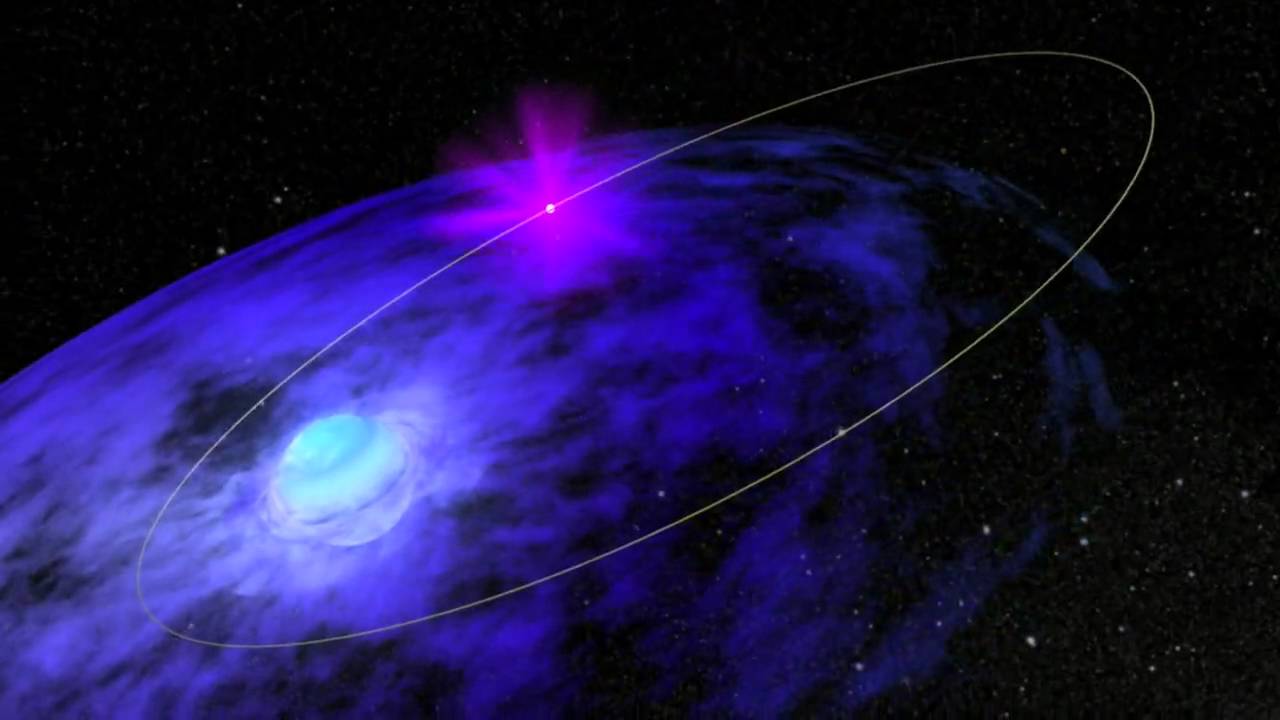
One of the many spectacular phenomena displayed by neutron stars are thermonuclear bursts. These events are observed from neutron stars that live their lives with a companion star which they steal gas from. Neutron stars can remove gas from their companion star at a startling rate of about 40 trillion kilograms per second. This gas accumulates on the surface of the neutron star, where the temperature and pressure increase as more and more matter piles up. Within hours, so much material builds up that nuclear reactions start occurring in the accumulated gas layer. This leads to the explosive ignition of the layer, causing it to burn away within seconds, somewhat like the head of a matchstick at stroke. The energy that is released in the explosion causes a bright flash of X-ray emission called a thermonuclear X-ray burst.
The most common type of thermonuclear bursts are the result of the ignition of a thin layer of hydrogen and/or helium, which are visible as flashes that last about 1 minute. Despite their short duration, an enormous amount of energy is produced in each of such bursts: about 1032 J (1039 erg). This is roughly as much as 1015 , which is one thousand trillion, nuclear bombs! Still, even more energetic bursts have been observed. The so-called superbursts are 1000x more energetic than common bursts, last for several hours and are the result of the ignition of a thick layer of carbon that was build up below the surface of the neutron star.
Recently we found evidence for the existence of yet another type of explosion from neutron stars that even diminishes the superbursts. This new kid in town, the hyperburst, is thought to be the result of the explosive burning of a deep layer of oxygen or neon, that has been steadily building up in the neutron star over hundreds or thousands of years of stealing gas from its companion. Hyperbursts would be the most energetic neutron star thermonuclear explosion known. releasing as much energy in about three minutes as the Sun releases in 800 years!
What does a hyperbursts look like? The tricky thing with hyperbursts is that they would not be directly visible as X-ray flashes, like the superbursts and common burst are detected. This is because the layer that ignites lies so deep inside the neutron star that all the energy that is released in the explosion gets absorbed by the layers above it and hence won’t escape through the stellar surface into our view.
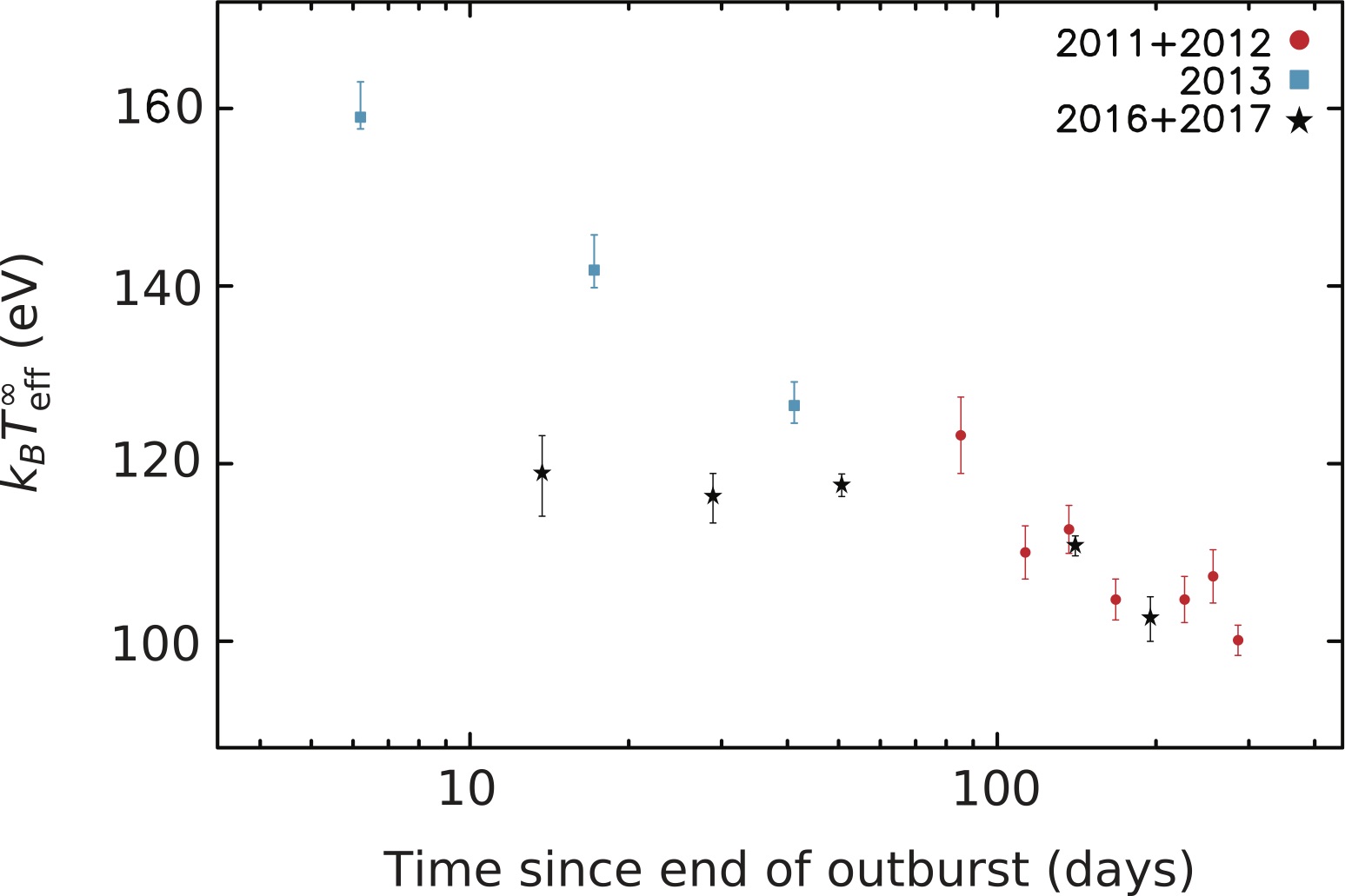
So how did we discover a hyperburst then? Even if a hyperburst may not be directly visible, the enormous amount of energy it releases should leave its imprint on the neutron star, in particular on its outer layers that absorb the explosion. This is what we think we observed in the neutron star MAXI 0556–332. This source spend about a year feasting on its companion star in 2010-2011 and when we measured its temperature afterwards it turned out to be incredibly hot. We had taken similar measurements of 10 other neutron stars before, but MAXI 0556-332 was much more hot than any of them. Its unusually high temperature puzzled astrophysicists for many years, as it was difficult to understand why this neutron star was so different then the rest.
Over the past decade we observed MAXI 0556-332 to gradually cool down as the neutron star is radiating heat from its surface. From its cooling trajectory we can infer how much heat must have been injected into it when it was swallowing gas and also at what depth that energy must have been generated. We then realized that at this depth we to find layers of oxygen and neon and when we calculated how much energy the ignition of such a layer would generate, that turned out to match the energy that was needed to heat MAXI 0556-332 to its observed high temperature. So we indirectly observed what we coined a hyperburst.
When will we observe the next hyperburst? Igniting any type of explosion requires very high pressure and temperatures. We estimate that the temperature and pressure needed to ignite a deep layer of oxygen or neon may only be reached once in 1,000 years in any neutron star. Hyperbursts should thus be exceedingly rare and we might just never see one again. If this is indeed the case is what we hope to answer next as we launch new investigations to understand precisely under what circumstances hyperbursts can occur.
Some press coverage: New Scientist and Sci Physics
Page et al. 2022, the Astrophysical Journal 933, 216: A “Hyperburst” in the MAXI J0556-332 Neutron Star: Evidence for a New Type of Thermonuclear Explosion
Paper link: ADS
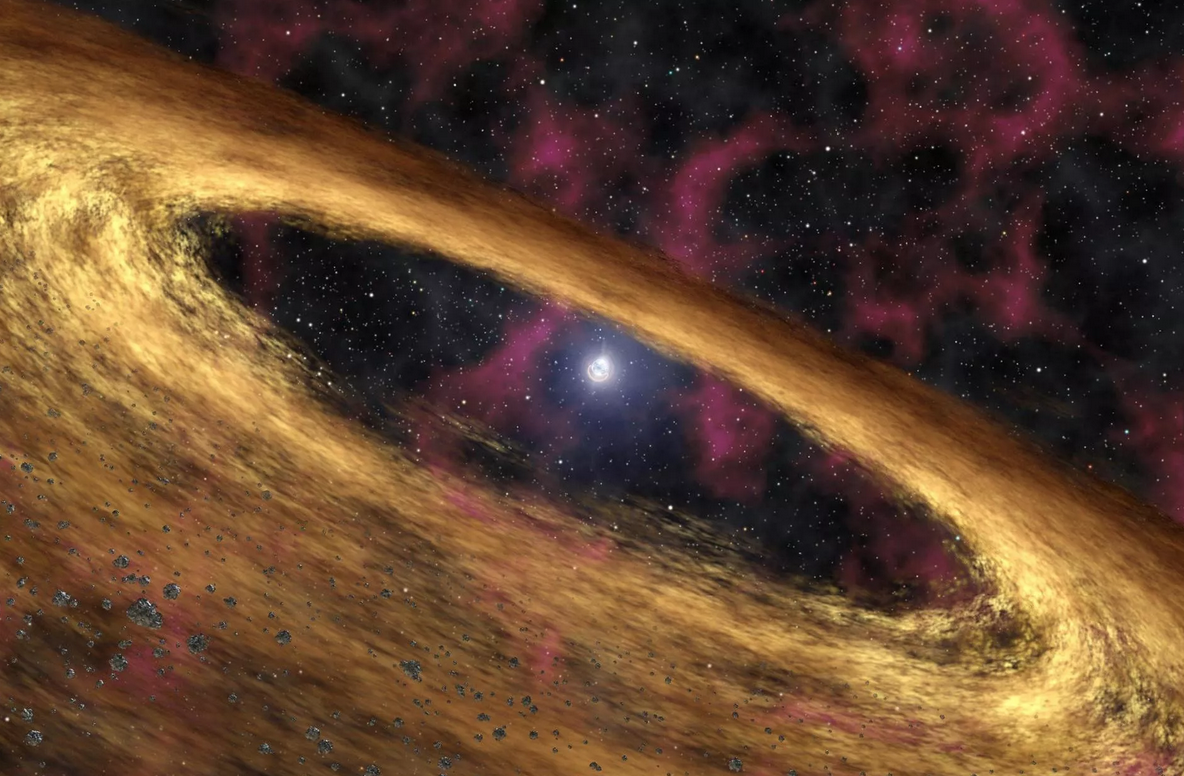
Artist’s impression of a neutron star lying in the center of a gaseous accretion disk. During quiescent episodes the disk is cold and residing far away from the neutron star, preventing it from swallowing gas from it. During such quiescent episodes, sensitive X-ray satellites can detect the thermal glow of the hot neutron star, which allows to measure its temperature.





 Nathalie Degenaar
You must be logged in to post a comment.