Challenging theoretical models

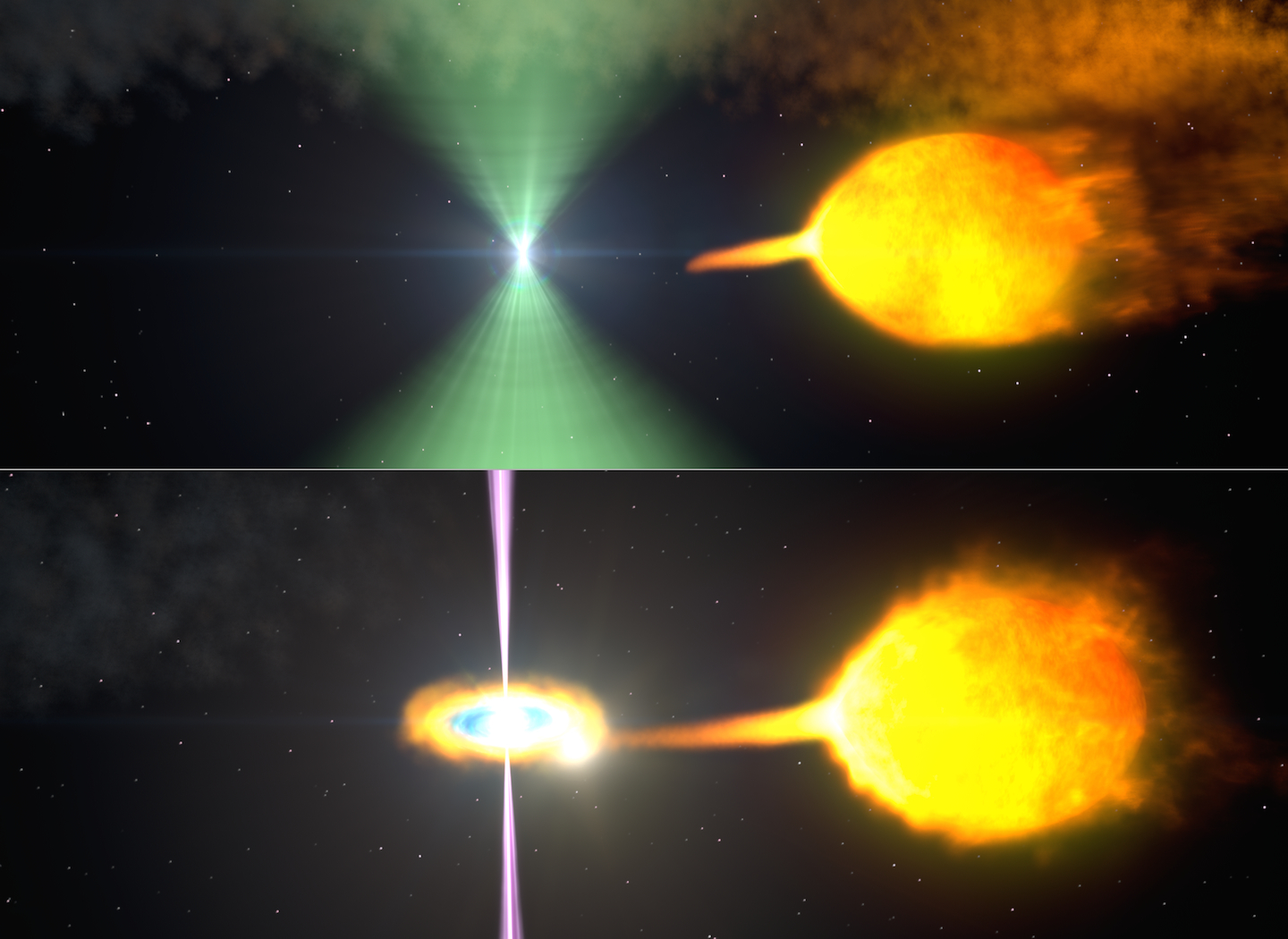
Studying the thermal evolution of neutron stars is a promising avenue to gain insight into their structure and composition, and therefore of how matter behaves under extreme physical conditions. These compact stellar remnants are born hot in supernova explosions, but quickly cool as their thermal energy is drained via neutrino emission from their dense interior and thermal photons radiated from their surface. When residing in low-mass X-ray binaries, neutron stars pull off and accrete the outer layers of a companion star. This can re-heat the neutron star and drastically impact its thermal evolution.

The accretion of matter causes a series of nuclear reactions (electron-captures and fusion of atomic nuclei) that produce heat at a rate that is proportional to the rate at which matter is falling onto the neutron star. These processes can significantly raise the temperature of the outer layers of the neutron star, the crust, which then become hotter than the stellar interior, the core. How much heat is released, and at which depth, depends sensitively on the structure and composition of the crustal layers. When the neutron star stops accreting (during so-called quiescent episodes), the crust cools down until it reaches the same temperature as the core again. How fast the crust cools depends strongly on its ability to store and transport heat, and hence on its structure and composition. Studying temperature changes of a neutron star due to accretion episodes thus holds valuable information about the properties of its crust.

In 2010, a neutron star called IGR J17480-2446 started accreting matter from its companion star, temporarily making it the brightest X-ray source in the globular cluster Terzan 5. When it stopped 10 weeks later, we began to follow the neutron star every few months with the Chandra satellite to study any possible changes in its temperature. With our initial observations we discovered that the neutron star was about 300 000 degrees hotter than before it started accreting. This provided the first strong evidence that a neutron star can become significantly heated after just 2 months of accreting matter (rather than >1 year; read more here).

Since this neutron star was heated for a relatively short time, theory predicted that it should cool down rapidly. On the contrary, we have found that the neutron star is still considerably hotter than its pre-accretion temperature 2.5 years later! This indicates that there might be some important ingredients missing in our current understanding of heating and cooling of accreting neutron stars. To be able to distinguish between different possible explanations and hence fully grasp the implications of our findings of IGR J17480-2446, we aim to keep observing this neutron star until it has fully cooled. A new Chandra observation has been scheduled for this purpose in the next year (2014). We are anxious to find out how the temperature of the neutron star has changed by that time.

Degenaar, Wijnands, Brown et al. 2014, ApJ 775, 48: Continued Neutron Star Crust Cooling of the 11 Hz X-Ray Pulsar in Terzan 5: A Challenge to Heating and Cooling Models?

Paper link: ADS

terzan5_edser

Three-color image of the globular cluster Terzan 5, obtained with the Chandra X-ray satellite.

An ultra-magnetized neutron star awakes

These days, astronomers all over the world sleep with one eye open, keeping a close watch of of the supermassive black hole located in the center of our Milky Way Galaxy: Sagittarius A* (Sgr A*). A mysterious gas cloud called “G2” is on a collision course with our Galactic nucleus and may produce some fireworks in the near future (read all about it here).

Imagine the excitement when on April 24 (2013), our daily observations performed with Swift’s X-ray Telescope suddenly detected enhanced activity at the position of Sgr A*. An Astronomer’s Telegram was readily distributed to instantly notify the astronomical community. To everybody’s surprise, however, rapid follow-up observations at infrared and radio wavelengths did not detect anything out of the ordinary and in stead suggested the supermassive black hole remained quiet as always.

The mystery was resolved when right next day, Swift’s Burst Alert Telescope detected a very short (less than a second) and energetic burst of gamma-ray emission. Together with the detection of a pulsed X-ray signal using the brand-new high-energy telescope NuSTAR, this revealed that an otherwise dormant neutron star, located very close to the supermassive black hole, had been revived. This neutron star, named SGR J1745-29, has an extremely strong magnetic field and belongs to the rare class of “magnetars”. So far it is only the magnetar that continues to show fireworks, whereas Sgr A* remains as quiet as it has ever been.

Kennea et al. 2013, ApJ Letters 770, L24: Swift Discovery of a New Soft Gamma Repeater, SGR J1745-29, near Sagittarius A*

Paper link: ADS

Press item: Sky&Telescope feature

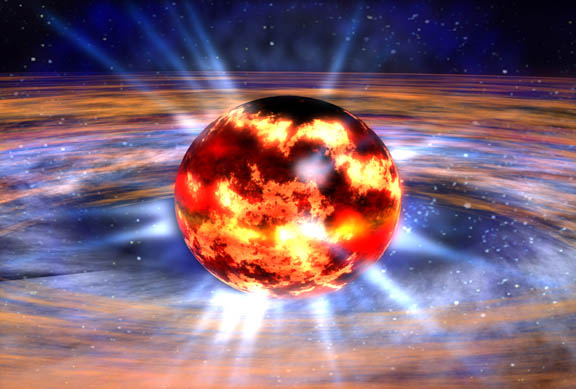
Artist’s concept of an explosion on the surface of a neutron star. Credit: NASA/Dana Berry.

Artist’s concept of an explosion on the surface of a neutron star.
Credit: NASA/Dana Berry.

The table manners of the Milky Way’s supermassive black hole


Understanding accretion onto supermassive black holes and the associated feedback to their environment lies at the basis of understanding their formation, growth and evolution, the chemical enrichment of the interstellar medium, galaxy evolution, and the formation of large scale structures in the universe. Sagittarius A* (a.k.a. Sgr A*) is a supermassive black hole that forms the dynamical center of our Milky Way Galaxy. Being the most nearby Galactic nucleus, it allows for an unparalleled study of the fueling process of supermassive black holes.

Surprisingly enough, the bolometric luminosity of Sgr A* is about 8-9 orders of magnitude lower than the maximum radiation (the Eddington limit) that can be emitted from the environment of a supermassive black hole with a mass of 4 million times that of our Sun. Its faintness is particularly puzzling because nearby dense star cluster are thought to supply enough matter to serve as a grant banquet for Sgr A*. However, it appears that our Galactic nucleus is on a diet.

Nevertheless, it appears to crave for an occasional snack; the relatively steady quiescent radiation of Sgr A* is, however, occasionally punctured by hours-long flares during which the X-ray emission increases by 1-2 orders of magnitude. These events are likely related to small accretion events or magnetic processes. Most excitingly, the time scale involved with these phenomena suggest that they must be originating very close to the black hole (within approximately 15 Schwarzschild radii). A few dozens of X-ray flares have been detected from Sgr A* by using the Chandra and XMM-Newton satellites. The far majority of these are relatively weak; only on 4 occasions was the emission observed to increase more than 100 times the steady base level.

We investigated nearly 800 observations of the center of our Galaxy that were obtained with the X-ray Telescope onboard the Swift telescope between 2006 and 2012. In these 6 years of monitoring data we discovered a total of 6 bright X-ray flares from Sgr A* during which the emission increased by a factor of 100. Owing to its uniquely dense sampling, the Swift campaign more than double the number of observed bright X-ray flares from our supermassive black hole. This allowed to constrain the recurrence rate of these events, and made an unbiased comparative study of their spectral properties possible for the first time. Having mapped out the long-term X-ray behavior of Sgr A* with Swift provides an important calibration point to assess whether the activity of our supermassive black hole is going to change as the result of its interaction with an approaching gas cloud (read more about this upcoming exciting event here).

Degenaar, Miller, Kennea, Gehrels, Reynolds, Wijnands 2013, ApJ 769, 155: The X-Ray Flaring Properties of Sgr A* during Six Years of Monitoring with Swift

Paper link: ADS

The Swift monitoring website: www.swift-sgra.com

Press: German radio interview

Three-color accumulated Swift X-ray Telescope Image of the Galactic center (2006-2014).

Three-color accumulated Swift X-ray Telescope Image of the Galactic center (2006-2014).

The effects of a violent thermonuclear burst

Thermonuclear X-ray bursts manifest themselves as intense flashes of X-ray emission that have a duration of seconds to hours, during which a total energy of approximately 1039 to 1042 erg is radiated. These events are caused by unstable thermonuclear burning that transforms hydrogen and/or helium that has falling onto the surface of a neutron star into heavier chemical elements. X-ray bursts are a unique signature of neutron stars in low-mass X-ray binaries. In such interacting binary star systems, a Roche-lobe overflowing late-type companion star feeds matter to the compact object via an accretion disk.

There is a delicate connection between the properties of X-ray bursts and that of the accretion flow. On the one hand, the rate at which mass is accreted onto the neutron star determines the duration, recurrence time, and radiated energy of the X-ray bursts, whereas the accretion geometry can strongly influence the observable properties. On the other hand, it has been proposed that particularly powerful X-ray bursts may be able to influence the accretion flow.

IGR J17062-6143 is an X-ray source that was discovered in 2006, but remained unclassified until the Burst Alert Telescope onboard the Swift satellite detected an X-ray burst in 2012. This unambiguously identified IGR J17062-6143 as a neutron star low-mass X-ray binary. But not just any ordinary neutron star. The X-ray burst was highly energetic (classifying as a so-called intermediately long X-ray burst), and displayed three very unique features that indicate that the explosion was violent enough to disrupt the accretion disk surrounding the neutron star.

Firstly, the 18-min long X-ray burst displayed dramatic, irregular intensity variations that were clearly visible in the X-ray light curve. Similar fluctuations have only been seen on a handful of occasions. They are likely caused by swept-up clouds of gas or puffed-up structures in the accretion disk. The time-scale of the fluctuations suggest this gas is located at a distance of approximately 103 km from the neutron star. Secondly, the X-ray spectrum of the X-ray burst showed a highly significant emission line around an energy of 1 keV (most likely a Fe-L shell line). This emission feature can be explained as irradiation of relatively cold gas. The width of the line suggests that this material is located at a distance of 103 km from the neutron star. Thirdly, significant absorption features near 8 keV were present in the X-ray spectrum (in the Fe-K band). These likely result from hot, ionized gas along the line of sight. Fitting these features with photo-ionization models points towards a similar radial distance as inferred from the emission line and the light curve fluctuations. Spectral emission and absorption features have never been (unambiguously) detected during an X-ray burst, making this a highly exciting discovery.

In conclusion, three independent observational features suggest that the energetic X-ray burst from IGR J17062-6143 swept up gas along our line of sight, out to a distance of roughly 1000 km from the neutron star (approximately 50 gravitational radii). This provides strong evidence  that powerful X-ray bursts can indeed disrupt the (inner) accretion disk.

Degenaar, Miller, Wijnands, Altamirano, Fabian 2013, ApJ 767, L37: X-Ray Emission and Absorption Features during an Energetic Thermonuclear X-Ray Burst from IGRJ17062-6143

Paper link: ADS

An artist impression of an interacting binary. Image credits: David. A. Hardy / STFC

An artist impression of an interacting binary.
Image credits: David. A. Hardy / STFC

Real-time cooling of a neutron star?

Neutron stars are the densest directly observable stellar objects in our universe and constitute ideal astrophysical laboratories to study matter under extreme physical conditions: immense gravitational fields, ultra-strong magnetic fields, vigorous radiation fields, and supra-nuclear densities. Many observable properties of neutron stars are set by the structure and composition of their crust. A promising way to investigate the properties of these outer stellar layers is to study neutron stars in low-mass X-ray binaries.

In these interacting binary star systems, the neutron star pulls off and accretes matter from a companion star that has a mass comparable to (or lower than) that of our Sun. Many of such X-ray binaries are transient and exhibit outbursts of accretion that last only a few weeks. These are interleaved by years-long episodes of quiescence during which little or no matter is being accreted onto the neutron star. During these quiescent episodes the thermal heat radiation from the glowing neutron star surface becomes visible. This effectively serves as a thermometer of the neutron star and provides a powerful probe of its interior properties.

Sensitive X-ray instruments aboard the Swift, Chandra and XMM-Newton satellites have revealed that outbursts of accretion can severely affect a neutron star’s temperature. Using sophisticated and tailored observing strategies, it has been shown that it causes the crust of a neutron star to be heated to millions of degrees Kelvin. This heat is produced in a cascade of nuclear reactions, including fusion of atomic nuclei (due to the high matter density), and other chemical processes. Once neutron stars stop swallowing matter, the crustal layers slowly cool until they return to their pre-outburst temperature after several years. Both the heating and the cooling encode unique information about the structure and composition of the neutron star’s crust.

With the aim to study the cooling-down of the neutron star in an X-ray binary called XTE J1709-267, we targeted this object in 2013 September shortly after it exhibited an accretion outburst, using the Swift and XMM-Newton satellites. We were expecting to see a gradual fading over the course of several years. Much to our surprise, however, we found that the thermal radiation from the neutron star was rapidly fading during our 8-hour long XMM-Newton observation. An intriguing explanation for this is that we were witnessing fast cooling of the very outer layers of the neutron star in real-time.

If this interpretation is correct, the time-scale of the observed decay places new, strong constraints on the amount of heat that was generated inside the neutron star, and at which depth. When taken at face value, the findings indicate that one particular process that causes atomic nuclei to separate out in different layers, is important in the heat generation. This has important implications for our understanding of the crust structure of accreting neutron stars. A plausible alternative explanation is that the rapid fading was caused by a rapid reduction of the matter supply onto neutron star, hence that our observations tracked the cessation of the accretion flow marking the end of the outburst.

Degenaar, Miller, Wijnands 2013, ApJ Letters 767, L31: A Direct Measurement of the Heat Release in the Outer Crust of the Transiently Accreting Neutron Star XTE J1709-267

Paper link: ADS

An artist impression of an X-ray binary.  Credit: Stuart Littlefair.

An artist impression of an X-ray binary.
Credit: Stuart Littlefair.

Swift: A neutron star finding machine

Many neutron stars reside in X-ray binaries, where they pull off and consume matter from a companion star. As the accreted material accumulates on the surface of the neutron star, the temperature and pressure rise, what can eventually lead to a gigantic explosion: a thermonuclear X-ray burst. These are very energetic, bright flashes of X-ray emission that can last from a few seconds to a few hours. These are a unique characteristic of neutron stars.

NASA’s Swift satellite carries instruments that can detect X-ray, ultra-violet and optical emission from astronomical objects. In addition, it is equipped with a Burst Alert Telescope (BAT). This instrument has a very wide field of view of about 2 steradians and monitors a large part of the sky with the aim to detect (rare) energetic events. The BAT has proven to be an very suitable instrument to detect thermonuclear X-ray bursts from accreting neutron stars.

Some neutron stars display X-ray bursts only very rarely (maybe only once every year). These events can be easily missed, so that the neutron star can remain hidden for a very long time. Indeed, Swift’s BAT has detected several thermonuclear X-ray bursts from previously unknown X-ray sources. In some cases, the BAT picked up an X-ray burst from an X-ray sources that had been discovered before, but was not known to harbor a neutron star. At present, approximately 100 X-ray bursting neutron stars are known (see this list of Galactic X-ray bursters and the MINBAR catalog for overviews). A significant fraction of these (about 10) have been discovered by the Swift satellite.

In 2011 and 2012, the BAT helped identify four new neutron stars via the detection of their thermonuclear X-ray bursts.

Degenaar, Altamirano, Wijnands 2012, Astronomer’s Telegram 4219: IGR J17062-6143 is likely a bursting neutron star low-mass X-ray binary

Paper link: ADS

Degenaar, Wijnands, Reynolds et al. 2014, ApJ 792, 109: The Peculiar Galactic Center Neutron Star X-Ray Binary XMM J174457-2850.3

Paper link: ADS

Degenaar, Linares, Altamirano, Wijnands 2012, ApJ 759, 8: Two New Bursting Neutron Star Low-mass X-Ray Binaries: Swift J185003.2-005627 and Swift J1922.7-1716

Paper link: ADS


Artist impression of the Swift satellite. Credit: NASA.

Artist impression of the Swift satellite.
Credit: NASA.

Staring at the center of the Milky Way

The region around Sagittarius A*, the supermassive black hole that represents the dynamical center of our Milky Way Galaxy, harbors a large number of accreting neutron stars and black holes. Between 2005 and 2008, we targeted this region every few months using the X-ray instruments onboard the Chandra and XMM-Newton satellites. The main objective of this monitoring campaign was to study the behavior of transient X-ray binaries. These spend most of their time in a dim quiescent state, during which they often can not be detected, but experience occasional outbursts of bright X-ray emission when the neutron star or black hole pulls off and accretes matter from its companion star.

Our observations covered a region of 1.2 square degree around Sagittarius A* that contains 17 known X-ray transients, 8 of which were active during our campaign. We performed a detailed study of the energy distribution and temporal variations of their X-ray emission. From one of the active neutron stars we detected two thermonuclear explosions, which occurred within a time interval of only 3.8 minutes. Such a short repetition time is only rarely seen and poses a challenge for theoretical models. In addition, we discovered a previously unknown X-ray source, which we tentatively classify as an accreting white dwarf.

Most remarkably, the majority of X-ray transients located near Sagittarius A* are considerably fainter during outburst than is usually seen for accreting neutron stars and black holes. One possible explanation for their sub-luminous character is that these X-ray binaries have very small orbits, in which the compact primary and their companion revolve around each other in less than two hours. Finding such binaries is of particular interest, because they are thought to be strong sources of gravitational waves. The existence of gravitational waves is one of the predictions of Einstein’s theory of General Relativity, which future space-missions hope to prove.

Degenaar, Wijnands, Cackett et al. 2012, A&A 545, 49: A four-year XMM-Newton/Chandra monitoring campaign of the Galactic centre: analysing the X-ray transients

Paper link: ADS

Chandra X-ray image of the center of our Milky Way Galaxy.  Credit: NASA/Wang et al. 2002.

Chandra X-ray image of the center of our Milky Way Galaxy.
Credit: NASA/Wang et al. 2002.

Quiescent but not quite?

The X-ray binary Swift J1749.4-2807 contains a neutron star that rotates around its own axis at a dazzling rate of 518 times per second. To date, only 14 of such fast spinning accreting X-ray pulsars are known. Amongst these, Swift J1749.4-2807 is the only one that shows eclipses: a temporary dramatic drop in the X-ray emission that lasts for approximately 36 minutes and repeats every 8.8 hours. These are caused by the companion star that periodically moves into our line of sight, thereby blocking the X-ray bright central part of the binary.

The unique combination of X-ray pulsations and eclipses makes Swift J1749.4-2807 a particularly promising target to precisely constrain the mass of the neutron star. This is one of the key objectives of modern astrophysics. We used the European satellite XMM-Newton to study the source in quiescence, when the accretion is thought to have switched off and the surface of the neutron star may become directly visible. Quiescent X-ray observations are an important aspect of the challenge to accurately constrain the mass of the neutron star.

Contrary to that seen for the majority of neutron stars, we found that the quiescent X-ray spectrum of Swift J1749.4-2807 consists primarily of high-energy (> 2 keV) photons and shows no evidence for heat radiation that comes from the surface of the neutron star. Its unusual properties can possibly be explained if matter continues to fall onto the neutron star in quiescence. This severely complicates the determination of its mass. It is of utmost importance to understand whether quiescent accretion is common amongst neutron star X-ray binaries.

Degenaar, Patruno, Wijnands 2012, ApJ 756, 148: The Quiescent X-Ray Properties of the Accreting Millisecond X-Ray Pulsar and Eclipsing binary Swift J1749.4-2807

Paper link: ADS

Discovery of eclipses in Swift J1749.4-2807 (2010): NASA press release

Schematic representation of the eclipsing binary Swift J1749.4-2807. Credit: NASA/GSFC.

Schematic representation of the eclipsing binary Swift J1749.4-2807.
Credit: NASA/GSFC.

Chasing the faint ASCA X-ray sources

In 1993, the Japanese Advanced Satellite for Cosmology and Astrophysics (ASCA) was successfully launched. This satellite was operated for 7 years (until 2000) and was the first mission that provided X-ray imaging capabilities in a relatively broad energy band (0.3-10 keV). During its lifetime, ASCA carried out two dedicated surveys of the Galactic Center and Plane, where it discovered around 200 distinct X-ray sources.

Up to date, about 1/3 of the ASCA-discovered X-ray sources could not be classified. They have relatively faint X-ray intensities that can trace a variety of Astronomical objects such as strongly magnetized neutron stars (called ‘magnetars’), bright accreting white dwarfs (‘polars’ and ‘intermediate polars’), sub-luminous accreting neutron stars and black holes, X-ray emitting massive stars, as well as foreground stars and background active galaxies (‘active galactic nuclei’).

In 2006, we launched a program to observe 35 of the unclassified ASCA-sources with the Swift satellite. The goal of this program was to study the X-ray spectrum of these objects, to find possible indications of temporal variations in the X-ray intensity and to obtain more accurate X-ray positions that would aid in conducting follow-up observations at other wavelengths (optical, infra-red, radio). With this approach we aim to gain more insight into the nature of the faint unclassified ASCA sources.

With our Swift observations we were able to tentatively identify three accreting compact objects: one likely magnetized white dwarf, one neutron star and one object that is likely a neutron star or a black hole. In addition, we found that three objects are possibly nearby X-ray emitting stars. Finally, we found evidence that two of the ASCA-detected sources likely undergo strong variations in their X-ray intensity, since these were not detected during our Swift observations.

Degenaar, Starling, Evans et al. 2012, A&A 540, 22: Swift follow-up observations of unclassified ASCA sources

Paper link: ADS

X-ray image from the ASCA survey of the Galactic Centre. Credit: Sugizaki et al. 2001.

X-ray image from the ASCA survey of the Galactic Centre.
Credit: Sugizaki et al. 2001.

Now you see me, now you don’t

Neutron stars in X-ray binaries often accrete matter only for a few weeks, after which the accretion stops and the binary remains quiescent for several years. As the naming suggests, it is generally assumed that accretion has completely stopped in quiescence. Yet, the binary still emits X-ray emission (albeit orders of magnitude lower than during the active phase), which is thought to result from the radiation of heat from the neutron star.

The neutron star X-ray binary EXO 1745-248 is located in the globular cluster Terzan 5 (see images) and has been studied in quiescence using Chandra observations obtained in 2003. Unlike the majority of neutron stars, surprisingly, its quiescent emission did not resemble thermal emission. This poses a puzzle for the origin of the quiescent X-ray emission of this X-ray binary.

We used three additional Chandra observations taken in 2009 and 2011 to further study the quiescent X-ray emission of EXO 1745-248. While in 2009 the neutron star was detected at a similar brightness as previously seen, the source had disappeared in 2011! The implied large variation in the quiescent X-ray intensity can possibly be explained if the accretion did not fully stop and the neutron star continued to slowly accumulate matter. Alternatively the 2011 disappearance might be caused by a temporarily obscuration of the X-ray source, for example by the outer edge of the accretion disk.

Degenaar & Wijnands, 2011, MNRAS 422, 581: Strong X-ray variability in the quiescent state of the neutron star low-mass X-ray binary EXO 1745-248

Paper link: ADS

Three-color images of the globular cluster Terzan 5, obtained with the Chandra X-ray satellite.

Three-color images of the globular cluster Terzan 5, obtained with the Chandra X-ray satellite.