Meet the micronova!

A new type of cosmic explosion discovered.


Staring up at the night sky, it may appear that the endless universe is calm and serene. However, the vastness of space harbors many extreme objects like black holes, neutron stars and white dwarfs. Despite being dead stars, their extreme properties causes them to produce all kinds of violent explosions like gravitational wave mergers, supernovae, gamma-ray bursts, X-ray bursts, fast radio bursts and what not. As of 2022, we can add a new type of explosion to this menagerie: the micronova.

Micronova are thermonuclear explosions that occur on the surface of a white dwarf. In just a matter of hours, an amount of matter equivalent to 3.5 billion Great Pyramids of Giza is burned into flames. Despite being so magnificent, micronovae are just tiny explosions on astrophysical context. In particular, micronovae are about a million times smaller than the common nova explosions that have been known for many decades. Nova explosions occur when a white dwarf slurps gas from a nearby companion; when accumulating on the surface of the cannibal, this gas gets so enormously hot that hydrogen atoms explosively fuse together to form helium. The energy released in this process makes the entire surface of the white dwarf light up and shine bright for several weeks. This makes it easy to spot and study novae. Micronovae, however, are both shorter and less intense, which explains why they went undiscovered for so long.

The mysterious micronovae were spotted in data collected with NASA’s Transiting Exoplanet Survey Satellite (TESS), which takes highly frequent snapshots of large part of the sky. While designed to find new planets around other stars, its high-cadence optical monitoring can reveal many other interesting phenomena to the keen observer. It is in this way that a bright flash of optical light lasting for a few hours was found from a known white dwarf binary. Searching further revealed similar signals in two other systems. Their origin remained a puzzle until subsequent follow-up observations with ESO’s Very Large Telescope revealed a common denominator for the three binaries showing the hours-long optical flashes: all contained white dwarfs with magnetic fields strong enough to channel the siphoned gas onto the magnetic poles rather than it splashing over the entire surface. Putting things together and working out the energetics of the optical flashes revealed that these can be thermonuclear explosions that are confined to the magnetic poles, opposed to the well-known nova explosions that happen over the entire white dwarf surface. The smaller area involved in the explosion explains both the shorter duration and the lower energy output.

The discovery of micronovae shows for the first time that detonations apparently can happen in confined regions, which was not known before. The challenge is now to find more micronovae and to study them in detail to learn more about thermonuclear explosions on stellar cannibals.

Press release: ESO

Scaringi et al. 2022, Nature 604, 447: Localized thermonuclear bursts from accreting magnetic white dwarfs

Paper link: ADS
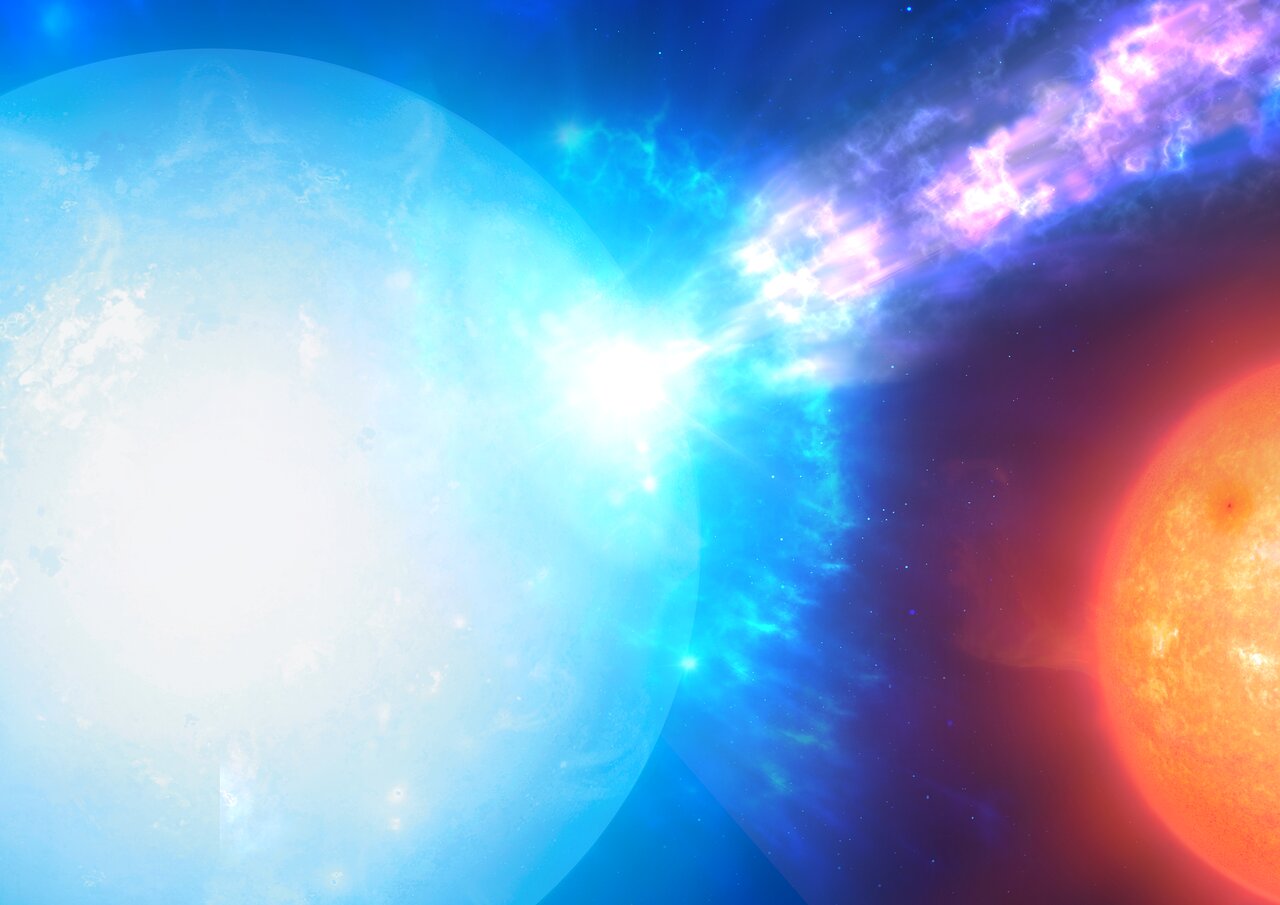
Artist’s impression of a localized explosion on the surface of a white dwarf that is swallowing gas from a companion star. Image credit: Mark Garlick

Changing emission mechanisms

X-ray binaries, in which a neutron star or black hole swallows gas from a companion star, have been known since the dawn of X-ray astronomy in the 1960s. With decades of studies, using many different space-based and ground-based telescopes across the electromagnetic spectrum, we have learned many things about how neutron stars and black holes accrete gas. Nearly all of this knowledge has been assembled for stages during which X-ray binaries are rapidly accreting gas, making them shine bright at all wavelengths and hence can easily be studied. However, most X-ray binaries spend only a fraction of their time being bright and rapidly accreting; the far majority of their time their gas consumption occurs at a very low level. Because X-ray binaries are much dimmer when accreting slowly, it is much more challenging to study them. Our standard  models predict that accretion proceeds very differently at low rates, but we have hardly any observational constraints to test and further develop models of low-level accretion.

There are many different components in an X-ray binary that emit electromagnetic radiation. One of the prime emission components is the accretion disk that, depending on its physical properties like its temperature, radiates at X-ray, UV, optical and near-infrared wavelengths. At low accretion rates, however, theory predicts that this disk evaporates into a more extended hot flow that may emit energy at the same wavelengths as the disk. Apart from the accretion stream, be it a disk or a hot flow, the companion star also emits UV, optical and near-infrared emission  (depending on what type of star it is and whether it is being irradiated by the accretion flow), whereas X-ray binaries also launch jets that can be detected at radio and near-infrared wavelengths, but possibly also in the optical, UV and X-ray bands too. Disentangling the different emission components, and finding which one(s) dominate(s) the total observed emission, can be a powerful way to obtain details about the accretion process. This is not an easy task, however, because for each different wavelength we (generally) need different telescopes and it’s very challenging to coordinate different observatories.

The Swift satellite is a very important observatory to study X-ray binaries. This is for two reasons. Firstly, it is a relatively small satellite that can easily maneuver around, allowing us to take frequent snapshots of sources (which is not possible for bigger satellites). Secondly, Swift carries both an X-ray telescope and a UV/optical telescope, which can observe an astrophysical object at the same time. Combined with its good sensitivity, this makes that Swift is a powerful tool to study how the accretion flow in X-ray binaries changes when it moves (quickly!) from high to low accretion rates. We attempted such a dedicated study for the well-known neutron star X-ray binary Aquila X-1 (aka Aql X-1).

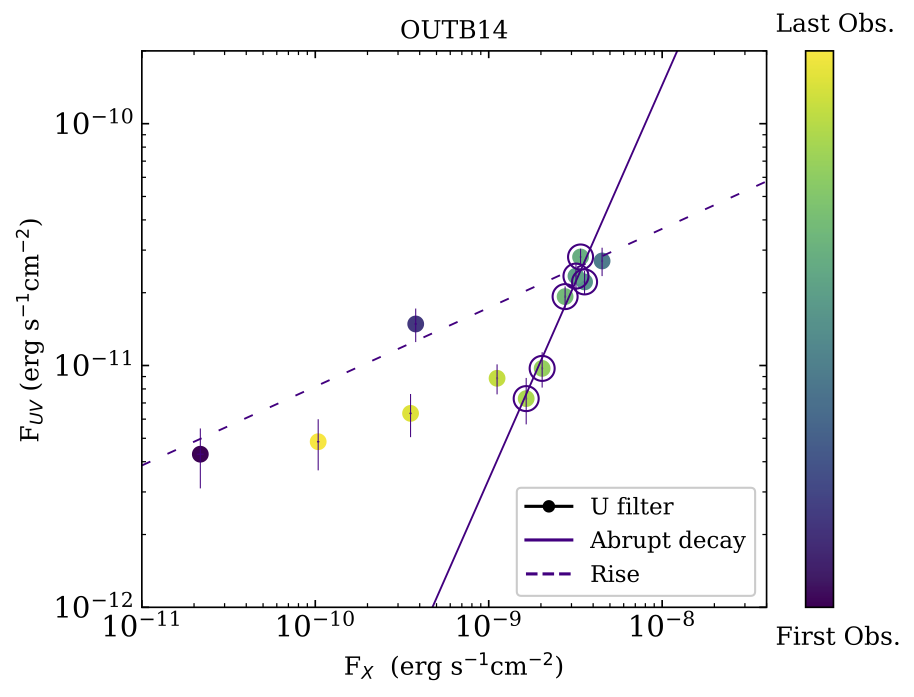
Using Swift data from the NASA archives that covered three different accretion outbursts of Aql X-1, we studied how the X-ray, UV and optical emission changed as the source evolved between high and low accretion rates. We found that the X-ray and UV/optical emission always change together, but that this happens in a different manner when Aql X-1 is bright than when it is fading. This implies that the dominant mechanism producing UV and optical emission changes during the decay of an outburst, as is expected from accretion theory. It might be a hint that an accretion disk is changing into a hot flow, or that the properties of the accretion disk are changing otherwise. Moreover, we found that the UV and optical emission behaves differently during the rise of an outburst than during the decay. This suggests that the accretion flow may have different properties at the start and the end of an outburst. This investigating has exposed some interesting behavior that warrants follow-up by performing similar studies for other X-ray binaries or using additional observatories.

López-Navas, Degenaar, Parikh, Hernández Santisteban, van den Eijnden 2020, MNRAS 493, 940: The connection between the UV/optical and X-ray emission in the neutron star low-mass X-ray binary Aql X-1

Paper link: ADS

14U_fits

The X-ray and UV flux of Aql X-1 over an entire outburst. It can be seen that the emission at the two wavelengths is coupled in a different manner when the source is bright than when it is faint. Moreover, the UV flux is fainter during the decay (yellow/green points) than during the rise (blue/purple points) of the outburst.

Astrophysical pollution

The outflows, i.e. the jets and disk winds, that are produced by accreting black holes and neutron stars can potentially have a significant impact on the environment of X-ray binaries. The space in between stars and binary star systems is not empty: it’s filled with tenuous gas and dust that is referred to as the interstellar medium (ISM). Jets and disk winds can slam into this ISM, thereby stirring it and heating it. Moreover, extremely powerful thermonuclear X-ray bursts may eject material into the surroundings of the neutron star and create the same effect. These interactions can may have far-reaching consequences, perhaps influencing the formation of stars and thereby influence the evolution of the entire galaxy. However, it is not yet established if the majority of X-ray binaries truly impact their surroundings; this likely depends on the power of the outflows and the density of the ISM.

Whether or not an X-ray binary interacts with its environment may be determined by looking for shocks in the surrounding ISM. Such shocks produce ionized radiation that are characterized by strong emission lines, e.g. one produced by hydrogen gas at a wavelength of 650 nm (H-alpha emission). Some telescopes are equipped with filters that allow you to look at such a specific wavelength; by taking images with a H-alpha filter, shocked regions around X-ray binaries may be revealed. In addition, a camera with a very wide field of view is required, because the shocked regions may be lying quite far away from the X-ray binaries (and hence would be missed when looking with a camera that has a narrow field of view).

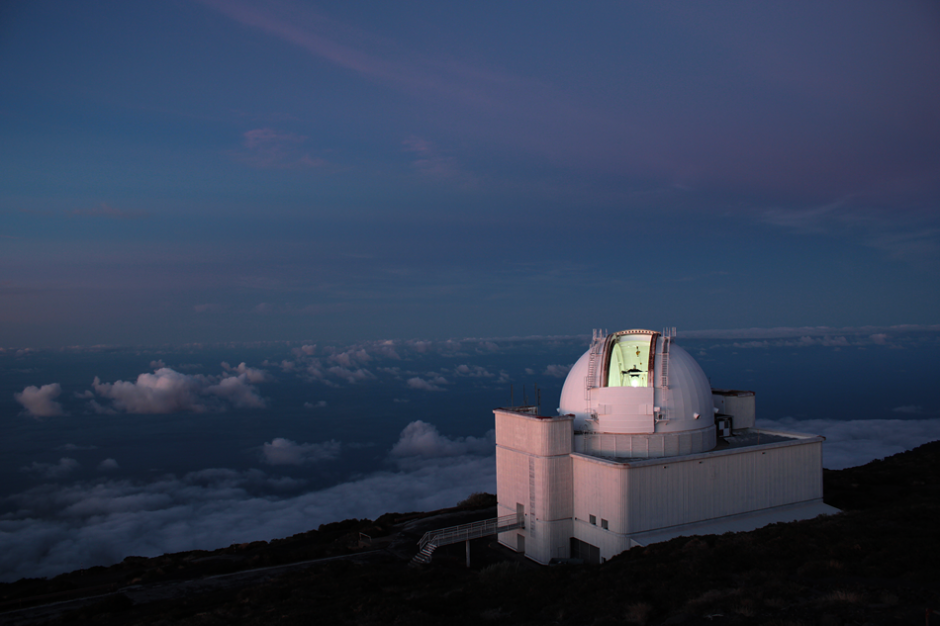
Determined to find out if X-ray binaries generally create shocks in their surroundings, we set up a very large campaign to take H-alpha images of many tens of X-ray binaries. For this purpose we are using the Wide Field Camera (WFC) mounted on the Isaac Newton Telescope that is located on La Palma, Spain. To be able to also access X-ray binaries that are located in the Southern hemisphere,  we are also using the Las Cumbres Observatory, which consists of network of telescopes located across the globe, and the Very Large Telescope located in Chile. To pull off this massive observing campaign, my group and I are joining forces with researchers from the University of Sounthampton in the United Kingdom, St Andrews University in Schotland, the Instituto de Astrofísica de Canarias in Spain, and New York University Abu Dhabi in the United Arab Emirates. Stay tuned for the results!

INT_bigger

The Isaac Newton Telescope on La Palma. Photo credit: see here