Facts and myths about neutron star jets

Jets are collimated outflows of matter and energy produced by accreting astrophyical objects. Such jets are found on many different scales in the universe, ranging from young stars to supermassive black holes in the centers of galaxies. Black holes and neutron stars that accrete gas from a companion star in an X-ray binary are prominent jet producers too. In these systems, the collimated jets are most prominently detected at radio wavelengths.

Starting in the 1970s, the radio jets of X-ray binaries have been studied in great detail. One key characteristic is that there is a very strong correlation between the radio brightness and the X-ray luminosity, which suggests a strong coupling between the inflow of matter (traced by the X-rays) and the outflow (traced by the radio emission). Early studies suggested, however, that the coupling between the X-rays and the radio emission, parametrized by the coupling index beta, is different for black holes and neutron stars. A plausible explanation for this difference could be that neutron stars have a solid surface; whereas gas that reaches a black hole can be carried across the event horizon without emitting any radiation, all energy contained by the gas will be converted into X-ray radiation when it hits the surface of a neutron star. This could translate into a different X-ray/radio correlation.

Collecting the largest sample of radio/X-ray points of X-ray binaries to date, we set out to perform a rigorous statistical analysis to investigate if the jets of neutrons stars are  fundamentally different from those of black holes. Our analysis contained a total of 35 individual black holes, and 41 neutron stars and let to several important conclusions. Several common conjectures about neutron star jets were disproved by our analysis, while others were strengthened, leading to the following facts and myths:

Facts:

Our rigorous analysis reinforces previous conjectures that the radio emission of neutron stars is fainter, by a factor ~20, than that of black holes accreting at similar X-ray luminosity. Correcting for different factors that might influence the comparison (e.g. their difference in mass, different bolometric correction factors and the extra X-ray emission of neutron stars coming from their surface) does not lift this difference. Therefore, we are left to conclude that, in general, neutron stars produce less bright radio emission than black holes accreting at similar rates.

Myths:

1) For decades, the number of neutron stars observed in the radio band was much more modest than that of black holes, partly driven by the fact (see above) that neutron stars were considerably fainter in the radio band, hence more difficult to observe. However, exploiting the current generation of upgraded radio facilities, much more neutron stars have been observed in the radio band. In fact, our study included 41 different neutron stars, compared to 35 different black holes. Neutron stars are thus no longer underrepresented in radio studies.

2) It is commonly said that neutron stars display a larger scatter in the radio/X-ray plane, i.e. display more chaotic behavior. However, in our study we found that the statistical scatter in the neutron star sample is similar to that in the black hole sample.

3) It is often assumed that neutron stars, in general, show a different (namely steeper) correlation between their radio and X-ray luminosity. However, this conjecture is largely based on a detailed study of one individual neutron star. Considering the sample as a whole, we obtained a coupling index for the neutron stars that was consistent with being the same as that of the black hole sample. It thus appears that neutron stars do not show a different radio/X-ray coupling than black holes.

Apart from comparing the neutron star and black hole samples, we also investigated if  sub-samples among the neutron stars may behave differently. Interestingly, we found that the sub-population of transitional millisecond radio pulsars, statistically behaves differently from the other neutron stars. This suggest that their jet properties are fundamentally different.

Gallo, Degenaar & van den Eijnden 2018, MNRAS Letters 478, L132: Hard state neutron star and black hole X-ray binaries in the radio:X-ray luminosity plane

Paper link: ADS

gallo2018_Lx_Lr

Radio versus X-ray luminosity of about 36 black holes (black filled circles) and 41 neutron stars (red open diamonds). The solid lines and shaded areas represent statistical fits to the correlation between the radio and X-ray luminosity. The resulting coupling index beta is quoted for both populations and is consistent with being the same within the errors.

What do neutron stars look like inside?

Everything around us is constructed of atoms, which themselves consist of electrons and nucleons (i.e. protons and neutrons). This familiar structure of matter is, however, disrupted when matter is compressed to very high densities that reach beyond the density of an atom, called the nuclear density. It is one of the prime pursuits of modern physics to understand what happens to matter beyond this point. It is not possible to generate supra-nuclear densities in terrestrial laboratories on Earth. However, neutron stars are extreme objects in which matter is compressed to enormously high densities. These stellar bodies therefore serve as exciting, natural laboratories to further our understanding of the fundamental behavior of matter.

Neutron stars are the remnants of once massive stars that ended their life in a supernova explosion. A defining property of neutron stars is that these objects are very compact; while being roughly a factor of 1.5 more massive than our Sun, their radius is almost 100.000 times smaller. Due to their extreme compactness, neutron stars are the densest, directly observable stellar objects in our universe. These fascinating objects come in a wide range of manifestations, e.g. as single stars or as part of a binary, and can be detected at different wavelengths.

Unfortunately it is not possible to travel to a neutron star to conduct experiments of how their interiors look like. However, the macroscopic properties of neutron stars, such as their mass, radius and rotation rate, provide indirect yet powerful information about their interiors. The electromagnetic radiation coming directly from the surface of neutron stars, or from matter that revolves around them, can be used to measure these macroscopic properties. These observational constraints can then be used to infer for instance how high their central density is, what kind of particles are present, and what the superfluid properties of their interior are.

We recently reviewed how different types of electromagnetic observations can be employed to learn more about the interior of neutron stars. This included commonly used techniques of combining radio pulsar timing with optical spectroscopic studies to measure neutron star masses, as well as various techniques to measure neutron star radii from X-ray data. In addition, we touched upon various techniques that have not yielded strong constraints to date, but have great potential to be further developed in the future and can be particularly interesting when combined with other methods. Finally, we provided an outlook of the potential for neutron star research of the future generation of ground-based  observatories such as the Square Kilometer Array and the new class of 30-m telescopes, as well as new and upcoming X-ray facilities such as NICER, eXTP, Athena and X-ray polarimetry missions.

Degenaar & Suleimanov 2018, book chapter in The Physics and Astrophysics of Neutron Stars, Springer Astrophysics and Space Science Library: Testing the equation of state of neutron stars with electromagnetic observations

Paper link: ADS

SKA

Artist impression of the Square Kilometer Array (SKA), which is currently in the design phase. This radio facility is expected to be transformable in many areas of science, including measuring the masses (and spins) of neutron stars.

Zooming in on an intriguing neutron star

Neutron stars and black holes are the collapsed remnants of once massive stars that ended their life in a supernova explosion. A defining property of neutron stars and black holes is that their mass is compressed into a very small volume and therefore these stellar corpses are also referred to as compact objects.

One direct consequence of their compactness is that neutron stars and black holes exert immense gravity. When they are part of a binary star system, this allows them to pull off gas from their companion star and swallow this material to their own benefit (e.g. to increase their own mass and spin). This process of mass transfer is called accretion and plays an important role throughout the universe. Understanding exactly how neutron stars and black holes eat, and how much they spit back into space, is therefore a very active area of research.

Accretion onto compact objects leads to the liberation of enormous amounts of gravitational energy, which is carried into space as electromagnetic radiation. Most of the energy is released in the inner part of the gaseous disk that forms around the neutron star or black hole. The temperatures in this part of the disk are billions of degrees Celsius, which implies that the radiation is visible at X-ray wavelengths. For this reason, accreting neutron stars and black holes are called X-ray binaries.

Despite that X-ray binaries radiate most prominently in the X-rays, the cooler parts of their accretion disks emit at ultra-violet (UV), optical and infrared wavelengths, while the material that is blown back into space is typically detected in the radio band. Furthermore, their companion star also emits optical, infrared, and sometimes UV, radiation. Although the accretion in X-ray binaries is typically studied with X-ray telescopes, forming a complete picture of all components involved in the accretion process requires studying X-ray binaries at all wavelengths, from X-ray and UV to optical and infrared, all the way to radio. Such multi-wavelength studies are highly challenging, however, because every different wavelength requires another observatory and the data acquisition, reduction and analysis techniques are widely different.

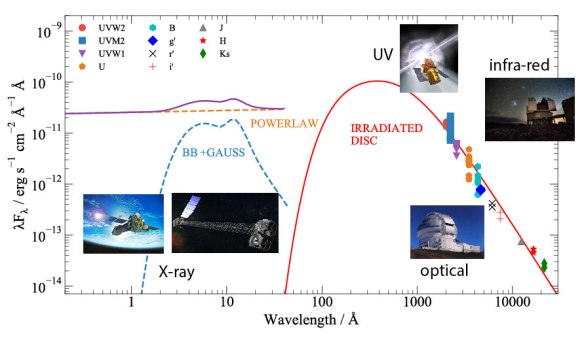
In an effort to elucidate the puzzling nature of the intriguing neutron star X-ray binary IGR J17062-6143, we carried out an ambitious multi-wavelength observing campaign. We used three satellites (NuSTAR, XMM-Newton, and the Neil Gehrel’s Swift observatory), as well as two large ground-based telescopes (Gemini South and Magellan) to understand i) if the neutron star in this X-ray binary is stopping the accretion flow with its magnetic field, ii) if part of the accreted gas is blown away in a wind, and iii) if the accretion disk has a size similar to other X-ray binaries or is comparatively small.

Jakob utilized a total of four different X-ray analysis techniques (broad-band X-ray spectral fitting, reflection spectroscopy, high-resolution X-ray spectroscopy and coherent X-ray timing) to zoom in on the properties of the hot inner part of the accretion flow, near the neutron star. Among his main findings are that the inner part of the gas disk does not extend close to the neutron star as is usually the case in X-ray binaries, but is truncated well away from it (question i above). Secondly, he found evidence for an outflowing wind (question ii above), which may be related to the fact that the inner disk is vacated (e.g. the magnetic field of the neutron star may be pushing the gas away and expelling it into a wind). Finally, he found evidence for unusually high abundances of oxygen in the gas surrounding the neutron star. This could indicate that the companion star is very old, which ties in with our other multi-wavelength data analyzed by Juan.

Juan did an amazing job at combining the information from various different wavelengths to understand the size of the accretion disk in IGR J17062-6143 in (question iii above). Fitting the multi-wavelength spectral-energy distribution to accretion models, he found that the gas disk in this X-ray binary must be exceedingly small compared to other systems. In particular, he found that the companion star must be orbiting the neutron star in less than an hour, which implies that the companion must be a very old, small star. Such old stars have lost all their hydrogen and as a result the accretion that they feed has a more exotic chemical composition, which can explain the abundance of oxygen found in Jakob’s X-ray analysis.

X-ray binaries with very small orbits and old companions are called ultra-compact X-ray binaries. Only about a dozen of such systems are known, but their is high desire to find more of them. For instance, characterizing ultra-compact binaries is very important for understanding how binary stars evolve. Furthermore, these systems are expected to emit gravitational waves that should be detectable with future gravitational wave detectors such as LISA.

Our efforts demonstrated the power of multi-wavelength studies to gain a deeper understanding of accretion processes and to find rare, exotic X-ray binaries.

van den Eijnden, Degenaar, Pinto et al. 2018, MNRAS 475, 2027: The very faint X-ray binary IGR J17062-6143: a truncated disc, no pulsations, and a possible outflow

Paper link: ADS

Hernández Santisteban, Cuneo, Degenaar et al. 2019, MNRAS in press: Multi-wavelength characterisation of the accreting millisecond X-ray pulsar and ultra-compact binary IGR J17062-6143

Paper link: ADS

global_sed_flux

Accumulation of multi-wavelength data for the neutron star X-ray binary IGR J17062-6143. Shown is the spectral-energy distribution that was obtained with three different satellites and two ground-based telescopes. This image is adopted from Juan’s paper.

The devastating impact of X-ray bursts

When plasma falls onto a neutron star it undergoes thermo-nuclear reactions that can cause an extremely energetic explosion called an X-ray burst. Such explosions are extremely common: tens of thousands of X-ray bursts have been recorded to date with different X-ray detectors and on some neutron stars the explosions repeat every few hours.

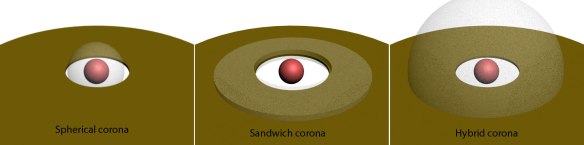
X-ray bursts occur on neutron stars that are surrounded by a gaseous disk in which material that is pulled off the companion star spirals at increasing speed until it finally plunges into the neutron star. Apart from this accretion disk, a neutron star is also surrounded by a hot plasma, called a corona. The formation and properties of accretion disks are much better understood than that of the corona.

It has long been appreciated that the properties of the accretion flow (i.e. the accretion disk and the corona) affect the observable properties of X-ray bursts such as their peak brightness, duration, recurrence rate and variability properties. However, in recent years evidence for the reverse interaction have been accumulating too: the devastating power of X-rays bursts can destruct the accretion disk and corona that surround the neutron star. Shortly after the surge of energy from the X-ray burst is over, the disk and corona should return to their original status.

Change is always a very powerful diagnostic in astronomy. The destruction and re-formation of accretion disks and coronae in response to an X-ray burst can therefore reveal intriguing new insight in the properties of accretion flows. Given that X-ray bursts are very common, they can thus serve as a powerful, repeating probe to study the poorly known properties of coronae (such as their geometry) and how an accretion disk responds to a sudden shower of intense radiation.

We recently reviewed all the observational evidence for X-ray bursts interacting with the accretion flow. Based on our current understanding of these interactions, we looked ahead and studied how new and concept X-ray missions such as ASTROSAT (launched in 2015), NICER and HXMT (both launched in 2017), eXTP and STROBE-X (mission concepts currently under study) can further this research field. We also proposed various multi-wavelength strategies can be leveraged to learn more about accretion flows using X-ray bursts.

Degenaar, Ballantyne, Belloni et al. 2018, Space Science Reviews 214, 15: Accretion Disks and Coronae in the X-Ray Flashlight

Paper link: ADS

corona

Schematic overview of three different possible geometries for the corona in an X-ray binary. The neutron star is indicated as the red ball, the accretion disk as the brown surface, and the corona as the grey structure.

Exploring a very dim X-ray binary

Some neutron stars that consume gas from a companion star generate much dimmer X-rays than the general population of X-ray binaries. Since the brightness scales with the amount of mass that is being devoured, it seems that in these sub-luminous X-ray binaries the neutron star is not eating much. There are two leading theories to explain why this may be happening, which breaks down to a supply or demand problem.

One obvious explanation might be that some neutron stars have old, small companion stars that are deprived of hydrogen (the most abundant element in the Universe) and supply only a limited amount of gas. Indeed, attempts to study the donor stars suggest that some of these neutron stars are being starved. However, there are also a few cases where the optical emission is bright and the transferred gas clearly contains hydrogen, implying that there shouldn’t be a supply problem.

An alternative explanation is that some neutron stars have little appetite and consume only a small amount of the gas that is offered to them. In particular, these neutron stars may have a relatively strong magnetic fields that is able to stop the gas supplied by the donor from falling on to the neutron star or perhaps spit much of it out. To test this idea, we performed an in-depth study of the sub-luminous X-ray binary IGR J17062-6143.

First, studying its X-ray reflection using the NuSTAR and Swift satellites, we found that the gas stripped from the donor star does not reach as close to the neutron star as  normally the case in X-ray binaries. Second, using the Chandra satellite we found hints of narrow X-ray emission and absorption lines that could indicate that gas is blown away from the neutron star. The picture that appears to emerge from our study is that the neutron star in IGR J17062-6143 has a relatively strong magnetic field that pushes the in-falling gas away. Moreover, as the neutron star is (rapidly) rotating, its magnetic field may blow a large portion of the in-falling gas away, much like the propellor blades of a chopper do.

We are going to carry out further tests of this scenario. In particular, we recently obtained sensitive radio observations with the Australia Telescope Compact Array to search for  additional evidence that this neutron star is spitting out a lot of gas. Moreover, we recently obtained an optical spectrum with the large (8-m diameter) Gemini South telescope in Chili, to test if this neutron star has a normal, hydrogen-containing companion star. We are eager to see what comes out of those new observations and if those allow us to conclusively solve the “supply or demand problem” for the neutron star in IGR J17062-6143.

Degenaar, Pinto, Miller et al. 2017, MNRAS 464, 398: An in-depth study of a neutron star accreting at low Eddington rate: on the possibility of a truncated disc and an outflow

Paper link: ADS

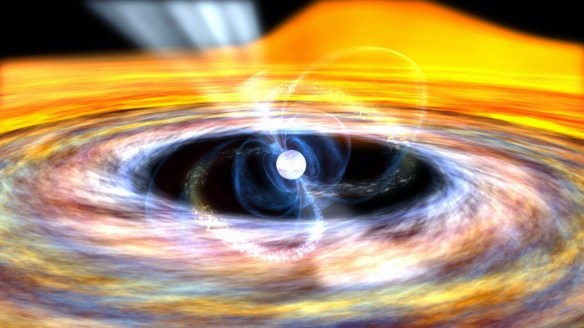
nasa_ns_pulsar

Artist impression of an X-ray binary with a neutron star that has a relatively strong magnetic field. Image credit: NASA.

Characterizing a new neutron star

Since the dawn of X-ray astronomy over 50 years ago, more than 150 neutron stars swallowing gas from a nearby (Sun-like) companion star have been identified in our Galaxy. Still, every year a few new neutron stars are discovered when they suddenly start to devour their unfortunate neighbours. Different telescopes and satellites are then used to characterize such a previously unknown X-ray binary.

In February 2015, the X-ray emission of an object named 1RXS J180408.9-342058 was suddenly found to have brightened by more than 3 orders of magnitude. It was known to be an X-ray binary since 2012 when it displayed a thermonuclear X-ray burst; a devastating burp from a dining neutron star. At the time, however, it seemed that the neutron star was only taking a mid-night snack and had gone back to sleep before we could point our telescopes to investigate its eating patterns. Luckily, when it awoke in 2015 the neutron star clearly had much more appetite and kept swallowing gas from its companion for several months. This provided ample opportunity to study it in high detail.

We used three different X-ray satellites, namely NuSTAR, Chandra and Swift, to chart the geometry of this X-ray binary and the table manners of its neutron star. NuSTAR is a particularly powerful tool to study X-rays reflecting off the gaseous disk that surrounds and feeds the neutron star. Leveraging this, we determined that we view the binary at an angle of about 30 degrees, and that the gas disk was extending very close to the neutron star. In turn, this shows that the neutron star’s magnetic field is relatively weak and not able to keep the accretion flow at a distance. With Swift and Chandra we collected X-ray data when 1RXS J180408.9-342058 was at its brightest, and this suggested that the neutron star was eating rather messy; hints of narrow absorption lines suggest that part of the gas flowing towards the neutron star was blown away in a disk wind.

Degenaar, Altamirano, Parker et al. 2016, MNRAS 461, 4049: Disc reflection and a possible disc wind during a soft X-ray state in the neutron star low-mass X-ray binary 1RXS J180408.9-342058

Paper link: ADS

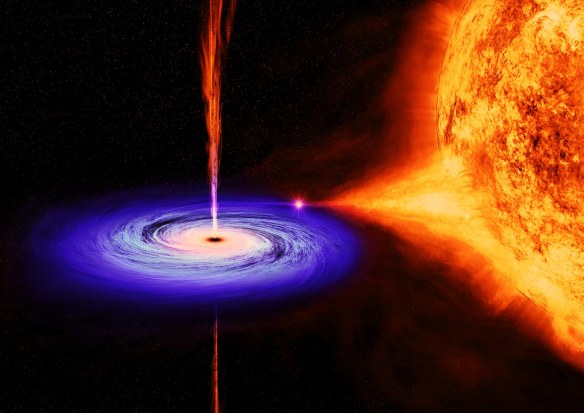
bh_binary_nasa_artistimpression_small

Artist impression of an X-ray binary. Image credit: NASA.

Accreting or cooling?

Some brave neutron stars are consuming gas from a big companion star that is about ten times as massive as the tiny neutron star itself. In these so-called Be X-ray binaries, the neutron star is typically in a very wide, eccentric orbit and only able to swallow gas from its companion when it’s making its closest approach. Usually this results in modest accretion outbursts. Occasionally, however, very bright and powerful “giant outbursts” are observed during which the neutron star has a much bigger banquet. X-ray binaries that harbor massive companion stars are younger than those with small companion stars (millions of years compared to billions of years). Furthermore, neutron stars accompanied by a massive star are more strongly magnetized (by a factor of 1000 or so) and rotate much slower (seconds versus milliseconds) than when they are fed by a small companion.

When neutron stars feed off a small companion, their 1-km thick crust is heated and cools on a timescale of years after a meal. This heating and cooling sequence provides very valuable information about the tantalizing interior of neutron stars, but there are many unanswered questions about these processes. For instance, it is not yet established how the spin rate and magnetic field strength of a neutron star affects its temperature changes. Given their widely different properties compared to neutron stars with small companions, searching for heating and cooling in Be X-ray binaries can potentially shed new light on these open questions. Giant outbursts should then provide the best opportunity for this quest, as we might expect a neutron star to become more severely heated (and hence more clearly cooling) when more matter is consumed.

Using the X-ray telescope on board of NASA’s Swift satellite, we followed the behavior two Be X-ray binaries, V0332+53 and 4U 0115+63, after their giant accretion outbursts. Interestingly, we discovered that the X-ray brightness of these neutron stars was higher in the months after they finished their meals than it was before they started eating. This could indeed be a sign of a heated crust! However, neutron stars with massive companions are generally more messy eaters than those with small donors; the quality of our data did not allow us to exclude the possibility that their X-ray emission was elevated because these neutron stars were still scraping for food after finishing their main course. Such behavior is in itself relatively unexplored and interesting to study. Our pilot project therefore warrants follow-up investigation to explore either of these exciting possibilities.

Wijnands & Degenaar 2016, MNRAS Letters 463, L46: Meta-stable low-level accretion rate states or neutron star crust cooling in the Be/X-ray transients V0332+53 and 4U 0115+63

Paper link: ADS

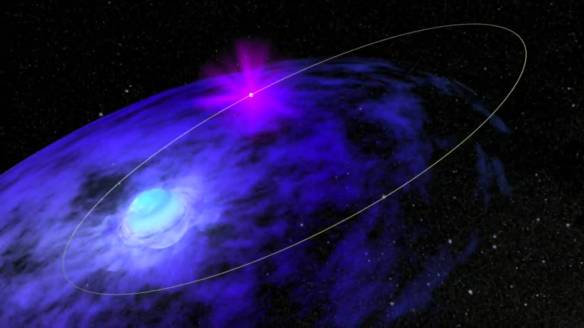
bexraybinary_artistimpress

Artist impression of a Be X-ray binary; a neutron star in a wide, eccentric orbit around a massive companion. Image credit: Walt Feimer, NASA/Goddard Space Flight Center.


Blown away by an accretion disk wind

GRO J1744-28 is among the most puzzling neutron star X-ray binaries known in our Galaxy. How could the companion star have possibly reduced to its current small size without spinning the neutron star up to very high rotation rate or without strongly reducing its magnetic field? High-resolution Chandra X-ray observations may have solved this puzzle.

After remaining dormant for nearly 20 years, GRO J1744-28 suddenly exhibited a new accretion outburst in 2014. This provided the excellent opportunity to study this extraordinary X-ray binary with modern X-ray telescopes. Using high-resolution Chandra Grating Spectroscopic observations, we found evidence for X-ray absorption lines that could arise from a dense wind blowing off the accretion disk. Such winds are commonly seen for black hole X-ray binaries, although it is not established yet whether similarly strong winds can also form in the accretion disks that surround neutron stars.

If the absorption features in GRO J1744-28 indeed origin in a disk wind, then energetic considerations suggest that this wind may carry away a considerable amount of matter that is being transferred from the companion star. Therefore, a considerable amount of matter may be lost from the binary without accreting onto the neutron star. This could potentially solve the long-standing puzzle of how to reconcile the very low mass of the companion star in GRO J1744-28 with the slow rotation period and high magnetic field of the neutron star primary.

Degenaar, Miller, Harrison, Kennea, Kouveliotou, Younes 2014, ApJ Letters 796, L9: High-resolution X-Ray Spectroscopy of the Bursting Pulsar GRO J1744-28

Paper link: ADS

 Artist impression of an X-ray binary with a strong disk wind. Credit: NASA’s Goddard Space Flight Center / Chandra X-ray observatory / M. Weiss

Artist impression of an X-ray binary with a strong disk wind.
Credit: NASA’s Goddard Space Flight Center / Chandra X-ray observatory / M. Weiss