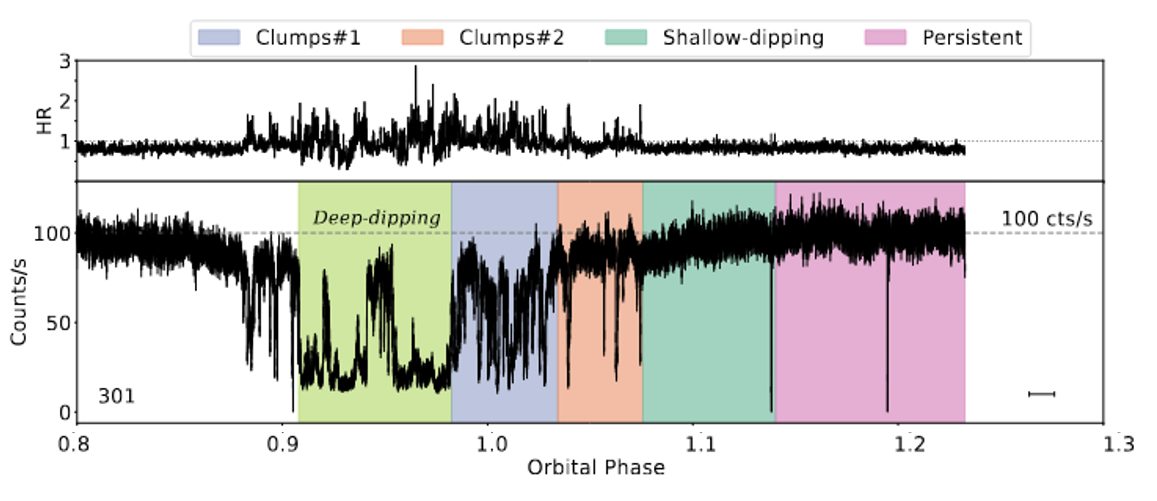
Everybody experiences a dip sometimes, but some X-ray binaries have a lot of dips. In the world of X-ray binaries, 4U 1624-490 is quite a legend. Known as Big Dipper, this binary system, consisting of a neutron star snacking on a nearby companion, is famous for the dramatic, periodic drops in its X-ray light. For long, these “dips” are thought to happen because a massive bulge of gas on the edge of the accretion disk swings into our line of sight, temporarily blocking the view. The properties of this bulge, such as its structure, size and temperature, remain largely unknown, however, and so is the role that these may play in setting the dynamics of the flow of accretion towards the neutron star.
A new, deep look with the XMM-Newton satellite has revealed that the bulge isn’t a solid wall of gas, but more like a cosmic sandstorm. Slicing the X-ray data into different segments revealed that the material hitting the disk is surprisingly complex. Instead of a uniform cloud, the bulge is a multi-phase mixture of both cold gas and highly ionized hot gas. The most striking discovery, however, is just how clumpy the system is. The dipping phenomena isn’t observed as a smooth fade-out and fade-in, but rather as a chaotic series of flickers caused by individual clumps of dense gas passing through our line of sight. By calculating the size of the bulge compared to the shortest flickers in the light curve, we estimated that this turbulent region contains at least 7,000 individual clumps.
Even during episodes that 4U 1624-490 is not dipping, we found evidence of a highly ionized atmosphere surrounding the entire disk. It seems that it is much messier than previously thought, with the impact of the gas stream potentially creating a splash so turbulent that it generates a swarm of thousands of mini-clouds that we detect as an atmosphere. This study shows that dipping light curves are powerful tracers that let us map out the hidden, chaotic structures of accretion disks in unprecedented detail.
Caruso, Costantini, Degenaar, Diaz Trigo 2026, Astronomy & Astrophysics 705, 176: An XMM-Newton long look at the accretion disk plasma in the dipping neutron star LMXB 4U 1624-490
Shedding light on an old black hole mystery using… a neutron star!
Neutron stars and black holes are both remnants of massive stars that ended their lives in a supernova explosion. They also both exert very strong gravity and when they are part of a binary star system, this allows them to devour gas from their unfortunate companion star. This gas spirals towards the cannibal forming a disk that is incredibly hot, so hot that it emits X-ray radiation. As these cosmic dinner parties can be spotted as sudden eruptions of X-ray emission, these stellar binaries containing a black hole or a neutron star are called X-ray binaries. However, neutron stars and black holes are greedy and cannot swallow all gas they attract; some of it is flung into space through powerful collimated jets or dense winds.
Despite their similar behavior, there is a distinct difference between the two tribes of cannibals: whereas for neutron stars the attracted gas plunges into their solid surface or anchored magnetic field where it may create observable shocks or explosions, a black hole silently swallows the gas from view beyond its event horizon. However, it has not been established yet how this and other differences between the two types of objects, such as the higher mass and faster spin rate of black holes, affect their eating patterns. Vice versa, comparing how neutron stars and black holes take their meals in can teach us how accretion and the production of outflows fundamentally works.
In 2018, a X-ray binary called Swift J1858.6-0814 was discovered when it suddenly started consuming material from its companion star. Unlike other X-ray binaries, it did so in an incredibly violent way, showing bright sparks, called flares, visible from radio to X-ray wavelengths The origin of this “cosmic fireworks” was unknown, but since it was so extreme, the astronomical community was convinced that this was the work of a black hole. However, over a year after its discovery, Swift J1858.6-0814 suddenly ignited a thermonuclear explosion, which require the presence of a solid surface. This exposed the black hole imposter, revealing that this extreme X-ray binary, in fact, harbored a neutron star.
Because of its extreme behavior, Swift J1858.6-0814 was closely watched, using many different space-based and ground based telescopes, including NASA’s Hubble Space Telescope, ESO’s Very Large Telescope and ESA’s XMM-Newton satellite. For over a year, this suite of observing facilities was used to decipher the complex table matters of the neutron star. This led to the remarkable result that similar patters were found as seen in the notorious black hole X-ray binary GRS 1915+105, which had been standing out for decades because of its extreme behavior. Intense study suggests that the gaseous disk surrounding these compact objects must cyclically empty and fill, causing repeated spectacular ejections of matter into jets (seen at radio waves and infrared wavelengths). The discovery that both black holes and neutron stars experience this instability implies that it is a fundamental (i.e. unavoidable) process that occurs when compact objects are overfed.
Vincentelli et al. 2023, Nature 615, 45: A shared accretion instability for black holes and neutron stars
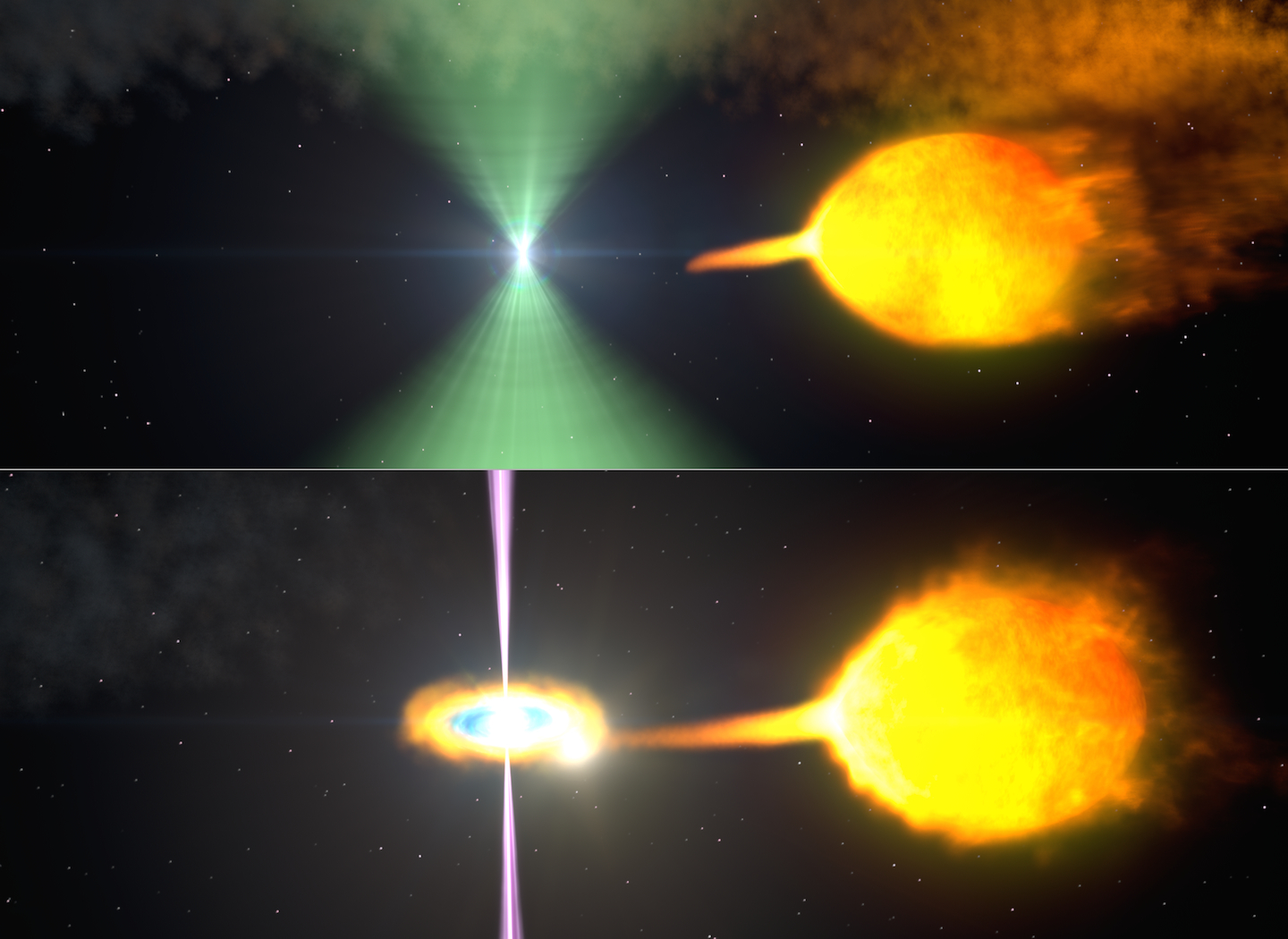
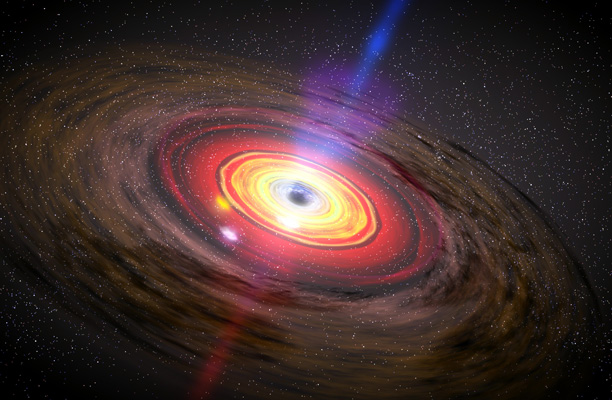
Artist’s impression of an X-ray binary containing a black hole (left) and a neutron star (right) swallowing gas from a companion star through an accretion disk. The insets show how the intensity of the emission varies strongly as the inner disk cyclically empties and re-fills. Whereas the timescales are different for the two objects, the underlying mechanism is thought to be the same. Image credit: Gabriel Pérez Díaz (IAC).
At the heart of our Milky Way galaxy lurks a supermassive black hole. It is called Sagittarius A*, or Sgr A* for short, and contains as much mass as 4 million Suns together. Our Milky Way is not unique in this respect: it is thought that every galaxy in our Universe harbors a supermassive black hole in its center. As they are notorious for, black holes suck up material from their surroundings, but they also blast large amounts of gas and energy into space. By doing so, the monstrous black holes in the centers of galaxies play an important role in how galaxies evolve over cosmic timescales and also how large-scale structures formed in our Universe. Studying the table manners of supermassive black holes is therefore a very active area of research.
The material that is irrevocably dragged towards a black hole lights up and provides us with a measure of how (much) the black hole is eating. Our very own supermassive black hole does not appear to have a large appetite as we see relatively little light coming from its surroundings compared to other supermassive black holes. However, roughly once a day we see a flare of (X-ray) emission coming from the position of Sgr A*. Despite that this flickering has long been known, we do not know yet what is causing it. Possibly, these are instances that the supermassive black hole is taking a gollup of material for instance a comet or some other small astrophysical object. Another possibility is that magnetic fields that must be treading the material swirling around Sgr A* are playing up.
Over the past two decades there have been many different efforts to understand the flickering behavior of Sgr A*, for instance by studying the energy of flares, to map out the distribution of flare properties, or attempting to constrain how often they occur. A challenge for the latter is that the flares are relatively sporadic. It therefore requires a lot of staring with telescopes to collect a sufficiently large number of flares to be able to draw firm conclusions on their recurrence rate. Most telescopes do not allow for such studies, either because it is technically not possible to take long stares at a single point in the sky, because their detectors do not have sufficient angular resolution to separate Sgr A* from the many nearby stars, or because the competition for telescope time is so high that long stares can usually not be granted.
The Neil Gehrels Swift observatory, shortly called Swift, is a satellited that was launched by NASA in 2005 and was specifically designed to be able to rapidly point to different positions in the sky. Because of this rapid slewing capability, it is no trouble for Swift to very frequently visit a certain position in the sky, hence effectively build up a long stare at that position. Taking advantage of this exceptional capability, Swift has been taking brief (about 20-min long) snapshots of the center of our Milky Way galaxy with its onboard X-ray telescope nearly every day since 2006. Having accumulated over 2000 X-ray pictures of Sgr A* by now, these Swift data provide a truly unique opportunity to study its flickering behavior over a 15 year baseline.
In the summer of 2019, Alexis Andes, an undergraduate student in El Salvador at the time, came to Amsterdam as part of the ASPIRE program. This program provides research opportunities for students that cannot easily study astrophysics in their home country. Alexis’ research project was to perform a statistical analysis of Swift’s X-ray data of Sgr A* to understand if its flickering behavior is constant over time. Excitingly, this turned out not to be the case! Our study revealed that there are sequences of years in which our supermassive black hole is frequently flickering but also stretches of years in which it is much more quiet. It was not known before that Sgr A* changes its behavior in this way.
Our results do not provide a conclusive answer on the cause of the flickering just jet. However, we noted that years of enhanced flickering seemed to occur after orbiting stars closely passed Sgr A*, such as the object G2 did a few years ago. Possibly, this can stir up the gas swirling around the supermassive black hole, causing it to be more restless for some period of time. While this is highly speculative at present, we can test this idea with continued Swift monitoring of Sgr A*: we predict that the flickering will become more quiet again within 1-2 years as the gas flow settles again after G2’s passage. So stay tuned!
Andes, van den Eijnden, Degenaar, Evans, Chatterjee, Reynolds, Miller, Kennea, Wijnands, Markoff, Altamirano, Heinke, Bahramian, Ponti, Haggard 2022, MNRAS 510, 285: A Swift study of long-term changes in the X-ray flaring properties of Sagittarius A*
X-ray binaries, in which a neutron star or black hole swallows gas from a companion star, have been known since the dawn of X-ray astronomy in the 1960s. With decades of studies, using many different space-based and ground-based telescopes across the electromagnetic spectrum, we have learned many things about how neutron stars and black holes accrete gas. Nearly all of this knowledge has been assembled for stages during which X-ray binaries are rapidly accreting gas, making them shine bright at all wavelengths and hence can easily be studied. However, most X-ray binaries spend only a fraction of their time being bright and rapidly accreting; the far majority of their time their gas consumption occurs at a very low level. Because X-ray binaries are much dimmer when accreting slowly, it is much more challenging to study them. Our standard models predict that accretion proceeds very differently at low rates, but we have hardly any observational constraints to test and further develop models of low-level accretion.
There are many different components in an X-ray binary that emit electromagnetic radiation. One of the prime emission components is the accretion disk that, depending on its physical properties like its temperature, radiates at X-ray, UV, optical and near-infrared wavelengths. At low accretion rates, however, theory predicts that this disk evaporates into a more extended hot flow that may emit energy at the same wavelengths as the disk. Apart from the accretion stream, be it a disk or a hot flow, the companion star also emits UV, optical and near-infrared emission (depending on what type of star it is and whether it is being irradiated by the accretion flow), whereas X-ray binaries also launch jets that can be detected at radio and near-infrared wavelengths, but possibly also in the optical, UV and X-ray bands too. Disentangling the different emission components, and finding which one(s) dominate(s) the total observed emission, can be a powerful way to obtain details about the accretion process. This is not an easy task, however, because for each different wavelength we (generally) need different telescopes and it’s very challenging to coordinate different observatories.
The Swift satellite is a very important observatory to study X-ray binaries. This is for two reasons. Firstly, it is a relatively small satellite that can easily maneuver around, allowing us to take frequent snapshots of sources (which is not possible for bigger satellites). Secondly, Swift carries both an X-ray telescope and a UV/optical telescope, which can observe an astrophysical object at the same time. Combined with its good sensitivity, this makes that Swift is a powerful tool to study how the accretion flow in X-ray binaries changes when it moves (quickly!) from high to low accretion rates. We attempted such a dedicated study for the well-known neutron star X-ray binary Aquila X-1 (aka Aql X-1).
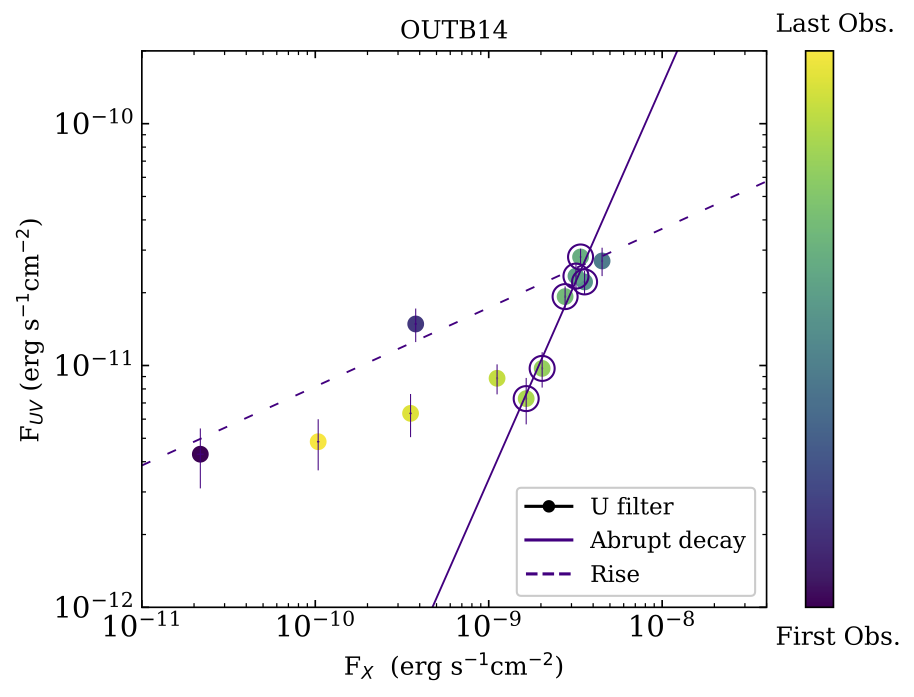
Using Swift data from the NASA archives that covered three different accretion outbursts of Aql X-1, we studied how the X-ray, UV and optical emission changed as the source evolved between high and low accretion rates. We found that the X-ray and UV/optical emission always change together, but that this happens in a different manner when Aql X-1 is bright than when it is fading. This implies that the dominant mechanism producing UV and optical emission changes during the decay of an outburst, as is expected from accretion theory. It might be a hint that an accretion disk is changing into a hot flow, or that the properties of the accretion disk are changing otherwise. Moreover, we found that the UV and optical emission behaves differently during the rise of an outburst than during the decay. This suggests that the accretion flow may have different properties at the start and the end of an outburst. This investigating has exposed some interesting behavior that warrants follow-up by performing similar studies for other X-ray binaries or using additional observatories.
López-Navas, Degenaar, Parikh, Hernández Santisteban, van den Eijnden 2020, MNRAS 493, 940: The connection between the UV/optical and X-ray emission in the neutron star low-mass X-ray binary Aql X-1
The X-ray and UV flux of Aql X-1 over an entire outburst. It can be seen that the emission at the two wavelengths is coupled in a different manner when the source is bright than when it is faint. Moreover, the UV flux is fainter during the decay (yellow/green points) than during the rise (blue/purple points) of the outburst.
X-ray binaries are most easily studied when they are devouring a lot of gas and therefore produce bright radiation at X-ray, UV, optical, infrared and radio wavelengths. During such outburstepisodes, the gas that is being stripped off from the companion forms a disk that swirls around the black hole or neutron star. We think that this accretion disk extends very close to the cannibal star, maybe even touching it.
During quiescent episodes, X-ray binaries are consuming much less gas and are therefore orders of magnitude dimmer at all wavelengths. Current theories of accretion prescribe that during quiescence, the accretion disk cannot extend close to the black hole or the neutron star and must lie (tens of) thousands of kilometers away. In between the edge of this disk and the compact star, the gas flow might be very hot and vertically extended. However, because this gas is very tenuous and not producing strong radiation, it is very hard to test this idea with observations.
Accretion theory thus predicts that as an X-ray binary starts to fade from outburst to quiescence, the geometry of the accretion flow is strongly changing. However, it is highly challenging to measure this because 1) it’s not predictable exactly when X-ray binaries transition to quiescence, 2) once they do, the transition happens very rapidly, typically on a timescale of 1-2 weeks, and is therefore easy to miss, and 3) as X-ray binaries decay into quiescence they become increasingly dim and therefore long/sensitive observations are needed in order to study the properties of the accretion stream. Ready to take up this challenge, we recently designed an ambitious observing campaign aimed to reveal the changing accretion flow in an X-ray binary called 4U 1608-52.
One powerful way to measure the location of the inner edge of an accretion disk is X-ray reflection. This produces prominent emission features at certain X-ray energies that can be studied with sensitive X-ray telescope. NuSTAR is one of the telescopes that is optimally suited to study X-ray reflection. In a previous study, we observed the X-ray binary 4U 1608-52 during one of its accretion outbursts. Our NuSTAR observation revealed a beautiful X-ray reflection spectrum that allowed us to determine that the accretion disk was extending very close to the neutron star. Taking advantage of the fact that 1) this X-ray binary goes into outburst once every few years (opposed to some sources for which we have observed only 1 outburst over 5 decades), and 2) it produces a very strong reflection spectrum, we designed an observing campaign to capture the source again with NuSTAR, but then at a factor ~10 lower luminosity. The main aim was to use the reflection spectrum to determine if with this change in brightness, the accretion geometry changes a lot.
When our target 4U 1608-52 was seen to enter a new accretion outburst in 2018, we closely monitored how its brightness evolved by looking at the data obtained with the Japanese MAXI X-ray telescope that is installed on the International Space Station. Once MAXI showed that the X-ray brightness of 4U 1608-52 was decreasing, we performed observations with the much more sensitive Swift and NICER telescopes. This allowed us to continue watching our target once it became too faint to be detected with MAXI. We analyzed each new Swift observation immediately after it was performed and tried to predict how the brightness of our target would decay onward. With a few days lead time, we then triggered our NuSTAR observation, hoping that it would observe our target at exactly the right time.
After an intense 2 weeks of watching 4U 1608-52 closely every day, we succeeded to have NuSTAR point to our target at exactly the right time. Interestingly, our new NuSTAR observation showed that with a factor ~10 change in brightness, the reflection spectrum completely disappeared. We think that this is because the accretion flow is changing from a (flat) disk into a hot (spherical) structure. This constitutes one of the very few observations that supports standard accretion models, so we are very excited about these results.
van den Eijnden, Degenaar, Ludlam, Parikh, Miller, Wijnands, Gendreau, Arzoumanian, Chakrabarty, Bult, 2020, MNRAS 493, 1318: A strongly changing accretion morphology during the outburst decay of the neutron star X-ray binary 4U 1608-52
NICER and NuSTAR spectra of 4U1608-52. The left panel shows the data obtained during several instances along the 2018 outburst. Data obtained during the 2014 outburst is shown for comparison. A prominent feature can be seen between 5 and 10 keV that is referred to as the iron (Fe-K) line and gives information about the accretion geometry. The right panel shows that this emission feature disappears during the decay of the outburst, which shows that there is a dramatic change in the accretion flow.
MXB 1730-335, also known as “the rapid burster”, is a neutron star that is located in the Galactic globular cluster Liller 1 and swallows gas from a companion star. It is infamous for displaying a peculiar phenomena called type-II X-ray bursts. These brief, bright flashes of X-ray emission are likely caused by a short-lived increase in the amount of gas that falls onto the neutron star, but over 40 years after the discovery the exact nature of these tantalizing X-ray flashes remains unknown. One of the puzzles is that there are only two neutron stars in our entire Galaxy that exhibit these flashes; the other is “the bursting pulsar” GRO J1744-28.
The rapid burster exhibits accretion outbursts that lasts a few weeks and recur about every 100 days. It so happened that in 2015 October an outburst was anticipated at a time that both NuSTAR and XMM-Newton could observe the object. This provided the unique opportunity to leverage the strengths of both instruments — high sensitivity at soft photon energies (0.3-3 keV) for XMM-Newton and high sensitivity to reflection features for NuSTAR — to study this peculiar neutron star. To this end, rapid-burster expert and former Amsterdam/SRON PhD student Tullio Bagnoli designed a novel observing campaign with Swift to catch a new outburst and trigger observations with NuSTAR and XMM-Newton accordingly. Jakob analyzed these data and may have found new clues to the old, unsolved mystery of the origin of type-II X-ray bursts.
Accretion disks normally extend close to the surface of the neutron star. However, analysis of reflected X-ray light in the rapid burster reveals that the inner accretion disk is strongly truncated; it lies about a factor of 5 further away from the neutron star than is typically seen in other objects. A plausible explanation for this finding is that the rapid burster has magnetic field strong enough to prevent the accretion disk from coming closer to the neutron star. Since we obtained a similar result for GRO J1744-28, this could indicate that the type-II phenomenon is related to the magnetic field of the neutron stars.
van den Eijnden, Bagnoli, Degenaar et al. 2017, MNRAS Letters 466, L98: A strongly truncated inner accretion disc in the Rapid Burster
Near-infrared (J,K) images of the Galactic globular cluster Liller 1 obtained with the GeMS camera mounted on the 8-m Gemini telescope in Chile. The inset shows a zoom of the core of the cluster, spanning 1.9 light year across. Image credit: F.R. Ferraro/E. Dalessandro (Cosmic-Lab / University of Bologna, Italy)
The X-ray binary 4U 1608-52 contains a neutron star that is normally dormant, but awakens about every 2 years to feast on (i.e., accrete from) its companion star for a few weeks-months before it returns to quiescence again. In October 2014, 4U 1608-52 entered such an accretion outburst and we took the opportunity to observe the neutron star in action using NASA’s newly launched NuSTAR satellite.
NuSTAR was launched in 2012, and provides unprecedented sensitivity at X-ray energies of 3-79 keV. As such, it is an excellent tool to detect X-ray reflection off accretion disks in systems such as X-ray binaries and Active Galactic Nuclei (AGN). Such reflection manifests itself as a broad iron emission line around 6-7 keV, and a “Compton hump” near 20-40 keV. The ability of NuSTAR to detect both these features with excellent sensitivity allows to obtain detailed information about the accretion geometry, such as the inner radius of the accretion disk and the location of the illuminating X-ray source. Such studies are routinely performed for accreting supermassive black holes and stellar-mass black holes in X-ray binaries, but much less is known about the accretion geometry of neutron stars.
The NuSTAR observation of 4U 1608-52 revealed a reflection spectrum of unprecedented quality. This allowed us to match the observational data with detailed theoretical reflection models to infer information about the accretion geometry. Excitingly, we caught the neutron star accreting very slowly, at only about 1% of the Eddington limit. This is a regime that is difficult to capture, and therefore the accretion geometry is particularly uncertain. From our observation, we found that the accretion disk was extending very close to the neutron star, opposed to the expectation that the accretion disk is receding at slow accretion rates. Furthermore, our modeling showed that the X-ray source illuminating the accretion disk (often referred to as the “corona”) was located very close to the neutron star.
Degenaar, Miller, Chakrabarty, Harrison, Kara, Fabian 2014, MNRAS Letters 451, L85: A NuSTAR observation of disc reflection from close to the neutron star in 4U 1608-52
Schematic representation of the reflection of X-ray radiation off an accretion disk. Credit: Gilfanov M., 2010, Lecture Notes in Physics, Vol. 794, Springer-Verlag, Berlin, p. 17
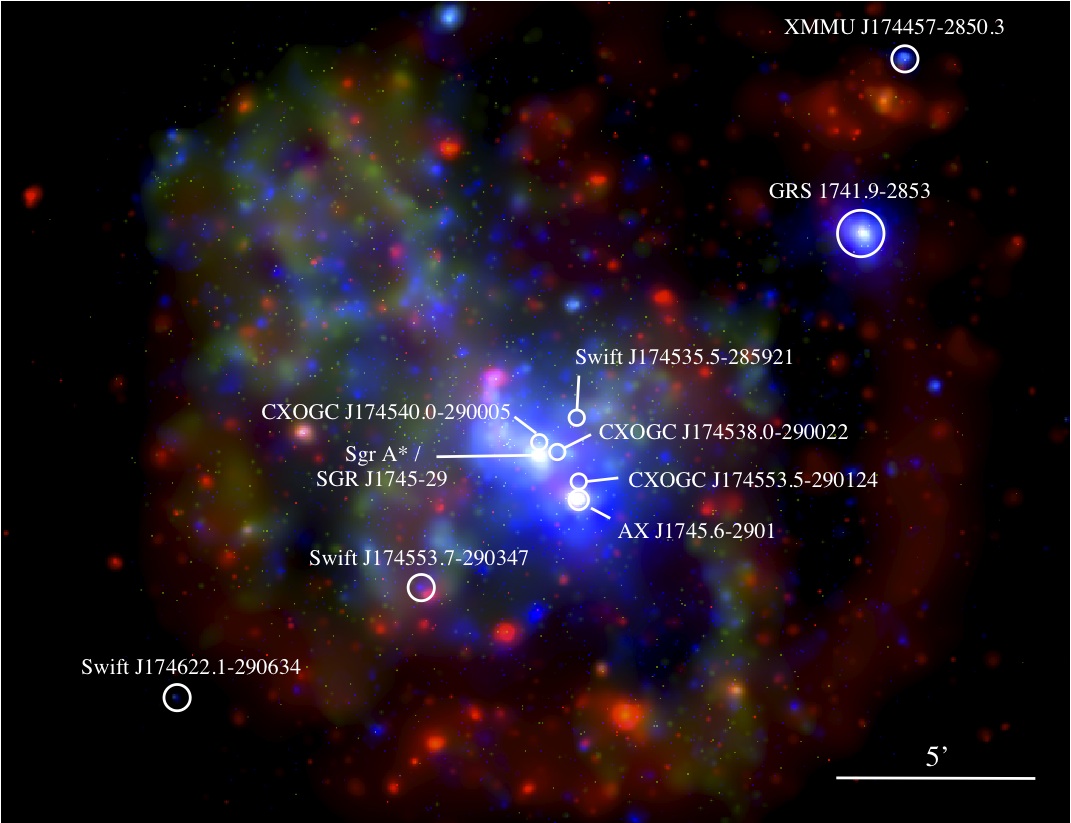
In 2006 February, shortly after its launch, the Swift satellite began monitoring the inner 50 x 50 pc (1.5×10^15 km squared) of our Milky Way with the on board X-Ray Telescope. In the months February-October*, 15-minute X-ray snapshots of our Galactic center were taken every 1-4 days. In nearly 10 years years time (2006 February till 2014 October), this accumulated to nearly 1.3 Ms of total exposure time, equivalent to about 15 days of continuous observing. This legacy program has yielded a wealth of information about the long-term X-ray behavior of the Milky Way’s supermassive black hole Sgr A*, as well as numerous transient X-ray sources that are located in region covered by the campaign.
One of the main discoveries resulting from this campaign was the detection of six bright X-ray flares from Sgr A*. These are mysterious flashes of X-ray emission during which the supermassive black hole brightens by a factor of up to approximately 150 for tens of minutes to hours. Unfortunately, Swift temporarily lost its view of Sgr A* as of April 2013, due to the sudden awakening of a nearby ultra-magnetized neutron star (a “magnetar”). The X-ray emission from this object was about 200 times brighter than that of Sgr A*, hence it outshined our supermassive black hole. However, the notorious magnetar steadily faded over time and in late 2014 we regained view of the supermassive black hole again. Indeed, a seventh X-ray flare from Sgr A* was caught in 2014 September, the brightest ever seen with Swift.
The Swift/XRT monitoring campaign has also been instrumental to understand the nature of a peculiar class of sub-luminous X-ray binaries. These are binary star systems in which a neutron star or a black hole accretes matter from a nearby companion (e.g., Sun-like) star. It has been a puzzle for decades why a small sub-group X-ray binaries are much fainter than accretion theory prescribes. This suggests that these neutron stars/black holes have little appetite, but the question is why. Swift has made a very important contribution in mapping the accretion behavior (“eating patterns”) of this class of objects and also identified 3 new members.
In addition, we discovered that “normal” X-ray binaries (i.e., ones eating more exorbitantly) sometimes display similar eating patterns as the sub-luminous X-ray binaries, giving important clues about the underlying mechanism producing low-level accretion events (i.e., fasting periods). For example, we found that in some cases the neutron stars/black holes sub-luminous X-ray binaries were likely caught enjoying an occasional midnight snack, and should be feasting on a larger banquet at other times. However, the behavior of one particular neutron star suggests that it may have a relatively strong magnetic field that sometimes simply impedes the infall (i.e., accretion) of material that is transferred from its companion. This object is therefore a candidate X-ray binary/millisecond radio pulsar transitional object.
After nearly 10 successful years, continuation of Swift’s Galactic center monitoring program remains highly valuable. For example, this would allow the collection of even more X-ray flares from our supermassive black hole, and to investigate whether the eating patterns of Sgr A* change in any way after the gaseous object “G2” has swung by.
Degenaar, Wijnands, Miller, Reynolds, Kennea, Gehrels 2015, JHEA 7, 137: The Swift X-ray monitoring campaign of the center of the Milky Way
*Due to proximity of the Sun the center of our Galaxy cannot be observed with Swift in November-January.
Swift/XRT image of the inner ~50×50 pc of the Milky Way using 1.3 Ms of data accumulated in 2006-2014. Red represents 0.3-1.5 keV energies, green 1.5-3.0 keV and blue 3.0-10 keV.
The universe is full of remarkable objects. PSR J1824-2452 is a neutron star that is located in the globular cluster M28 and emits pulsed radio emission. This energy is powered by its rapid rotation: the pulsar spins around its own axis about 15,000 times per second (it takes only 3.9 milliseconds to complete one rotation). In 2013, however, its radio pulsations disappeared and instead its X-ray emission increased by 5 orders of magnitude, it lighted off a thermonuclear X-ray burst, and exhibited X-ray pulsations power by the accretion of matter: The neutron star had suddenly become active as an X-ray binary! After about 2 months the X-rays faded and it returned to its life as radio pulsar like nothing had happened. For the first time in the history of astronomy a neutron star was caught in the act of switching identity.
Low-mass X-ray binaries and millisecond radio pulsars are two different manifestations of neutron stars in binary systems that are thought to be evolutionarily linked. In an X-ray binary, the outer gaseous layers of a small companion star (that has a mass less than that of our Sun) are stripped off and accreted by the neutron star. The large amount of energy that is liberated during the accretion process makes these interacting binaries shine bright in X-rays. After millions-billions of years the companion star will stop feeding the compact primary. The rapidly rotating neutron star, spun up to millisecond periods by gaining angular momentum during the accretion process, may now emit pulsed radio emission so that the binary is observed as a millisecond radio pulsar.
The discovery that neutron stars may rapidly switch identity between these two manifestations opens up a new avenue to study their evolutionary link. It is therefore of prime interest to identify other X-ray binary/radio pulsar transitional objects. The M28 source displayed remarkable X-ray spectral properties and X-ray flux variability, which can potentially serve as a template for such searches. Based on that, we identified one possible candidate: the peculiar X-ray source XMM J174457-2850.3 that is located at a projected distance of about 14 arcminutes from the Milky Way’s supermassive black hole Sgr A*.
XMM J174457-2850.3 is just on the edge of the region surveyed in Swift’s Galactic center monitoring program, which has taken almost daily X-ray snapshots since 2006. For years we were puzzled by the remarkable X-ray variability of XMM J174457-2850.3: instead of spending remaining dim for most of its time and making occasional excursions to bright X-ray states, we often found the source lingering in between its quiescent and outburst levels. This behavior is not typical for low-mass X-ray binaries, leaving us to ponder about the exact nature of this peculiar X-ray source. We got our answer in late 2012, when Swift suddenly caught a rare, very energetic thermonuclear X-ray burst from XMM J174457-2850.3. This conclusively established that the source is, in fact, a neutron star low-mass X-ray binary.
By investigating 12 years of Swift, XMM-Newton and Chandra data of the Galaxy center (obtained between 2000 and 2012), we found that XMM J174457-2850.3 exhibits three different X-ray luminosity states, and has an X-ray spectrum that is much harder (that is, relatively more photons are emitted at higher energies) than commonly seen in low-mass X-ray binaries. These properties are strikingly similar to the M28 X-ray binary/radio pulsar transitional object. Its unusual X-ray properties are explained as interactions between the magnetic field of the neutron star with the surrounding accretion flow. A similar mechanism may be at work in the peculiar Galactic center source XMM J174457-2850.3.
Degenaar, Wijnands, Renolds et al. 2014, MNRAS 792, 109: The Peculiar Galactic Center Neutron Star X-Ray Binary XMM J174457-2850.3
Black holes are infamous for their relentless gravitational pull through which they drain matter and energy from their surroundings. However, with their enormous power, these tantalizing objects also blast matter back into space via ultra-fast collimated jets and dense winds. Understanding the exact connection between how black holes accrete from – and supply feedback to – their environment is one of the outstanding challenges of modern astrophysics.
X-ray binaries are excellent laboratories to study the eating habits of black holes. In these binary star systems a black hole orbits a Sun-like star close enough to pull off and accrete the outer layers of its unfortunate companion. This accretion process liberates enormous amounts of energy that is emitted across the electromagnetic spectrum. Studying the accretion flow in X-ray binaries thus warrants a multi-wavelength approach.
We recently performed such a study for the newly discovered X-ray binary Swift J1910.2-0546. In 2012 May the Swift satellite suddenly discovered a new, bright X-ray point source in the sky and very soon it became clear that the X-ray emission was powered by accretion onto a black hole. Using the X-ray and UV telescopes onboard Swift, we continued to monitor this new X-ray binary for about three months. To complement these observations, the source was also closely followed at optical and infrared wavelengths (B, V, R, I, J, H, and K filters) using the 1.3-m SMARTS telescope located at the Cerro Tololo Inter-American Observatory (CTIO) in Chile. Finally, a high-resolution X-ray spectroscopic observation was obtained with the Chandra satellite.
This monitoring campaign allowed us to map out the accretion morphology around the black hole in Swift J1910.2-0546. Firstly, X-ray spectroscopy revealed two peculiarities: although disk winds appear to be ubiquitous in black hole X-ray binaries when they are at their brightest, our Chandra observations did not reveal any emission or absorption features that are the imprints of an accretion disk wind. Since such winds are thought to be concentrated in the equatorial plane, this may imply that we are viewing the binary at relatively low inclination. Moreover, even during the brightest stages of its outburst tracked by Swift, the temperature of the accretion disk did not reach above 0.5 keV (about 6 million degrees Kelvin), whereas most black hole disks are much hotter with temperatures above 1 keV. This could plausibly be a geometrical effect, again suggesting that the inclination angle of the binary is relatively low.
Comparing the overall light curves of the outburst in different wavebands revealed two other striking features. A sharp and prominent flux dip appeared in the X-rays almost one week later than at UV, optical and infrared wavelengths. The detailed properties of this flux dip appear to point to a global change in accretion flow geometry, possibly related to the formation of a collimated jet or the condensation of the inner part of the accretion disk. In addition, when the activity of the black hole started to cease, we found that the X-rays steadily decreased whereas the UV emission suddenly was rising again. The observed strong anti-correlation between the X-ray/UV flux also indicates a global change in accretion flow.
Degenaar, Maitra, Cackett et al. 2014, ApJ 784, 122: Multi-wavelength Coverage of State Transitions in the New Black Hole X-Ray Binary Swift J1910.2-0546





 Nathalie Degenaar
You must be logged in to post a comment.