Unknown's avatar

About degenaar

Astrophysicist (associate professor) at the University of Amsterdam

Accreting or cooling?

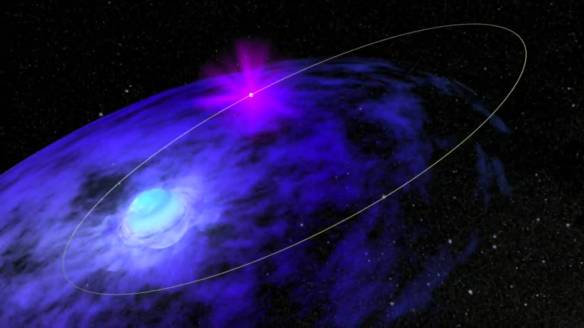
Some brave neutron stars are consuming gas from a big companion star that is about ten times as massive as the tiny neutron star itself. In these so-called Be X-ray binaries, the neutron star is typically in a very wide, eccentric orbit and only able to swallow gas from its companion when it’s making its closest approach. Usually this results in modest accretion outbursts. Occasionally, however, very bright and powerful “giant outbursts” are observed during which the neutron star has a much bigger banquet. X-ray binaries that harbor massive companion stars are younger than those with small companion stars (millions of years compared to billions of years). Furthermore, neutron stars accompanied by a massive star are more strongly magnetized (by a factor of 1000 or so) and rotate much slower (seconds versus milliseconds) than when they are fed by a small companion.

When neutron stars feed off a small companion, their 1-km thick crust is heated and cools on a timescale of years after a meal. This heating and cooling sequence provides very valuable information about the tantalizing interior of neutron stars, but there are many unanswered questions about these processes. For instance, it is not yet established how the spin rate and magnetic field strength of a neutron star affects its temperature changes. Given their widely different properties compared to neutron stars with small companions, searching for heating and cooling in Be X-ray binaries can potentially shed new light on these open questions. Giant outbursts should then provide the best opportunity for this quest, as we might expect a neutron star to become more severely heated (and hence more clearly cooling) when more matter is consumed.

Using the X-ray telescope on board of NASA’s Swift satellite, we followed the behavior two Be X-ray binaries, V0332+53 and 4U 0115+63, after their giant accretion outbursts. Interestingly, we discovered that the X-ray brightness of these neutron stars was higher in the months after they finished their meals than it was before they started eating. This could indeed be a sign of a heated crust! However, neutron stars with massive companions are generally more messy eaters than those with small donors; the quality of our data did not allow us to exclude the possibility that their X-ray emission was elevated because these neutron stars were still scraping for food after finishing their main course. Such behavior is in itself relatively unexplored and interesting to study. Our pilot project therefore warrants follow-up investigation to explore either of these exciting possibilities.

Wijnands & Degenaar 2016, MNRAS Letters 463, L46: Meta-stable low-level accretion rate states or neutron star crust cooling in the Be/X-ray transients V0332+53 and 4U 0115+63

Paper link: ADS

bexraybinary_artistimpress

Artist impression of a Be X-ray binary; a neutron star in a wide, eccentric orbit around a massive companion. Image credit: Walt Feimer, NASA/Goddard Space Flight Center.


A mathematical tool to study X-ray bursts

Neutron stars can rip off gas from a nearby companion star and pull this material towards them; a process called accretion. The material that is accreted on to the neutron star undergoes nuclear reactions that can cause detonations generating more energy than an atomic bomb. Such thermonuclear bursts are observed as brief, bright flashes of X-ray emission that last for seconds to hours and repeat on a timescale of hours to months.

Not surprisingly, these violent explosions can be destructive to the surroundings of a neutron star. Indeed, evidence has been accumulating that X-ray bursts have a profound effect on the  accretion flow that transports material toward the neutron star. For example, the explosions can cool, blow away, or accelerate the in-falling flow of material. One way to investigate this is by studying how the X-ray energy spectrum of the accretion flow changes during an X-ray burst. This is not an easy task, however, because the X-ray burst emission typically outshines that of the accretion flow. Small changes in the weak accretion emission are therefore swamped by the bright burst emission.

Mathematical techniques that involve decomposing complex data into matrices (e.g., “non-negative matrix factorization”) have been previously applied to reveal subtle changes in the X-ray emission of super-massive and stellar-mass black holes. Motivated by those successes, we investigated the applicability of such techniques to study changes in the accretion emission induced by X-ray bursts.

For this purpose we used high-quality data obtained with the NuSTAR satellite of a well-known neutron star X-ray binary and thermonuclear burster 4U 1608-52. Our case study revealed that these mathematical techniques can be a very powerful tool to reveal changes in the accretion emission that remain hidden in conventional spectral analysis. Applying these techniques to NuSTAR data is particularly promising, as this instrument can provide valuable information on the  accretion geometry, that helps interpret the results from the X-ray burst analysis.

Degenaar, Koljonen, Chakrabarty, Kara, Altamirano, Miller, Fabian 2016, MNRAS 456, 4256: Probing the effects of a thermonuclear X-ray burst on the neutron star accretion flow with NuSTAR

Paper link: ADS

nustar_nasa

Artist impression of NASA’s NuSTAR mission (launched in 2012). Image credits: NASA.

Breaking model degeneracies

Neutron stars are sometimes referred to as “dead stars”, because they cannot burn nuclear fuel in their interior as other stars do. Nevertheless, neutron stars can generate energy by accreting gas from a companion star in an X-ray binary.

When a neutron star accretes material, its ~1 km thick crust is compressed. This compression induces nuclear reactions such as atomic nuclei capturing electrons and nuclear fusion reactions. Theoretical calculations and accelerator experiments (e.g., such as done at the nuclear superconducting cyclotron laboratory at Michigan State University), provide a handle on how much heat should be generated inside neutron stars as a result of accretion. These results can then be compared with astrophysical observations.

Neutron stars often feast on their companion only for a few weeks/months (in exceptional cases years), after which they typically sag for years/decades before becoming active again. It is during these periods of quiescence that heat radiation from the neutron star (which have a temperature of millions of degrees Celsius) can be detected with sensitive X-ray satellites such as Chandra, XMM-Newton, or Swift. Since neutron stars do not generate energy when they are not accreting, they will gradually cool as they radiate their heat away as X-rays. Excitingly, dedicated efforts have allowed to detect the cooling trajectories of 7 neutron stars by now.

In this area of research there is thus a direct interplay between astrophysical observations of neutron stars, theoretical calculations about their interior, and nuclear accelerator experiments that mimic the nuclear reactions that take place in their outer layers. Interestingly, our X-ray observations seem to suggest that neutron stars are heated to a larger extend than is currently accounted for by nuclear heating models. It appears that there is a puzzling source of extra energy generation in the outermost layers of the neutron star, referred to as a “shallow heat source“, the origin of which remains to be established.

So far, it appears that the amount of extra heating differs between sources. It is not clear, however, if this is due to their different outburst properties (e.g., length, duration, total accreted mass, accretion geometry), or relates to different neutron star parameters (e.g., rotation period, age, mass, radius). A powerful way to break these degeneracies would be to observe cooling curves for one particular source after different types of outbursts. If the shallow heating is different for each outburst, it is likely related to the accretion properties — else we need to seek its origin in the properties of the neutron star itself.

We took up this challenge by studying the prolific neutron star X-ray binary Aql X-1, which is active approximately once every year and exhibits a wide range of outburst properties. In particular, we exploited the unique flexibility and good sensitivity of the Swift satellite to study the temperature evolution of the neutron star after different outbursts. The first test was to prove whether cooling is actually observable for this particular neutron star, which definitely appears to be the case. Future observations of Aql X-1 aiming to study the cooling trajectories after different outbursts are therefore a very promising avenue to elucidate the origin of the shallow heat generation in neutron star crusts that puzzles astrophysical observers, physicists and nuclear experimentalists.

Waterhouse, Degenaar, Wijnands, Brown, Miller, Altamirano, Linares 2016, MNRAS 456, 4001: Constraining the properties of neutron star crusts with the transient low-mass X-ray binary Aql X-1

Paper link: ADS

bat_maxi_longterm_AqlX1

Long-term activity of Aql X-1 as seen through daily monitoring observations with Swift/BAT (launched in 2005) and MAXI (launched in 2009). This illustrates the frequent activity of this neutron star X-ray binary. Figure from Waterhouse et al. 2016.

Beautiful reflection

The X-ray binary 4U 1608-52 contains a neutron star that is normally dormant, but awakens about every 2 years to feast on (i.e., accrete from) its companion star for a few weeks-months before it returns to quiescence again. In October 2014, 4U 1608-52 entered such an accretion outburst and we took the opportunity to observe the neutron star in action using NASA’s newly launched NuSTAR satellite.

NuSTAR was launched in 2012, and provides unprecedented sensitivity at X-ray energies of 3-79 keV. As such, it is an excellent tool to detect X-ray reflection off accretion disks in systems such as X-ray binaries and Active Galactic Nuclei (AGN). Such reflection  manifests itself as a broad iron emission line around 6-7 keV, and a “Compton hump” near 20-40 keV. The ability of NuSTAR to detect both these features with excellent sensitivity allows to obtain detailed information about the accretion geometry, such as the inner radius of the accretion disk and the location of the illuminating X-ray source. Such studies are routinely performed for accreting supermassive black holes and stellar-mass black holes in X-ray binaries, but much less is known about the accretion geometry of neutron stars.

The NuSTAR observation of 4U 1608-52 revealed a reflection spectrum of unprecedented quality. This allowed us to match the observational data with detailed theoretical reflection models to infer information about the accretion geometry. Excitingly, we caught the neutron star accreting very slowly, at only about 1% of the Eddington limit. This is a regime that is difficult to capture, and therefore the accretion geometry is particularly uncertain. From our observation, we found that the accretion disk was extending very close to the neutron star, opposed to the expectation that the accretion disk is receding at slow accretion rates. Furthermore, our modeling showed that the X-ray source illuminating the accretion disk (often referred to as the “corona”) was located very close to the neutron star.

Degenaar, Miller, Chakrabarty, Harrison, Kara, Fabian 2014, MNRAS Letters 451, L85: A NuSTAR observation of disc reflection from close to the neutron star in 4U 1608-52

Paper link: ADS

Schematic representation of the reflection of X-ray radiation off an accretion disk. Credit: Gilfanov M., 2010, Lecture Notes in Physics, Vol. 794, Springer-Verlag, Berlin, p. 17

Schematic representation of the reflection of X-ray radiation off an accretion disk. Credit: Gilfanov M., 2010, Lecture Notes in Physics, Vol. 794, Springer-Verlag, Berlin, p. 17

Nearly 10 years of Swift X-ray monitoring the Galactic center

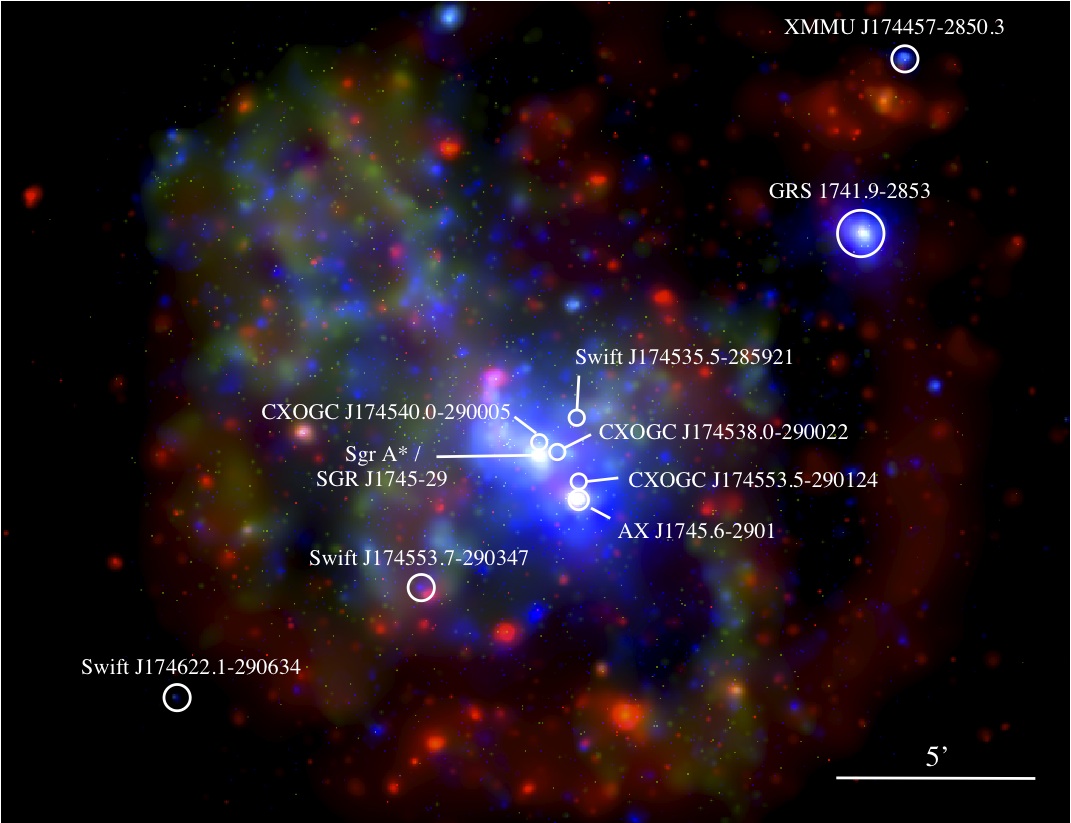
In 2006 February, shortly after its launch, the Swift satellite began monitoring the inner 50 x 50 pc (1.5×10^15 km squared) of our Milky Way with the on board X-Ray Telescope. In the months February-October*, 15-minute X-ray snapshots of our Galactic center were taken every 1-4 days. In nearly 10 years years time (2006 February till 2014 October), this accumulated to nearly 1.3 Ms of total exposure time, equivalent to about 15 days of continuous observing. This legacy program has yielded a wealth of information about the long-term X-ray behavior of the Milky Way’s supermassive black hole Sgr A*, as well as numerous transient X-ray sources that are located in region covered by the campaign.

One of the main discoveries resulting from this campaign was the detection of six bright X-ray flares from Sgr A*. These are mysterious flashes of X-ray emission during which the supermassive black hole brightens by a factor of up to approximately 150 for tens of minutes to hours. Unfortunately, Swift temporarily lost its view of Sgr A* as of April 2013, due to the sudden awakening of a nearby ultra-magnetized neutron star (a “magnetar”). The X-ray emission from this object was about 200 times brighter than that of Sgr A*, hence it outshined our supermassive black hole. However, the notorious magnetar steadily faded over time and in late 2014 we regained view of the supermassive black hole again. Indeed, a seventh X-ray flare from Sgr A* was caught in 2014 September, the brightest ever seen with Swift.

The Swift/XRT monitoring campaign has also been instrumental to understand the nature of a peculiar class of sub-luminous X-ray binaries. These are binary star systems in which a neutron star or a black hole accretes matter from a nearby companion (e.g., Sun-like) star. It has been a puzzle for decades why a small sub-group X-ray binaries are much fainter than accretion theory prescribes. This suggests that these neutron stars/black holes have little appetite, but the question is why. Swift has made a very important contribution in mapping the accretion behavior (“eating patterns”) of this class of objects and also identified 3 new members.

In addition, we  discovered that “normal” X-ray binaries (i.e., ones eating more exorbitantly) sometimes display similar eating patterns as the sub-luminous X-ray binaries, giving important clues about the underlying mechanism producing low-level accretion events (i.e., fasting periods). For example, we found that in some cases the neutron stars/black holes sub-luminous X-ray binaries were likely caught enjoying an occasional midnight snack, and should be feasting on a larger banquet at other times. However, the behavior of one particular neutron star suggests that it may have a relatively strong magnetic field that sometimes simply impedes the infall (i.e., accretion) of material that is transferred from its companion. This object is therefore a candidate X-ray binary/millisecond radio pulsar transitional object.

After nearly 10 successful years, continuation of Swift’s Galactic center monitoring program remains highly valuable. For example, this would allow the collection of even more X-ray flares from our supermassive black hole, and to investigate whether the eating patterns of Sgr A* change in any way after the gaseous object “G2” has swung by.

Degenaar, Wijnands, Miller, Reynolds, Kennea, Gehrels 2015, JHEA 7, 137: The Swift X-ray monitoring campaign of the center of the Milky Way

Paper link: ADS

Swift/XRT monitoring campaign website: www.swift-sgra.com

*Due to proximity of the Sun the center of our Galaxy cannot be observed with Swift in November-January.

gc_swift_2006_2014_withnames

Swift/XRT image of the inner ~50×50 pc of the Milky Way using 1.3 Ms of data accumulated in 2006-2014. Red represents 0.3-1.5 keV energies, green 1.5-3.0 keV and blue 3.0-10 keV.

Blown away by an accretion disk wind

GRO J1744-28 is among the most puzzling neutron star X-ray binaries known in our Galaxy. How could the companion star have possibly reduced to its current small size without spinning the neutron star up to very high rotation rate or without strongly reducing its magnetic field? High-resolution Chandra X-ray observations may have solved this puzzle.

After remaining dormant for nearly 20 years, GRO J1744-28 suddenly exhibited a new accretion outburst in 2014. This provided the excellent opportunity to study this extraordinary X-ray binary with modern X-ray telescopes. Using high-resolution Chandra Grating Spectroscopic observations, we found evidence for X-ray absorption lines that could arise from a dense wind blowing off the accretion disk. Such winds are commonly seen for black hole X-ray binaries, although it is not established yet whether similarly strong winds can also form in the accretion disks that surround neutron stars.

If the absorption features in GRO J1744-28 indeed origin in a disk wind, then energetic considerations suggest that this wind may carry away a considerable amount of matter that is being transferred from the companion star. Therefore, a considerable amount of matter may be lost from the binary without accreting onto the neutron star. This could potentially solve the long-standing puzzle of how to reconcile the very low mass of the companion star in GRO J1744-28 with the slow rotation period and high magnetic field of the neutron star primary.

Degenaar, Miller, Harrison, Kennea, Kouveliotou, Younes 2014, ApJ Letters 796, L9: High-resolution X-Ray Spectroscopy of the Bursting Pulsar GRO J1744-28

Paper link: ADS

 Artist impression of an X-ray binary with a strong disk wind. Credit: NASA’s Goddard Space Flight Center / Chandra X-ray observatory / M. Weiss

Artist impression of an X-ray binary with a strong disk wind.
Credit: NASA’s Goddard Space Flight Center / Chandra X-ray observatory / M. Weiss

A split-personality neutron star?


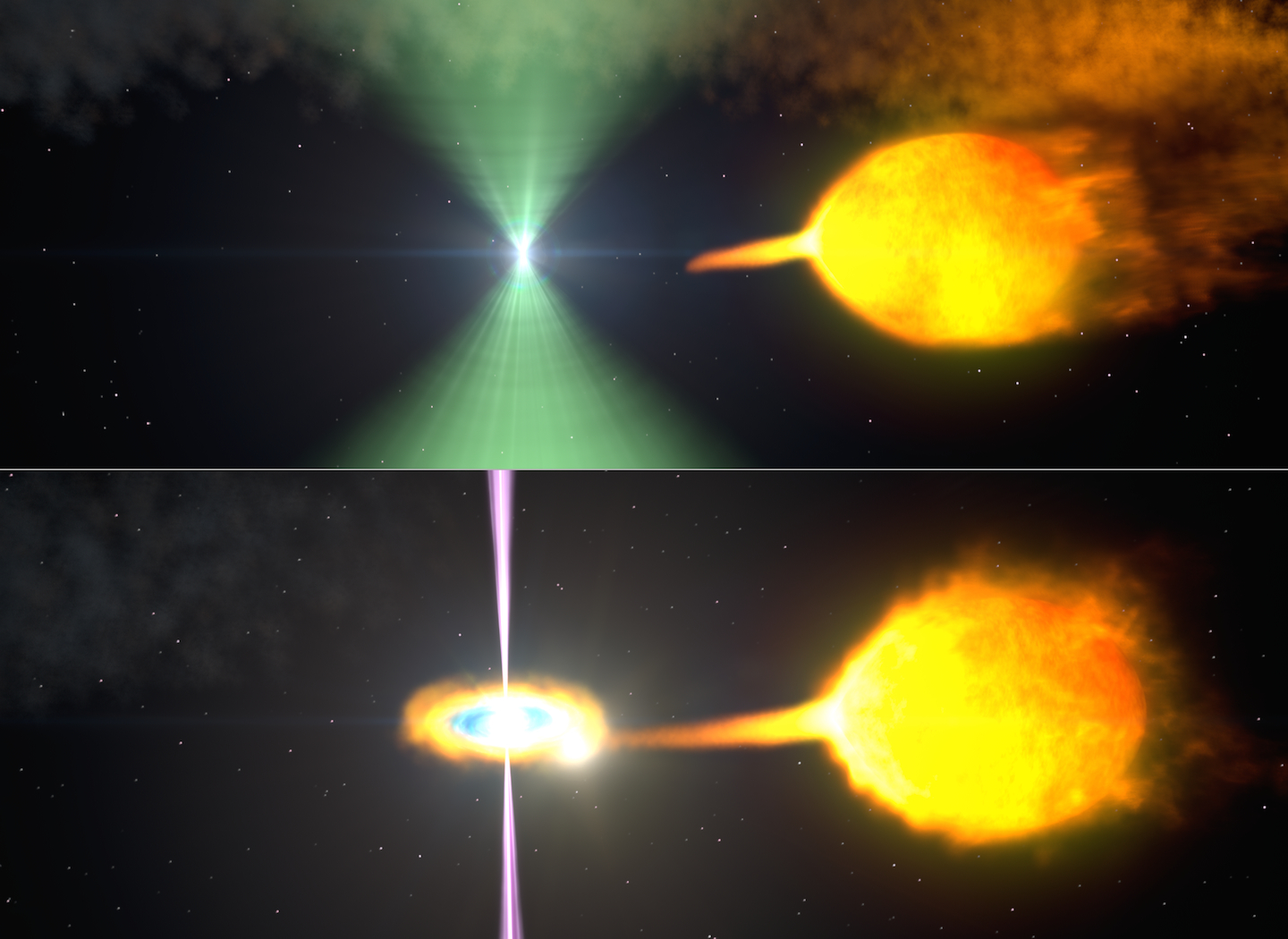
The universe is full of remarkable objects. PSR J1824-2452 is a neutron star that is located in the globular cluster M28 and emits pulsed radio emission. This energy is powered by its rapid rotation: the pulsar spins around its own axis about 15,000 times per second (it takes only 3.9 milliseconds to complete one rotation). In 2013, however, its radio pulsations disappeared and instead its X-ray emission increased by 5 orders of magnitude, it lighted off a thermonuclear X-ray burst, and exhibited X-ray pulsations power by the accretion of matter: The neutron star had suddenly become active as an X-ray binary! After about 2 months the X-rays faded and it returned to its life as radio pulsar like nothing had happened. For the first time in the history of astronomy a neutron star was caught in the act of  switching identity.

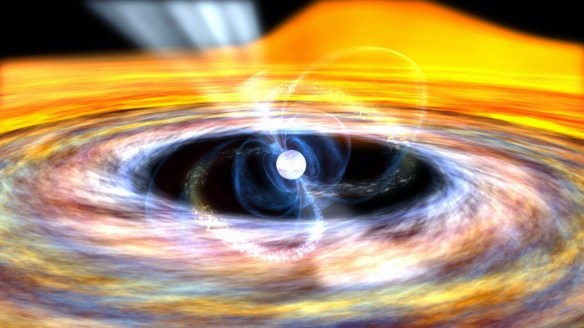
Low-mass X-ray binaries and millisecond radio pulsars are two different manifestations of neutron stars in binary systems that are thought to be evolutionarily linked. In an X-ray binary, the outer gaseous layers of a small companion star (that has a mass less than that of our Sun) are stripped off and accreted by the neutron star. The large amount of energy that is liberated during the accretion process makes these interacting binaries shine bright in X-rays. After millions-billions of years the companion star will stop feeding the compact primary. The rapidly rotating neutron star, spun up to millisecond periods by gaining angular momentum during the accretion process, may now emit pulsed radio emission so that the binary is observed as a millisecond radio pulsar.

The discovery that neutron stars may rapidly switch identity between these two manifestations opens up a new avenue to study their evolutionary link. It is therefore of prime interest to identify other X-ray binary/radio pulsar transitional objects. The M28 source displayed remarkable X-ray spectral properties and X-ray flux variability, which can potentially serve as a template for such searches. Based on that, we identified one possible candidate: the peculiar X-ray source XMM J174457-2850.3 that is located at a projected distance of about 14 arcminutes from the Milky Way’s supermassive black hole Sgr A*.

XMM J174457-2850.3 is just on the edge of the region surveyed in Swift’s Galactic center monitoring program, which has taken almost daily X-ray snapshots since 2006. For years we were puzzled by the remarkable X-ray variability of XMM J174457-2850.3: instead of spending remaining dim for most of its time and making occasional excursions to bright X-ray states, we often found the source lingering in between its quiescent and outburst levels. This behavior is not typical for low-mass X-ray binaries, leaving us to ponder about the exact nature of this peculiar X-ray source. We got our answer in late 2012, when Swift suddenly caught a rare, very energetic thermonuclear X-ray burst from XMM J174457-2850.3. This conclusively established that the source is, in fact, a neutron star low-mass X-ray binary.

By investigating 12 years of Swift, XMM-Newton and Chandra data of the Galaxy center (obtained between 2000 and 2012), we found that XMM J174457-2850.3 exhibits three different X-ray luminosity states, and has an X-ray spectrum that is much harder (that is, relatively more photons are emitted at higher energies) than commonly seen in low-mass X-ray binaries. These properties are strikingly similar to the M28 X-ray binary/radio pulsar transitional object. Its unusual X-ray properties are explained as interactions between the magnetic field of the neutron star with the surrounding accretion flow. A similar mechanism may be at work in the peculiar Galactic center source XMM J174457-2850.3.

Degenaar, Wijnands, Renolds et al. 2014, MNRAS 792, 109: The Peculiar Galactic Center Neutron Star X-Ray Binary XMM J174457-2850.3

Paper link: ADS

Press item on the M28 neutron star: NASA

ns_pulsar_xrb

Artist’s conception of a neutron star switching faces: a radio pulsar (top) and an X-ray binary (bottom). Credit: NASA’s Goddard Space Flight Center

Chemical processes in the crust of a neutron star

Neutron stars are one of the possible end products of the stellar life cycle. These objects are the compact remnants of once massive stars that burned all their fuel and consequently collapsed under their own gravity and exploded in a supernova. One can thus say that neutron stars are ‘dead stars’: they have no internal resources to replenish the energy that is lost via photons emitted from their surface and neutrinos escaping from their interior. When left alone, neutron stars would therefore slowly fade away over the course of millions of years. However, a neutron star can escape this fate when it is a member of a binary system: it can then regain energy by pulling off and accreting matter from its accompanying star (it can suck life out of its companion, so to say).

Accretion causes a complex network of nuclear reactions inside the neutron star, at a few hundred meters below its surface. These reactions serve as an effective energy supply. When the neutron star is done accreting, however, it will immediately start to loose energy again. Using sensitive X-ray telescopes and dedicated observing techniques, the signatures of these processes can be detected: the temperature of a neutron star rises during accretion episodes but then gradually decreases afterward. In particular, a detailed mapping of the ‘cooling curve’ of a neutron star can give unique insight into its tantalizing interior structure, one of the basic quests of neutron star research.

These cooling studies cannot be carried out for just any neutron star: in order to create detectable temperature differences, a neutron star must be very cold to start with, and/or accrete (i.e., be heated) for a long time. EXO 0748-676 is one of the few sources for which such a study could be carried out. This neutron star started accreting some time between 1980 and 1984 and happily continued to cannibalize its companion star until it suddenly stopped in 2008. We seized this rare opportunity to study a cooling neutron star and embarked on a monitoring campaign using the sensitive Chandra, XMM-Newton and Swift X-ray satellites.

Our X-ray observations revealed that EXO 0748-676 harbors a relatively hot neutron star, as expected given its long history of feasting on its companion. During the first year after it stopped accreting, its temperature was gradually decreasing indicating that the hot neutron star was cooling. However, between 2009 and 2011, we did not detect any significant temperature change any more. To verify that the neutron star had indeed stopped cooling, we obtained a new Chandra observation in 2013. Surprisingly, this new data point showed that the temperature had dropped again, indicating that cooling is ongoing. Excitingly, the apparent plateau of stalled cooling in 2009-2011 could be the result of a chemical process in which light and heavy atoms separate out in different layers.

If this process indeed occurs, it would suggest that the crust of neutron stars has a very ordered, strong structure. That has important implications for several observational properties of neutron stars, including the emission of gravitational waves from deformations in their structure. This result on EXO 0748-676 nicely illustrates how astronomical observations can be used to probe micro-physical processes occurring in the dense interior of neutron stars.

Degenaar, Medin, Cumming et al. 2014, ApJ 791, 47: Probing the Crust of the Neutron Star in EXO 0748-676

Paper link: ADS

 Schematic overview of the interior of a neutron star.  Credit: Chamel & Haensel 2008, LRR 11, 10

Schematic overview of the interior of a neutron star.
Credit: Chamel & Haensel 2008, LRR 11, 10

The accretion flow around a black hole

Black holes are infamous for their relentless gravitational pull through which they drain matter and energy from their surroundings. However, with their enormous power, these tantalizing objects also blast matter back into space via ultra-fast collimated jets and dense winds. Understanding the exact connection between how black holes accrete from – and supply feedback to – their environment is one of the outstanding challenges of modern astrophysics.

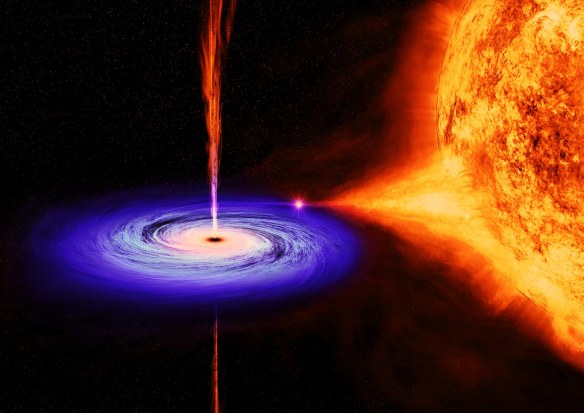
X-ray binaries are excellent laboratories to study the eating habits of black holes. In these binary star systems a black hole orbits a Sun-like star close enough to pull off and accrete the outer layers of its unfortunate companion. This accretion process liberates enormous amounts of energy that is emitted across the electromagnetic spectrum. Studying the accretion flow in X-ray binaries thus warrants a multi-wavelength approach.

We recently performed such a study for the newly discovered X-ray binary Swift J1910.2-0546.  In 2012 May the Swift satellite suddenly discovered a new, bright X-ray point source in the sky and very soon it became clear that the X-ray emission was powered by accretion onto a black hole. Using the X-ray and UV telescopes onboard Swift, we continued to monitor this new X-ray binary for about three months. To complement these observations, the source was also closely followed at optical and infrared wavelengths (B, V, R, I, J, H, and K filters) using the 1.3-m SMARTS telescope located at the Cerro Tololo Inter-American Observatory (CTIO) in Chile. Finally, a high-resolution X-ray spectroscopic observation was obtained with the Chandra satellite.

This monitoring campaign allowed us to map out the accretion morphology around the black hole in Swift J1910.2-0546. Firstly, X-ray spectroscopy revealed two peculiarities: although disk winds appear to be ubiquitous in black hole X-ray binaries when they are at their brightest, our Chandra observations did not reveal any emission or absorption features that are the imprints of an accretion disk wind. Since such winds are thought to be concentrated in the equatorial plane, this may imply that we are viewing the binary at relatively low inclination. Moreover, even during the brightest stages of its outburst tracked by Swift, the temperature of the accretion disk did not reach above 0.5 keV (about 6 million degrees Kelvin), whereas most black hole disks are much hotter with temperatures above 1 keV. This could plausibly be a geometrical effect, again suggesting that the inclination angle of the binary is relatively low.

Comparing the overall light curves of the outburst in different wavebands revealed two other striking features. A sharp and prominent flux dip appeared in the X-rays almost one week later than at UV, optical and infrared wavelengths. The detailed properties of this flux dip appear to point to a global change in accretion flow geometry, possibly related to the formation of a collimated jet or the condensation of the inner part of the accretion disk. In addition, when the activity of the black hole started to cease, we found that the X-rays steadily decreased whereas the UV emission suddenly was rising again. The observed strong anti-correlation between the X-ray/UV flux also indicates a global change in accretion flow.

Degenaar, Maitra, Cackett et al. 2014, ApJ 784, 122: Multi-wavelength Coverage of State Transitions in the New Black Hole X-Ray Binary Swift J1910.2-0546

Paper link: ADS

Artist impression of the accretion flow around a black hole.  Credit: NASA/Dana Berry, SkyWorks Digital

Artist impression of the accretion flow around a black hole.
Credit: NASA/Dana Berry, SkyWorks Digital

Challenging theoretical models

Studying the thermal evolution of neutron stars is a promising avenue to gain insight into their structure and composition, and therefore of how matter behaves under extreme physical conditions. These compact stellar remnants are born hot in supernova explosions, but quickly cool as their thermal energy is drained via neutrino emission from their dense interior and thermal photons radiated from their surface. When residing in low-mass X-ray binaries, neutron stars pull off and accrete the outer layers of a companion star. This can re-heat the neutron star and drastically impact its thermal evolution.

The accretion of matter causes a series of nuclear reactions (electron-captures and fusion of atomic nuclei) that produce heat at a rate that is proportional to the rate at which matter is falling onto the neutron star. These processes can significantly raise the temperature of the outer layers of the neutron star, the crust, which then become hotter than the stellar interior, the core. How much heat is released, and at which depth, depends sensitively on the structure and composition of the crustal layers. When the neutron star stops accreting (during so-called quiescent episodes), the crust cools down until it reaches the same temperature as the core again. How fast the crust cools depends strongly on its ability to store and transport heat, and hence on its structure and composition. Studying temperature changes of a neutron star due to accretion episodes thus holds valuable information about the properties of its crust.

In 2010, a neutron star called IGR J17480-2446 started accreting matter from its companion star, temporarily making it the brightest X-ray source in the globular cluster Terzan 5. When it stopped 10 weeks later, we began to follow the neutron star every few months with the Chandra satellite to study any possible changes in its temperature. With our initial observations we discovered that the neutron star was about 300 000 degrees hotter than before it started accreting. This provided the first strong evidence that a neutron star can become significantly heated after just 2 months of accreting matter (rather than >1 year; read more here).

Since this neutron star was heated for a relatively short time, theory predicted that it should cool down rapidly. On the contrary, we have found that the neutron star is still considerably hotter than its pre-accretion temperature 2.5 years later! This indicates that there might be some important ingredients missing in our current understanding of heating and cooling of accreting neutron stars. To be able to distinguish between different possible explanations and hence fully grasp the implications of our findings of IGR J17480-2446, we aim to keep observing this neutron star until it has fully cooled. A new Chandra observation has been scheduled for this purpose in the next year (2014). We are anxious to find out how the temperature of the neutron star has changed by that time.

Degenaar, Wijnands, Brown et al. 2014, ApJ 775, 48: Continued Neutron Star Crust Cooling of the 11 Hz X-Ray Pulsar in Terzan 5: A Challenge to Heating and Cooling Models?

Paper link: ADS

terzan5_edser

Three-color image of the globular cluster Terzan 5, obtained with the Chandra X-ray satellite.