
Exploring a very dim X-ray binary

Some neutron stars that consume gas from a companion star generate much dimmer X-rays than the general population of X-ray binaries. Since the brightness scales with the amount of mass that is being devoured, it seems that in these sub-luminous X-ray binaries the neutron star is not eating much. There are two leading theories to explain why this may be happening, which breaks down to a supply or demand problem.

One obvious explanation might be that some neutron stars have old, small companion stars that are deprived of hydrogen (the most abundant element in the Universe) and supply only a limited amount of gas. Indeed, attempts to study the donor stars suggest that some of these neutron stars are being starved. However, there are also a few cases where the optical emission is bright and the transferred gas clearly contains hydrogen, implying that there shouldn’t be a supply problem.

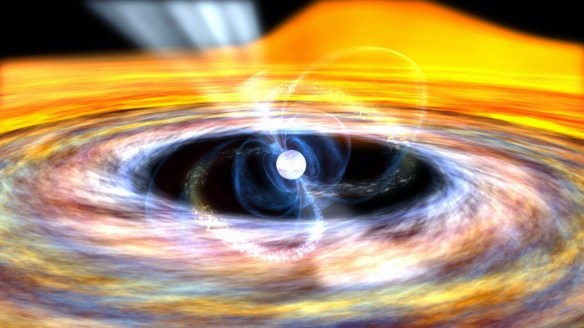
An alternative explanation is that some neutron stars have little appetite and consume only a small amount of the gas that is offered to them. In particular, these neutron stars may have a relatively strong magnetic fields that is able to stop the gas supplied by the donor from falling on to the neutron star or perhaps spit much of it out. To test this idea, we performed an in-depth study of the sub-luminous X-ray binary IGR J17062-6143.

First, studying its X-ray reflection using the NuSTAR and Swift satellites, we found that the gas stripped from the donor star does not reach as close to the neutron star as  normally the case in X-ray binaries. Second, using the Chandra satellite we found hints of narrow X-ray emission and absorption lines that could indicate that gas is blown away from the neutron star. The picture that appears to emerge from our study is that the neutron star in IGR J17062-6143 has a relatively strong magnetic field that pushes the in-falling gas away. Moreover, as the neutron star is (rapidly) rotating, its magnetic field may blow a large portion of the in-falling gas away, much like the propellor blades of a chopper do.

We are going to carry out further tests of this scenario. In particular, we recently obtained sensitive radio observations with the Australia Telescope Compact Array to search for  additional evidence that this neutron star is spitting out a lot of gas. Moreover, we recently obtained an optical spectrum with the large (8-m diameter) Gemini South telescope in Chili, to test if this neutron star has a normal, hydrogen-containing companion star. We are eager to see what comes out of those new observations and if those allow us to conclusively solve the “supply or demand problem” for the neutron star in IGR J17062-6143.

Degenaar, Pinto, Miller et al. 2017, MNRAS 464, 398: An in-depth study of a neutron star accreting at low Eddington rate: on the possibility of a truncated disc and an outflow

Paper link: ADS
nasa_ns_pulsar

Artist impression of an X-ray binary with a neutron star that has a relatively strong magnetic field. Image credit: NASA.
Nearly 10 years of Swift X-ray monitoring the Galactic center

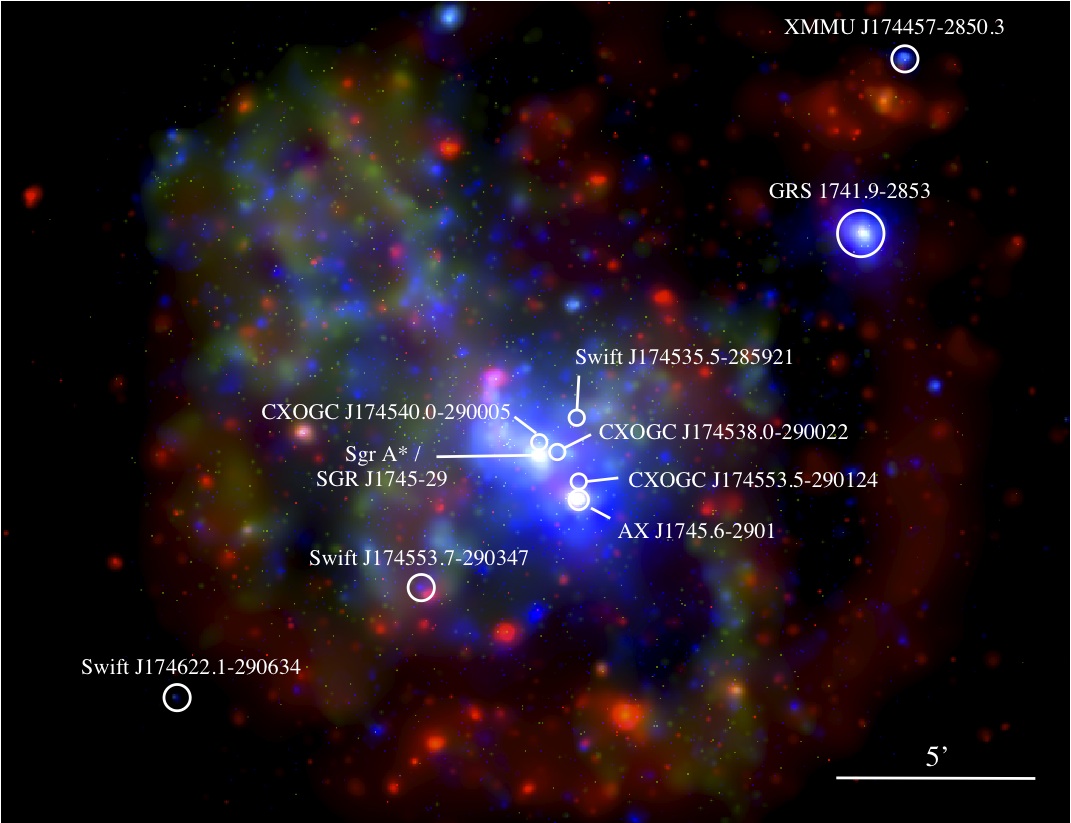
In 2006 February, shortly after its launch, the Swift satellite began monitoring the inner 50 x 50 pc (1.5×10^15 km squared) of our Milky Way with the on board X-Ray Telescope. In the months February-October*, 15-minute X-ray snapshots of our Galactic center were taken every 1-4 days. In nearly 10 years years time (2006 February till 2014 October), this accumulated to nearly 1.3 Ms of total exposure time, equivalent to about 15 days of continuous observing. This legacy program has yielded a wealth of information about the long-term X-ray behavior of the Milky Way’s supermassive black hole Sgr A*, as well as numerous transient X-ray sources that are located in region covered by the campaign.

One of the main discoveries resulting from this campaign was the detection of six bright X-ray flares from Sgr A*. These are mysterious flashes of X-ray emission during which the supermassive black hole brightens by a factor of up to approximately 150 for tens of minutes to hours. Unfortunately, Swift temporarily lost its view of Sgr A* as of April 2013, due to the sudden awakening of a nearby ultra-magnetized neutron star (a “magnetar”). The X-ray emission from this object was about 200 times brighter than that of Sgr A*, hence it outshined our supermassive black hole. However, the notorious magnetar steadily faded over time and in late 2014 we regained view of the supermassive black hole again. Indeed, a seventh X-ray flare from Sgr A* was caught in 2014 September, the brightest ever seen with Swift.

The Swift/XRT monitoring campaign has also been instrumental to understand the nature of a peculiar class of sub-luminous X-ray binaries. These are binary star systems in which a neutron star or a black hole accretes matter from a nearby companion (e.g., Sun-like) star. It has been a puzzle for decades why a small sub-group X-ray binaries are much fainter than accretion theory prescribes. This suggests that these neutron stars/black holes have little appetite, but the question is why. Swift has made a very important contribution in mapping the accretion behavior (“eating patterns”) of this class of objects and also identified 3 new members.

In addition, we  discovered that “normal” X-ray binaries (i.e., ones eating more exorbitantly) sometimes display similar eating patterns as the sub-luminous X-ray binaries, giving important clues about the underlying mechanism producing low-level accretion events (i.e., fasting periods). For example, we found that in some cases the neutron stars/black holes sub-luminous X-ray binaries were likely caught enjoying an occasional midnight snack, and should be feasting on a larger banquet at other times. However, the behavior of one particular neutron star suggests that it may have a relatively strong magnetic field that sometimes simply impedes the infall (i.e., accretion) of material that is transferred from its companion. This object is therefore a candidate X-ray binary/millisecond radio pulsar transitional object.

After nearly 10 successful years, continuation of Swift’s Galactic center monitoring program remains highly valuable. For example, this would allow the collection of even more X-ray flares from our supermassive black hole, and to investigate whether the eating patterns of Sgr A* change in any way after the gaseous object “G2” has swung by.

Degenaar, Wijnands, Miller, Reynolds, Kennea, Gehrels 2015, JHEA 7, 137: The Swift X-ray monitoring campaign of the center of the Milky Way

Paper link: ADS

Swift/XRT monitoring campaign website: www.swift-sgra.com

*Due to proximity of the Sun the center of our Galaxy cannot be observed with Swift in November-January.

gc_swift_2006_2014_withnames

Swift/XRT image of the inner ~50×50 pc of the Milky Way using 1.3 Ms of data accumulated in 2006-2014. Red represents 0.3-1.5 keV energies, green 1.5-3.0 keV and blue 3.0-10 keV.

A split-personality neutron star?


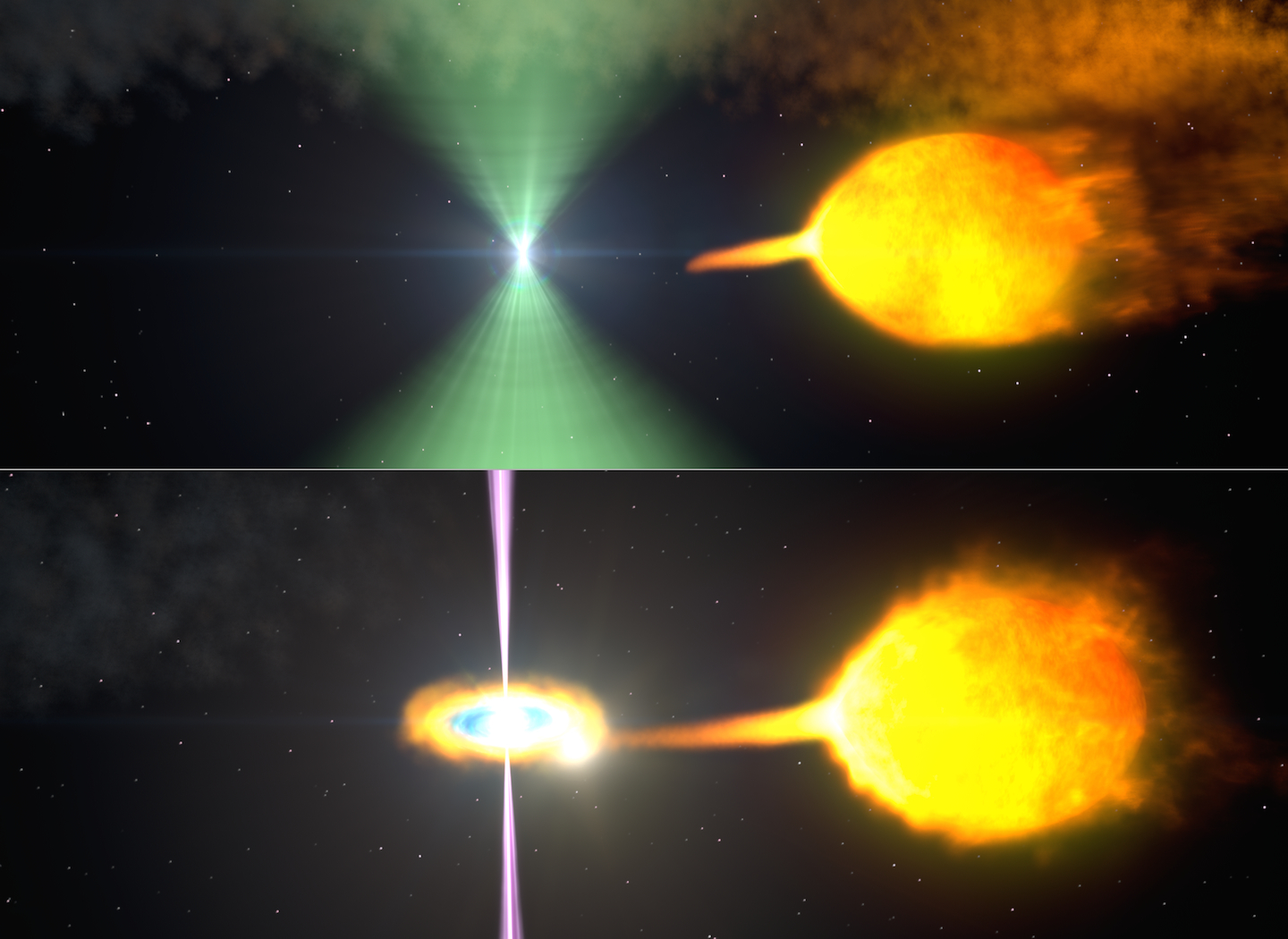
The universe is full of remarkable objects. PSR J1824-2452 is a neutron star that is located in the globular cluster M28 and emits pulsed radio emission. This energy is powered by its rapid rotation: the pulsar spins around its own axis about 15,000 times per second (it takes only 3.9 milliseconds to complete one rotation). In 2013, however, its radio pulsations disappeared and instead its X-ray emission increased by 5 orders of magnitude, it lighted off a thermonuclear X-ray burst, and exhibited X-ray pulsations power by the accretion of matter: The neutron star had suddenly become active as an X-ray binary! After about 2 months the X-rays faded and it returned to its life as radio pulsar like nothing had happened. For the first time in the history of astronomy a neutron star was caught in the act of  switching identity.

Low-mass X-ray binaries and millisecond radio pulsars are two different manifestations of neutron stars in binary systems that are thought to be evolutionarily linked. In an X-ray binary, the outer gaseous layers of a small companion star (that has a mass less than that of our Sun) are stripped off and accreted by the neutron star. The large amount of energy that is liberated during the accretion process makes these interacting binaries shine bright in X-rays. After millions-billions of years the companion star will stop feeding the compact primary. The rapidly rotating neutron star, spun up to millisecond periods by gaining angular momentum during the accretion process, may now emit pulsed radio emission so that the binary is observed as a millisecond radio pulsar.

The discovery that neutron stars may rapidly switch identity between these two manifestations opens up a new avenue to study their evolutionary link. It is therefore of prime interest to identify other X-ray binary/radio pulsar transitional objects. The M28 source displayed remarkable X-ray spectral properties and X-ray flux variability, which can potentially serve as a template for such searches. Based on that, we identified one possible candidate: the peculiar X-ray source XMM J174457-2850.3 that is located at a projected distance of about 14 arcminutes from the Milky Way’s supermassive black hole Sgr A*.

XMM J174457-2850.3 is just on the edge of the region surveyed in Swift’s Galactic center monitoring program, which has taken almost daily X-ray snapshots since 2006. For years we were puzzled by the remarkable X-ray variability of XMM J174457-2850.3: instead of spending remaining dim for most of its time and making occasional excursions to bright X-ray states, we often found the source lingering in between its quiescent and outburst levels. This behavior is not typical for low-mass X-ray binaries, leaving us to ponder about the exact nature of this peculiar X-ray source. We got our answer in late 2012, when Swift suddenly caught a rare, very energetic thermonuclear X-ray burst from XMM J174457-2850.3. This conclusively established that the source is, in fact, a neutron star low-mass X-ray binary.

By investigating 12 years of Swift, XMM-Newton and Chandra data of the Galaxy center (obtained between 2000 and 2012), we found that XMM J174457-2850.3 exhibits three different X-ray luminosity states, and has an X-ray spectrum that is much harder (that is, relatively more photons are emitted at higher energies) than commonly seen in low-mass X-ray binaries. These properties are strikingly similar to the M28 X-ray binary/radio pulsar transitional object. Its unusual X-ray properties are explained as interactions between the magnetic field of the neutron star with the surrounding accretion flow. A similar mechanism may be at work in the peculiar Galactic center source XMM J174457-2850.3.

Degenaar, Wijnands, Renolds et al. 2014, MNRAS 792, 109: The Peculiar Galactic Center Neutron Star X-Ray Binary XMM J174457-2850.3

Paper link: ADS

Press item on the M28 neutron star: NASA

ns_pulsar_xrb

Artist’s conception of a neutron star switching faces: a radio pulsar (top) and an X-ray binary (bottom). Credit: NASA’s Goddard Space Flight Center

An ultra-magnetized neutron star awakes

These days, astronomers all over the world sleep with one eye open, keeping a close watch of of the supermassive black hole located in the center of our Milky Way Galaxy: Sagittarius A* (Sgr A*). A mysterious gas cloud called “G2” is on a collision course with our Galactic nucleus and may produce some fireworks in the near future (read all about it here).

Imagine the excitement when on April 24 (2013), our daily observations performed with Swift’s X-ray Telescope suddenly detected enhanced activity at the position of Sgr A*. An Astronomer’s Telegram was readily distributed to instantly notify the astronomical community. To everybody’s surprise, however, rapid follow-up observations at infrared and radio wavelengths did not detect anything out of the ordinary and in stead suggested the supermassive black hole remained quiet as always.

The mystery was resolved when right next day, Swift’s Burst Alert Telescope detected a very short (less than a second) and energetic burst of gamma-ray emission. Together with the detection of a pulsed X-ray signal using the brand-new high-energy telescope NuSTAR, this revealed that an otherwise dormant neutron star, located very close to the supermassive black hole, had been revived. This neutron star, named SGR J1745-29, has an extremely strong magnetic field and belongs to the rare class of “magnetars”. So far it is only the magnetar that continues to show fireworks, whereas Sgr A* remains as quiet as it has ever been.

Kennea et al. 2013, ApJ Letters 770, L24: Swift Discovery of a New Soft Gamma Repeater, SGR J1745-29, near Sagittarius A*

Paper link: ADS

Press item: Sky&Telescope feature

Artist’s concept of an explosion on the surface of a neutron star. Credit: NASA/Dana Berry.

Artist’s concept of an explosion on the surface of a neutron star.
Credit: NASA/Dana Berry.

Staring at the center of the Milky Way

The region around Sagittarius A*, the supermassive black hole that represents the dynamical center of our Milky Way Galaxy, harbors a large number of accreting neutron stars and black holes. Between 2005 and 2008, we targeted this region every few months using the X-ray instruments onboard the Chandra and XMM-Newton satellites. The main objective of this monitoring campaign was to study the behavior of transient X-ray binaries. These spend most of their time in a dim quiescent state, during which they often can not be detected, but experience occasional outbursts of bright X-ray emission when the neutron star or black hole pulls off and accretes matter from its companion star.

Our observations covered a region of 1.2 square degree around Sagittarius A* that contains 17 known X-ray transients, 8 of which were active during our campaign. We performed a detailed study of the energy distribution and temporal variations of their X-ray emission. From one of the active neutron stars we detected two thermonuclear explosions, which occurred within a time interval of only 3.8 minutes. Such a short repetition time is only rarely seen and poses a challenge for theoretical models. In addition, we discovered a previously unknown X-ray source, which we tentatively classify as an accreting white dwarf.

Most remarkably, the majority of X-ray transients located near Sagittarius A* are considerably fainter during outburst than is usually seen for accreting neutron stars and black holes. One possible explanation for their sub-luminous character is that these X-ray binaries have very small orbits, in which the compact primary and their companion revolve around each other in less than two hours. Finding such binaries is of particular interest, because they are thought to be strong sources of gravitational waves. The existence of gravitational waves is one of the predictions of Einstein’s theory of General Relativity, which future space-missions hope to prove.

Degenaar, Wijnands, Cackett et al. 2012, A&A 545, 49: A four-year XMM-Newton/Chandra monitoring campaign of the Galactic centre: analysing the X-ray transients

Paper link: ADS

Chandra X-ray image of the center of our Milky Way Galaxy.  Credit: NASA/Wang et al. 2002.

Chandra X-ray image of the center of our Milky Way Galaxy.
Credit: NASA/Wang et al. 2002.

Chasing the faint ASCA X-ray sources

In 1993, the Japanese Advanced Satellite for Cosmology and Astrophysics (ASCA) was successfully launched. This satellite was operated for 7 years (until 2000) and was the first mission that provided X-ray imaging capabilities in a relatively broad energy band (0.3-10 keV). During its lifetime, ASCA carried out two dedicated surveys of the Galactic Center and Plane, where it discovered around 200 distinct X-ray sources.

Up to date, about 1/3 of the ASCA-discovered X-ray sources could not be classified. They have relatively faint X-ray intensities that can trace a variety of Astronomical objects such as strongly magnetized neutron stars (called ‘magnetars’), bright accreting white dwarfs (‘polars’ and ‘intermediate polars’), sub-luminous accreting neutron stars and black holes, X-ray emitting massive stars, as well as foreground stars and background active galaxies (‘active galactic nuclei’).

In 2006, we launched a program to observe 35 of the unclassified ASCA-sources with the Swift satellite. The goal of this program was to study the X-ray spectrum of these objects, to find possible indications of temporal variations in the X-ray intensity and to obtain more accurate X-ray positions that would aid in conducting follow-up observations at other wavelengths (optical, infra-red, radio). With this approach we aim to gain more insight into the nature of the faint unclassified ASCA sources.

With our Swift observations we were able to tentatively identify three accreting compact objects: one likely magnetized white dwarf, one neutron star and one object that is likely a neutron star or a black hole. In addition, we found that three objects are possibly nearby X-ray emitting stars. Finally, we found evidence that two of the ASCA-detected sources likely undergo strong variations in their X-ray intensity, since these were not detected during our Swift observations.

Degenaar, Starling, Evans et al. 2012, A&A 540, 22: Swift follow-up observations of unclassified ASCA sources

Paper link: ADS

X-ray image from the ASCA survey of the Galactic Centre. Credit: Sugizaki et al. 2001.

X-ray image from the ASCA survey of the Galactic Centre.
Credit: Sugizaki et al. 2001.