
The universe is full of remarkable objects. PSR J1824-2452 is a neutron star that is located in the globular cluster M28 and emits pulsed radio emission. This energy is powered by its rapid rotation: the pulsar spins around its own axis about 15,000 times per second (it takes only 3.9 milliseconds to complete one rotation). In 2013, however, its radio pulsations disappeared and instead its X-ray emission increased by 5 orders of magnitude, it lighted off a thermonuclear X-ray burst, and exhibited X-ray pulsations power by the accretion of matter: The neutron star had suddenly become active as an X-ray binary! After about 2 months the X-rays faded and it returned to its life as radio pulsar like nothing had happened. For the first time in the history of astronomy a neutron star was caught in the act of switching identity.
Low-mass X-ray binaries and millisecond radio pulsars are two different manifestations of neutron stars in binary systems that are thought to be evolutionarily linked. In an X-ray binary, the outer gaseous layers of a small companion star (that has a mass less than that of our Sun) are stripped off and accreted by the neutron star. The large amount of energy that is liberated during the accretion process makes these interacting binaries shine bright in X-rays. After millions-billions of years the companion star will stop feeding the compact primary. The rapidly rotating neutron star, spun up to millisecond periods by gaining angular momentum during the accretion process, may now emit pulsed radio emission so that the binary is observed as a millisecond radio pulsar.
The discovery that neutron stars may rapidly switch identity between these two manifestations opens up a new avenue to study their evolutionary link. It is therefore of prime interest to identify other X-ray binary/radio pulsar transitional objects. The M28 source displayed remarkable X-ray spectral properties and X-ray flux variability, which can potentially serve as a template for such searches. Based on that, we identified one possible candidate: the peculiar X-ray source XMM J174457-2850.3 that is located at a projected distance of about 14 arcminutes from the Milky Way’s supermassive black hole Sgr A*.
XMM J174457-2850.3 is just on the edge of the region surveyed in Swift’s Galactic center monitoring program, which has taken almost daily X-ray snapshots since 2006. For years we were puzzled by the remarkable X-ray variability of XMM J174457-2850.3: instead of spending remaining dim for most of its time and making occasional excursions to bright X-ray states, we often found the source lingering in between its quiescent and outburst levels. This behavior is not typical for low-mass X-ray binaries, leaving us to ponder about the exact nature of this peculiar X-ray source. We got our answer in late 2012, when Swift suddenly caught a rare, very energetic thermonuclear X-ray burst from XMM J174457-2850.3. This conclusively established that the source is, in fact, a neutron star low-mass X-ray binary.
By investigating 12 years of Swift, XMM-Newton and Chandra data of the Galaxy center (obtained between 2000 and 2012), we found that XMM J174457-2850.3 exhibits three different X-ray luminosity states, and has an X-ray spectrum that is much harder (that is, relatively more photons are emitted at higher energies) than commonly seen in low-mass X-ray binaries. These properties are strikingly similar to the M28 X-ray binary/radio pulsar transitional object. Its unusual X-ray properties are explained as interactions between the magnetic field of the neutron star with the surrounding accretion flow. A similar mechanism may be at work in the peculiar Galactic center source XMM J174457-2850.3.
Degenaar, Wijnands, Renolds et al. 2014, MNRAS 792, 109: The Peculiar Galactic Center Neutron Star X-Ray Binary XMM J174457-2850.3
Paper link: ADS
Press item on the M28 neutron star: NASA
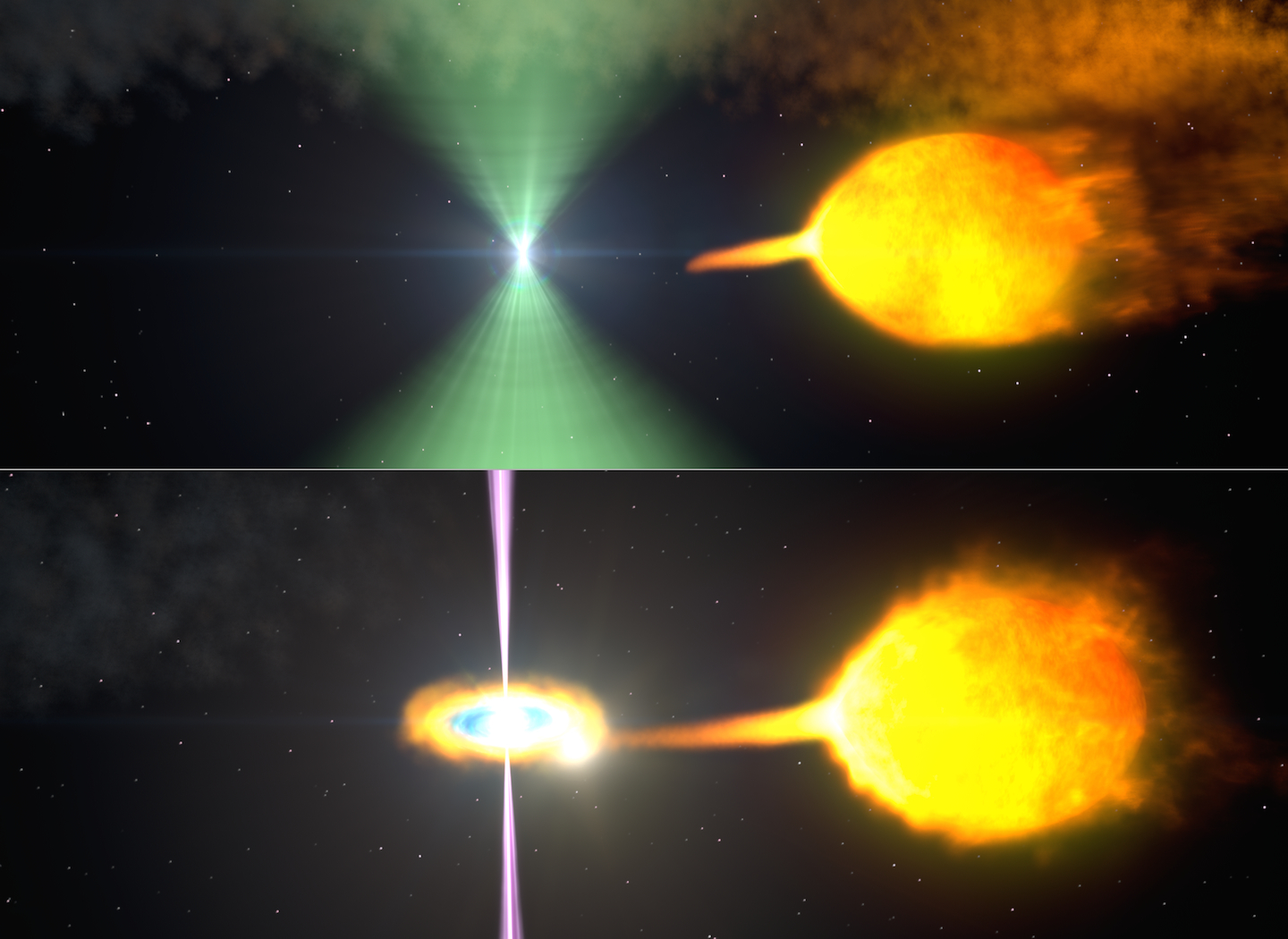
Artist’s conception of a neutron star switching faces: a radio pulsar (top) and an X-ray binary (bottom). Credit: NASA’s Goddard Space Flight Center



 Nathalie Degenaar
You must be logged in to post a comment.