
Characterizing a new neutron star

Since the dawn of X-ray astronomy over 50 years ago, more than 150 neutron stars swallowing gas from a nearby (Sun-like) companion star have been identified in our Galaxy. Still, every year a few new neutron stars are discovered when they suddenly start to devour their unfortunate neighbours. Different telescopes and satellites are then used to characterize such a previously unknown X-ray binary.

In February 2015, the X-ray emission of an object named 1RXS J180408.9-342058 was suddenly found to have brightened by more than 3 orders of magnitude. It was known to be an X-ray binary since 2012 when it displayed a thermonuclear X-ray burst; a devastating burp from a dining neutron star. At the time, however, it seemed that the neutron star was only taking a mid-night snack and had gone back to sleep before we could point our telescopes to investigate its eating patterns. Luckily, when it awoke in 2015 the neutron star clearly had much more appetite and kept swallowing gas from its companion for several months. This provided ample opportunity to study it in high detail.

We used three different X-ray satellites, namely NuSTAR, Chandra and Swift, to chart the geometry of this X-ray binary and the table manners of its neutron star. NuSTAR is a particularly powerful tool to study X-rays reflecting off the gaseous disk that surrounds and feeds the neutron star. Leveraging this, we determined that we view the binary at an angle of about 30 degrees, and that the gas disk was extending very close to the neutron star. In turn, this shows that the neutron star’s magnetic field is relatively weak and not able to keep the accretion flow at a distance. With Swift and Chandra we collected X-ray data when 1RXS J180408.9-342058 was at its brightest, and this suggested that the neutron star was eating rather messy; hints of narrow absorption lines suggest that part of the gas flowing towards the neutron star was blown away in a disk wind.

Degenaar, Altamirano, Parker et al. 2016, MNRAS 461, 4049: Disc reflection and a possible disc wind during a soft X-ray state in the neutron star low-mass X-ray binary 1RXS J180408.9-342058

Paper link: ADS
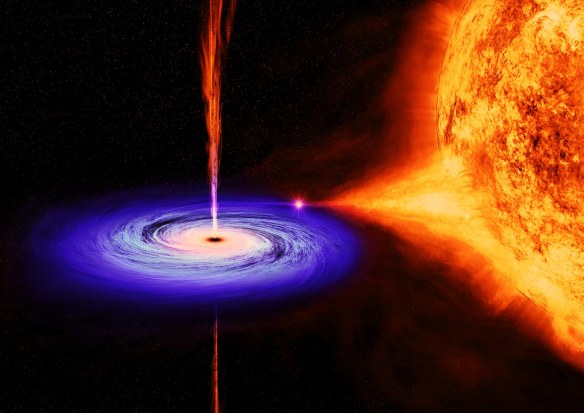
bh_binary_nasa_artistimpression_small

Artist impression of an X-ray binary. Image credit: NASA.
Accreting or cooling?

Some brave neutron stars are consuming gas from a big companion star that is about ten times as massive as the tiny neutron star itself. In these so-called Be X-ray binaries, the neutron star is typically in a very wide, eccentric orbit and only able to swallow gas from its companion when it’s making its closest approach. Usually this results in modest accretion outbursts. Occasionally, however, very bright and powerful “giant outbursts” are observed during which the neutron star has a much bigger banquet. X-ray binaries that harbor massive companion stars are younger than those with small companion stars (millions of years compared to billions of years). Furthermore, neutron stars accompanied by a massive star are more strongly magnetized (by a factor of 1000 or so) and rotate much slower (seconds versus milliseconds) than when they are fed by a small companion.

When neutron stars feed off a small companion, their 1-km thick crust is heated and cools on a timescale of years after a meal. This heating and cooling sequence provides very valuable information about the tantalizing interior of neutron stars, but there are many unanswered questions about these processes. For instance, it is not yet established how the spin rate and magnetic field strength of a neutron star affects its temperature changes. Given their widely different properties compared to neutron stars with small companions, searching for heating and cooling in Be X-ray binaries can potentially shed new light on these open questions. Giant outbursts should then provide the best opportunity for this quest, as we might expect a neutron star to become more severely heated (and hence more clearly cooling) when more matter is consumed.

Using the X-ray telescope on board of NASA’s Swift satellite, we followed the behavior two Be X-ray binaries, V0332+53 and 4U 0115+63, after their giant accretion outbursts. Interestingly, we discovered that the X-ray brightness of these neutron stars was higher in the months after they finished their meals than it was before they started eating. This could indeed be a sign of a heated crust! However, neutron stars with massive companions are generally more messy eaters than those with small donors; the quality of our data did not allow us to exclude the possibility that their X-ray emission was elevated because these neutron stars were still scraping for food after finishing their main course. Such behavior is in itself relatively unexplored and interesting to study. Our pilot project therefore warrants follow-up investigation to explore either of these exciting possibilities.

Wijnands & Degenaar 2016, MNRAS Letters 463, L46: Meta-stable low-level accretion rate states or neutron star crust cooling in the Be/X-ray transients V0332+53 and 4U 0115+63

Paper link: ADS

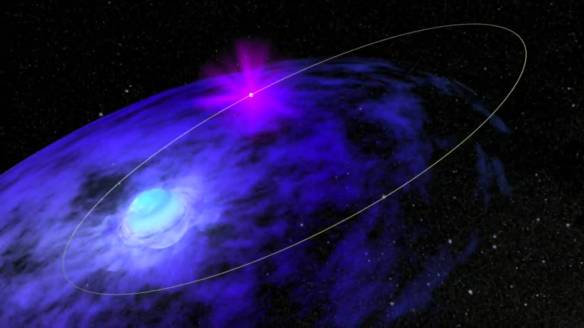
bexraybinary_artistimpress

Artist impression of a Be X-ray binary; a neutron star in a wide, eccentric orbit around a massive companion. Image credit: Walt Feimer, NASA/Goddard Space Flight Center.


Blown away by an accretion disk wind

GRO J1744-28 is among the most puzzling neutron star X-ray binaries known in our Galaxy. How could the companion star have possibly reduced to its current small size without spinning the neutron star up to very high rotation rate or without strongly reducing its magnetic field? High-resolution Chandra X-ray observations may have solved this puzzle.

After remaining dormant for nearly 20 years, GRO J1744-28 suddenly exhibited a new accretion outburst in 2014. This provided the excellent opportunity to study this extraordinary X-ray binary with modern X-ray telescopes. Using high-resolution Chandra Grating Spectroscopic observations, we found evidence for X-ray absorption lines that could arise from a dense wind blowing off the accretion disk. Such winds are commonly seen for black hole X-ray binaries, although it is not established yet whether similarly strong winds can also form in the accretion disks that surround neutron stars.

If the absorption features in GRO J1744-28 indeed origin in a disk wind, then energetic considerations suggest that this wind may carry away a considerable amount of matter that is being transferred from the companion star. Therefore, a considerable amount of matter may be lost from the binary without accreting onto the neutron star. This could potentially solve the long-standing puzzle of how to reconcile the very low mass of the companion star in GRO J1744-28 with the slow rotation period and high magnetic field of the neutron star primary.

Degenaar, Miller, Harrison, Kennea, Kouveliotou, Younes 2014, ApJ Letters 796, L9: High-resolution X-Ray Spectroscopy of the Bursting Pulsar GRO J1744-28

Paper link: ADS

 Artist impression of an X-ray binary with a strong disk wind. Credit: NASA’s Goddard Space Flight Center / Chandra X-ray observatory / M. Weiss

Artist impression of an X-ray binary with a strong disk wind.
Credit: NASA’s Goddard Space Flight Center / Chandra X-ray observatory / M. Weiss