
Real-time cooling of a neutron star?

Neutron stars are the densest directly observable stellar objects in our universe and constitute ideal astrophysical laboratories to study matter under extreme physical conditions: immense gravitational fields, ultra-strong magnetic fields, vigorous radiation fields, and supra-nuclear densities. Many observable properties of neutron stars are set by the structure and composition of their crust. A promising way to investigate the properties of these outer stellar layers is to study neutron stars in low-mass X-ray binaries.

In these interacting binary star systems, the neutron star pulls off and accretes matter from a companion star that has a mass comparable to (or lower than) that of our Sun. Many of such X-ray binaries are transient and exhibit outbursts of accretion that last only a few weeks. These are interleaved by years-long episodes of quiescence during which little or no matter is being accreted onto the neutron star. During these quiescent episodes the thermal heat radiation from the glowing neutron star surface becomes visible. This effectively serves as a thermometer of the neutron star and provides a powerful probe of its interior properties.

Sensitive X-ray instruments aboard the Swift, Chandra and XMM-Newton satellites have revealed that outbursts of accretion can severely affect a neutron star’s temperature. Using sophisticated and tailored observing strategies, it has been shown that it causes the crust of a neutron star to be heated to millions of degrees Kelvin. This heat is produced in a cascade of nuclear reactions, including fusion of atomic nuclei (due to the high matter density), and other chemical processes. Once neutron stars stop swallowing matter, the crustal layers slowly cool until they return to their pre-outburst temperature after several years. Both the heating and the cooling encode unique information about the structure and composition of the neutron star’s crust.

With the aim to study the cooling-down of the neutron star in an X-ray binary called XTE J1709-267, we targeted this object in 2013 September shortly after it exhibited an accretion outburst, using the Swift and XMM-Newton satellites. We were expecting to see a gradual fading over the course of several years. Much to our surprise, however, we found that the thermal radiation from the neutron star was rapidly fading during our 8-hour long XMM-Newton observation. An intriguing explanation for this is that we were witnessing fast cooling of the very outer layers of the neutron star in real-time.

If this interpretation is correct, the time-scale of the observed decay places new, strong constraints on the amount of heat that was generated inside the neutron star, and at which depth. When taken at face value, the findings indicate that one particular process that causes atomic nuclei to separate out in different layers, is important in the heat generation. This has important implications for our understanding of the crust structure of accreting neutron stars. A plausible alternative explanation is that the rapid fading was caused by a rapid reduction of the matter supply onto neutron star, hence that our observations tracked the cessation of the accretion flow marking the end of the outburst.

Degenaar, Miller, Wijnands 2013, ApJ Letters 767, L31: A Direct Measurement of the Heat Release in the Outer Crust of the Transiently Accreting Neutron Star XTE J1709-267

Paper link: ADS

An artist impression of an X-ray binary.  Credit: Stuart Littlefair.

An artist impression of an X-ray binary.
Credit: Stuart Littlefair.
Quiescent but not quite?

The X-ray binary Swift J1749.4-2807 contains a neutron star that rotates around its own axis at a dazzling rate of 518 times per second. To date, only 14 of such fast spinning accreting X-ray pulsars are known. Amongst these, Swift J1749.4-2807 is the only one that shows eclipses: a temporary dramatic drop in the X-ray emission that lasts for approximately 36 minutes and repeats every 8.8 hours. These are caused by the companion star that periodically moves into our line of sight, thereby blocking the X-ray bright central part of the binary.

The unique combination of X-ray pulsations and eclipses makes Swift J1749.4-2807 a particularly promising target to precisely constrain the mass of the neutron star. This is one of the key objectives of modern astrophysics. We used the European satellite XMM-Newton to study the source in quiescence, when the accretion is thought to have switched off and the surface of the neutron star may become directly visible. Quiescent X-ray observations are an important aspect of the challenge to accurately constrain the mass of the neutron star.

Contrary to that seen for the majority of neutron stars, we found that the quiescent X-ray spectrum of Swift J1749.4-2807 consists primarily of high-energy (> 2 keV) photons and shows no evidence for heat radiation that comes from the surface of the neutron star. Its unusual properties can possibly be explained if matter continues to fall onto the neutron star in quiescence. This severely complicates the determination of its mass. It is of utmost importance to understand whether quiescent accretion is common amongst neutron star X-ray binaries.

Degenaar, Patruno, Wijnands 2012, ApJ 756, 148: The Quiescent X-Ray Properties of the Accreting Millisecond X-Ray Pulsar and Eclipsing binary Swift J1749.4-2807

Paper link: ADS

Discovery of eclipses in Swift J1749.4-2807 (2010): NASA press release

Schematic representation of the eclipsing binary Swift J1749.4-2807. Credit: NASA/GSFC.

Schematic representation of the eclipsing binary Swift J1749.4-2807.
Credit: NASA/GSFC.

Peeking into the crust of a neutron star

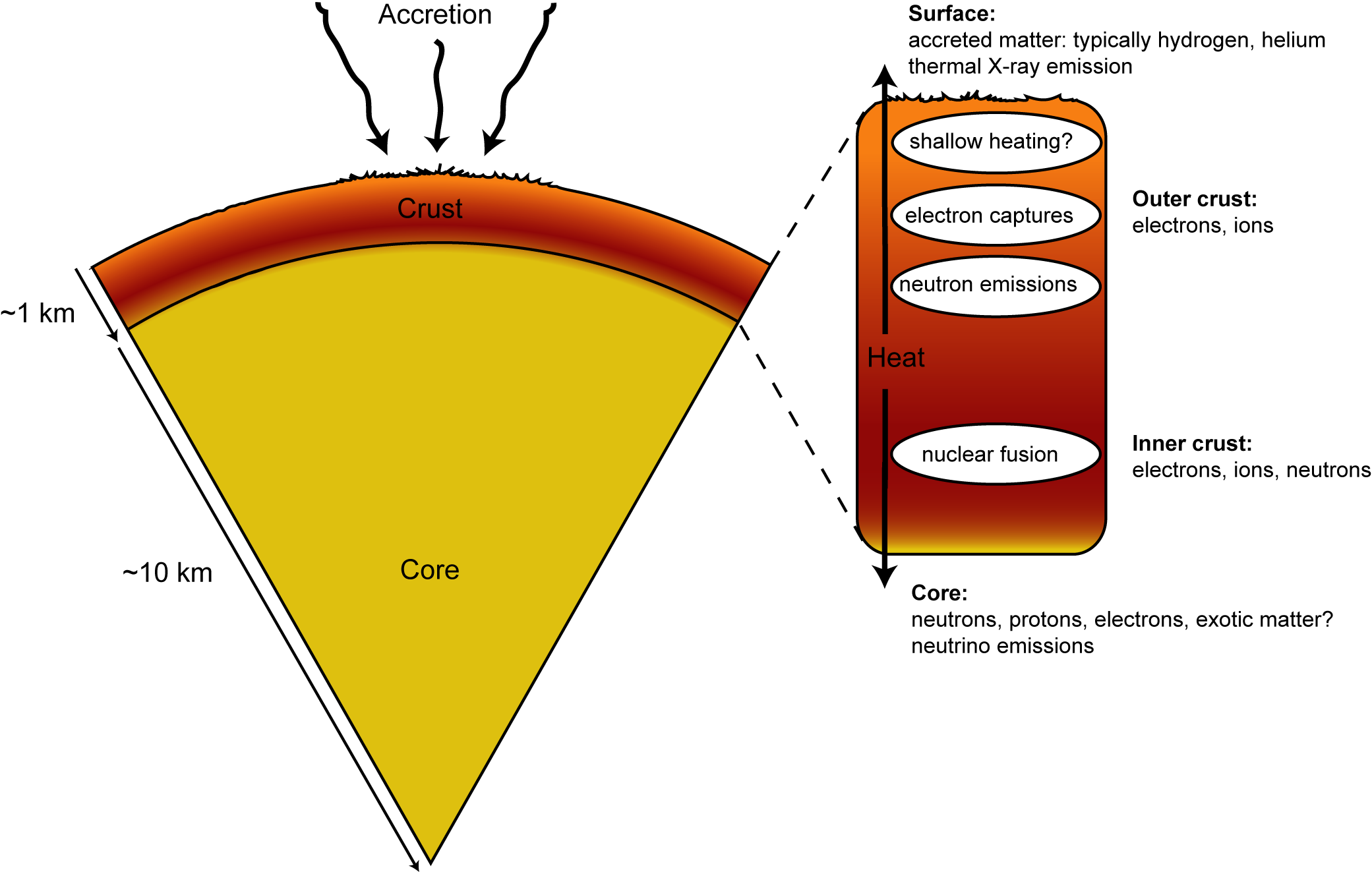
The outer layer of a neutron star, its crust, covers about one-tenth of the total stellar radius and consists of ions, electrons and neutrons (see image). Studying the structure and composition of a neutron star crust is of interest because it plays an important role in the emission of gravitational waves and the evolution of the neutron star’s magnetic field.

When neutron stars reside in X-ray binaries, their crusts can be temporarily heated due to the accretion of matter. Once the accretion stops, the crust will cool again as it transports the gained heat towards the stellar core (where it is radiated away in the form of neutrino’s) and towards the surface (where the heat is lost in the form of thermal X-ray emission). Studying the heating and subsequent cooling of the crust of a neutron star carries unique information about its structure and gives insight into a variety of nuclear reaction processes.

We used the Chandra satellite to study the neutron star X-ray binary IGR 17480-2446, which is located in the globular cluster Terzan 5 and discovered in 2010 October. We observed the neutron star at different epochs after it had ended a 10-week episode of accretion. Our first observation revealed that the neutron star was hotter just after the accretion outburst than it had been before. In our subsequent observation the temperature had markedly decreased, although it was still higher than before the accretion activity. This suggests that the crust of the neutron star was heated during the accretion phase and is currently cooling down.

It is the first time that cooling of an accretion-heated neutron star crust has been observed for a neutron star with a “normal” accretion phase of a few weeks. Previous results concerned neutron stars that were heated for several years before the accretion stopped and the crust started to cool. By comparing the observed change in temperature with theoretical calculations, we found evidence for the presence of (strong) sources of heat in the outer layers of the crust. It remains a puzzle what should produce heat at such shallow layers. Further Chandra observations are planned to further investigate the temperature evolution of this neutron star.

Degenaar, Brown & Wijnands 2011, MNRAS Letters 418, L152: Evidence for crust cooling in the transiently accreting 11-Hz X-ray pulsar in the globular cluster Terzan 5

Paper link: ADS

Dutch Press release: Astronomie.nl

A schematic overview of the interior of a neutron star.

A schematic overview of the interior of a neutron star.